TL;DR: A 2026 Research Square preprint followed 120 college students with a smartphone app and found that a higher share of positive emoji check-ins was the most consistent digital marker tied to lower depression, lower anxiety, and higher flourishing.
Key Findings
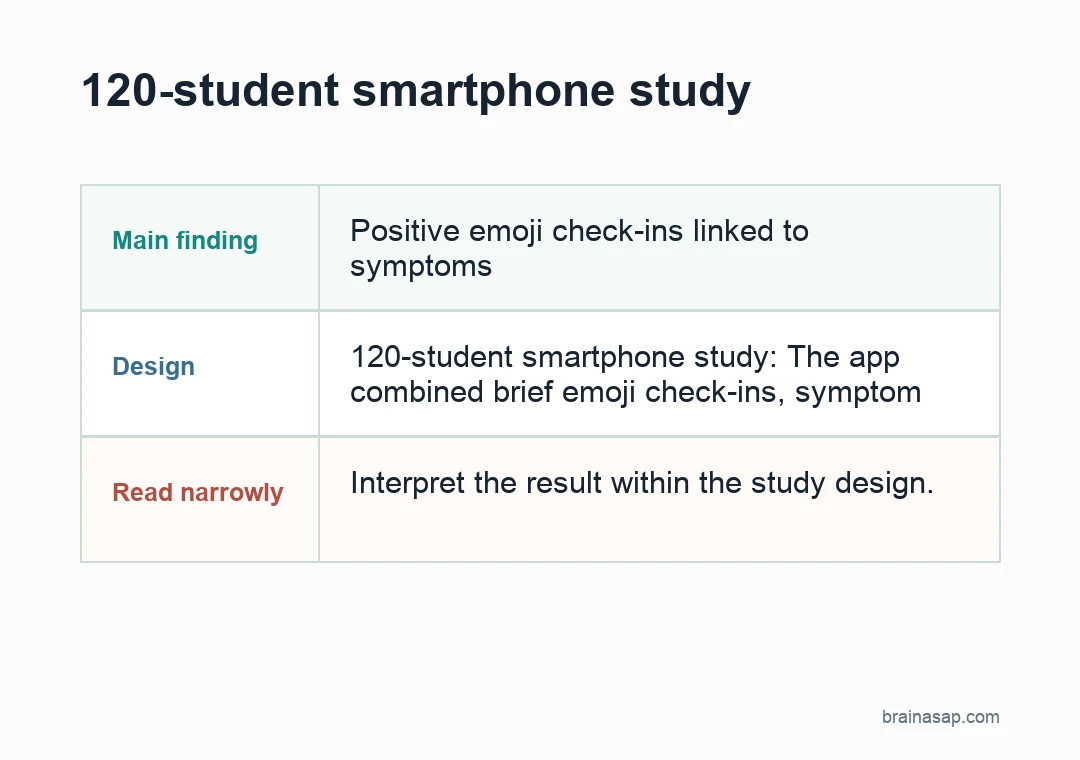
- 120-student smartphone study: The app combined brief emoji check-ins, symptom questionnaires, voice samples, GPS-derived behavior, sleep, and meals during a college semester.
- Positive emoji use stood out: Students with a higher average proportion of positive emoji selections had lower PHQ depression scores and higher flourishing.
- Anxiety moved with daily affect: On occasions when students used more positive emojis than usual, GAD anxiety scores were lower.
- Flourishing showed the strongest person-level link: Higher average positive emoji use was associated with much higher flourishing scores, with a reported estimate of b = 14.10.
- Passive markers were weaker: Speech rate and sleep showed selective links, but they were less consistent than the simple affect check-in.
A smartphone mental-health marker does not have to be a black-box prediction model. In this study, the clearest measure was a low-friction daily question: which emojis best match how you feel right now?
Researchers used the Meet Pandora smartphone app to combine brief self-reports, voice recordings, GPS-derived behavior, sleep, meals, and symptom questionnaires in university students. The analysis separated two different questions that are often blended together:
- Within-person change: Did a student’s own higher-than-usual positive emoji use line up with symptoms measured around that same period?
- Between-person difference: Did students who generally used more positive emojis differ from students who generally used fewer?
- Channel comparison: Did self-reported affect, voice features, or behavior markers carry the strongest relationship with mental-health scores?
The state-versus-trait split changes the interpretation. A phone marker can track a person’s daily fluctuation, identify stable differences between people, or do both.
The emoji measure came closest to doing both.
What the Smartphone App Measured
The study enrolled 120 undergraduate students during the spring 2025 semester. Participants were 18 to 26 years old, with a mean age of 21 years. The sample was mostly female, and about one-third reported neurodivergence.
Baseline symptoms were not rare in this group. Researchers reported that 27 students had clinically significant baseline PHQ-8 depression scores, 29 students had clinically significant baseline GAD-7 anxiety scores, and 39 students self-reported a psychological-disorder diagnosis.
The app collected several streams of information:
- Daily affect: Students selected up to three emojis from positive and negative emotion labels, including accepted, contented, excited, happy, hopeful, lonely, anxious, tired, and sad.
- Voice samples: About three times per week, students responded to short prompts, producing 2,241 vocal samples for speech-rate and vocal-feature analysis.
- Behavior markers: GPS and phone data estimated steps and places visited, while students also reported sleep duration and meals.
- Clinical scales: Depression and anxiety were measured with PHQ and GAD questionnaires, while flourishing was measured more frequently.
The emoji variable was simple: researchers calculated the proportion of selected emojis that were positive on a given day. That proportion was then compared with depression, anxiety, and flourishing outcomes in multilevel models.
Positive Emoji Use Was the Strongest Cross-Outcome Signal
For depression, students who generally used a higher proportion of positive emojis had lower overall PHQ scores. The between-person estimate was b = -6.46 after correction, meaning the trait-like emoji pattern was strongly tied to lower depressive-symptom burden.
The within-person depression result moved in the same direction but was weaker after multiple-comparison correction. On occasions when a student used more positive emojis than usual, PHQ scores tended to be lower, but that specific result did not survive the stricter corrected threshold.
Anxiety showed a clearer daily pattern. When students used a higher-than-usual proportion of positive emojis, GAD anxiety scores were lower, with a corrected within-person result of b = -3.30.
Students with higher average positive emoji use also tended to have lower anxiety, although that between-person estimate was marginal after correction.
For flourishing, the positive-emoji association was strongest at the person level. Higher average positive emoji use was associated with much higher flourishing scores, with a reported estimate of b = 14.10.
Researchers also found a time pattern: flourishing increased across the study only for students at the 90th percentile of positive emoji use. The simple slope for that high-positive-emoji group was b = 0.05, while average and low positive-emoji groups did not show the same significant upward trend.
Voice and Sleep Added Signals, but Less Consistently
The voice and behavior channels were not useless. They were just less stable across outcomes than the emoji check-in.
Speech rate, measured as words per minute, was associated with lower anxiety at the between-person level.
Researchers reported that a 100-word-per-minute higher average speech rate corresponded to about 6 points lower GAD anxiety scores. Speech-rate links with depression and flourishing were weaker after correction.
Sleep also showed a selective association. Longer average sleep duration was tied to higher flourishing, with a corrected between-person estimate of b = 2.78.
Sleep was not a consistent within-person predictor across all outcomes in this analysis.
Other behavior markers had narrower roles. More steps and more meals than usual were associated with higher flourishing, but these effects do not make steps or meals a general mental-health screen.
Daily routines can still travel with well-being in some models.
The Useful Part Is Not the Emoji Itself
Emojis do not diagnose depression or anxiety. A very brief affective check-in may capture something that noisier passive sensing misses.
Three design choices make the finding more interpretable:
- It was low burden: Selecting a few emojis takes less effort than completing a long symptom inventory.
- It separated state and trait patterns: The models distinguished a student’s own day-to-day changes from differences between students.
- It tracked positive affect: The strongest marker was not simply more negative mood. It was the presence of positive emotional expression.
The finding is relevant for digital phenotyping, a field that uses phone or wearable data to measure health-related behavior in everyday life.
The study suggests that active, tiny self-report measures can outperform passive data streams when the active question is tied closely to the psychology being measured.
Why This Should Not Be Treated as a Clinical Screening Tool Yet
The limits are substantial. This was a correlational study, so it cannot show whether positive affect lowered symptoms, lower symptoms made positive emojis more likely, or another factor influenced both.
The sample was also narrow: college students at one northeastern U.S. university, mostly female, using one app.
Phone behavior on a residential campus may not generalize to older adults, clinical populations, working adults, or people whose phone access and routines differ.
The passive streams carried measurement noise. Voice samples depended on who opted into speaking, GPS-based movement can be misleading if the phone is not carried, and self-reported sleep is not the same as wearable-measured sleep.
In this sample, a simple daily proportion of positive emoji selections tracked depression, anxiety, and flourishing more consistently than several passive phone-derived features. The result supports further testing of brief positive-affect markers, not automated diagnosis from emojis.
Citation: DOI: 10.21203/rs.3.rs-9226835/v1. Henry et al. Low-Burden Digital Phenotyping of Affective Risk: Positive Emoji Usage, Speech Rate, and Sleep Relate to College Student Mental Health. Research Square. 2026.
Study Design: Intensive smartphone-based observational study with multilevel models separating within-person and between-person associations.
Sample Size: 120 college students; 372 non-missing PHQ/GAD observations; 792 non-missing flourishing observations.
Key Statistic: Higher average positive emoji proportion was linked to lower PHQ scores (b = -6.46) and higher flourishing (b = 14.10); higher-than-usual positive emoji use was linked to lower GAD scores (b = -3.30).
Caveat: The preprint is correlational, student-specific, and not a validated clinical screening tool.