
TL;DR: A 2026 longitudinal study in Acta Sociologica found that partnered fathers who perceived a higher risk of divorce showed greater declines in political trust over time, especially when the worry persisted.
Key Findings
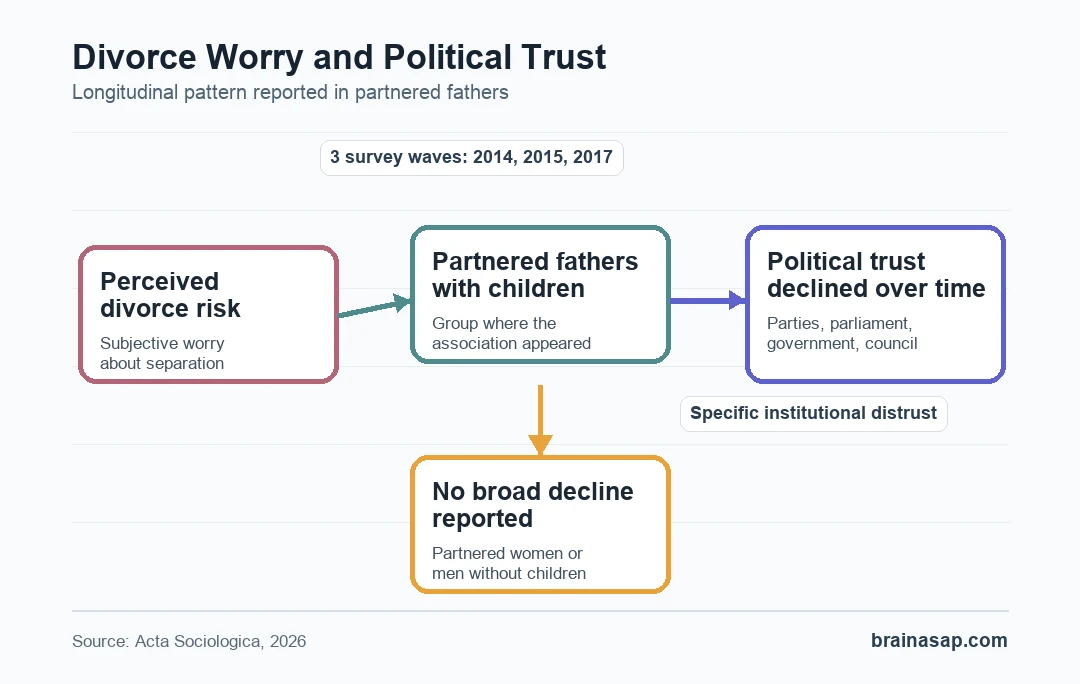
- Father-specific link: Perceived divorce risk predicted declining political trust among partnered men with children.
- No broad effect: The same pattern was not found for partnered women or partnered men without children.
- Panel design: Norwegian respondents were surveyed across three waves in 2014, 2015, and 2017.
- Institution target: The trust measure covered political parties, parliament, national government, and local council.
- Main caveat: Observational panel data can track attitude change, but it still cannot prove that divorce worry caused political distrust.
Source: Acta Sociologica (2026) | Kumlin
Perceived divorce risk means a person’s own estimate that their relationship might end soon. In this study, that subjective worry mattered politically even before any legal separation occurred.
Staffan Kumlin tested whether instability inside family life can spill into distrust of democratic institutions. The study focused on political trust, not voting behavior or party preference.
Divorce Worry Predicted Lower Political Trust Among Fathers
The main association was gendered and family-specific. Partnered fathers who perceived a higher risk of divorce tended to lose political trust over time.
The same decline did not appear broadly among partnered women. It also did not appear among partnered men who did not have children.
This specificity narrows the explanation. The association was not simply that relationship stress makes every adult more politically distrustful.
The study points to a more focused pathway:
- Relationship instability: fathers worried that their partnership might end.
- Family-role threat: separation could reduce everyday involvement with children.
- Political spillover: personal distress was associated with lower trust in political institutions.
Kumlin described the association as moderately strong at most, but the existence of the pattern is still useful. It identifies a family-domain source of political distrust that is different from wages, unemployment, or ideology.
The timing also matters for interpretation. The political shift appeared around perceived instability, not only after a completed divorce, which means anticipatory family stress was enough to enter the model.
The Norwegian Panel Followed Respondents Over Three Waves
The study used a Norwegian longitudinal panel collected in 2014, 2015, and 2017. Panel designs follow respondents over time, which makes it possible to examine whether attitudes change as worries persist or shift.
The survey included adults ages 18 to 75. The first wave had 5,420 participants, the second wave included 5,008 respondents, and the final wave included 1,560 people who had participated previously.
Participants rated how likely they thought it was that they would separate from their partner in the next 12 months. Most variation was between people who saw no risk and people who saw a mild risk; very few respondents expected divorce with certainty.
Researchers also accounted for other subjective worries:
- Poverty risk: worry about economic hardship.
- Unemployment risk: worry about losing work.
- Poor-health risk: worry about future health problems.
- Relationship risk: worry about separation or divorce.
The father-specific trust pattern was not reproduced by those other worries. That helped isolate relationship instability as the relevant subjective stressor.
Political Trust Covered Four Institutions
The political-trust measure combined ratings of political parties, the national parliament, the national government, and the local city council. This made the outcome broader than trust in one leader or one party.
Kumlin also checked whether the change was just general cynicism. The decline in political trust was not simply a decline in generalized social trust.
That distinction is important. A father worried about family instability was not only becoming less trusting of people overall. The reported shift was aimed at democratic institutions.
The study offered two possible explanations:
- Partner influence: deteriorating relationships could reduce political communication and civic influence between partners.
- Parenting-role loss: fathers can face reduced daily parenting involvement after separation, which can create a distinct source of distress.
The parenting-role explanation fit the father-specific pattern more closely. The political shift appeared where a separation could threaten fathers’ inclusion in everyday family life.
Family Instability May Feed Political Disaffection
The study helps widen the explanation for democratic distrust. Political disaffection is often discussed through jobs, income, education, immigration, or cultural conflict.
Family instability gives researchers another path to test. If personal distress lacks a clear institutional target, frustration can become diffuse and attach to politics in general.
Governments did not have to cause the relationship worry for the association to appear. Welfare-state citizens can connect personal vulnerability with broader judgments about institutions that are expected to support social security and well-being.
The result also fits a wider question about gender gaps in politics. If some men experience family instability as a threat to social belonging and parental identity, the emotional consequences can become politically relevant.
The Evidence Still Needs Causal Testing
The design is stronger than a one-time survey because it follows people across waves. It still remains observational research.
Unmeasured traits could influence both divorce worry and political distrust. For example, pessimism, conflict style, or prior institutional distrust could make a person more likely to fear separation and distrust government.
Future work could follow couples for longer, measure custody expectations directly, and test whether actual separation changes political trust differently for fathers and mothers.
The current paper gives a clear starting point: family-domain distress is not politically neutral. For some partnered fathers, fear of losing family stability was linked with declining trust in the institutions around them.
Citation: DOI: 10.1177/00016993261429680. Kumlin S. Divorce risk and political distrust: Gendered consequences of couple instability. Acta Sociologica. 2026.
Study Design: Longitudinal panel analysis of Norwegian adults across three survey waves.
Sample Size: 5,420 participants in wave 1, 5,008 in wave 2, and 1,560 continuing participants in wave 3.
Key Statistic: Persistent perceived divorce risk was linked with loss of political trust over time among partnered fathers with children.
Caveat: The observational design cannot rule out unmeasured factors that influence both relationship worry and political distrust.