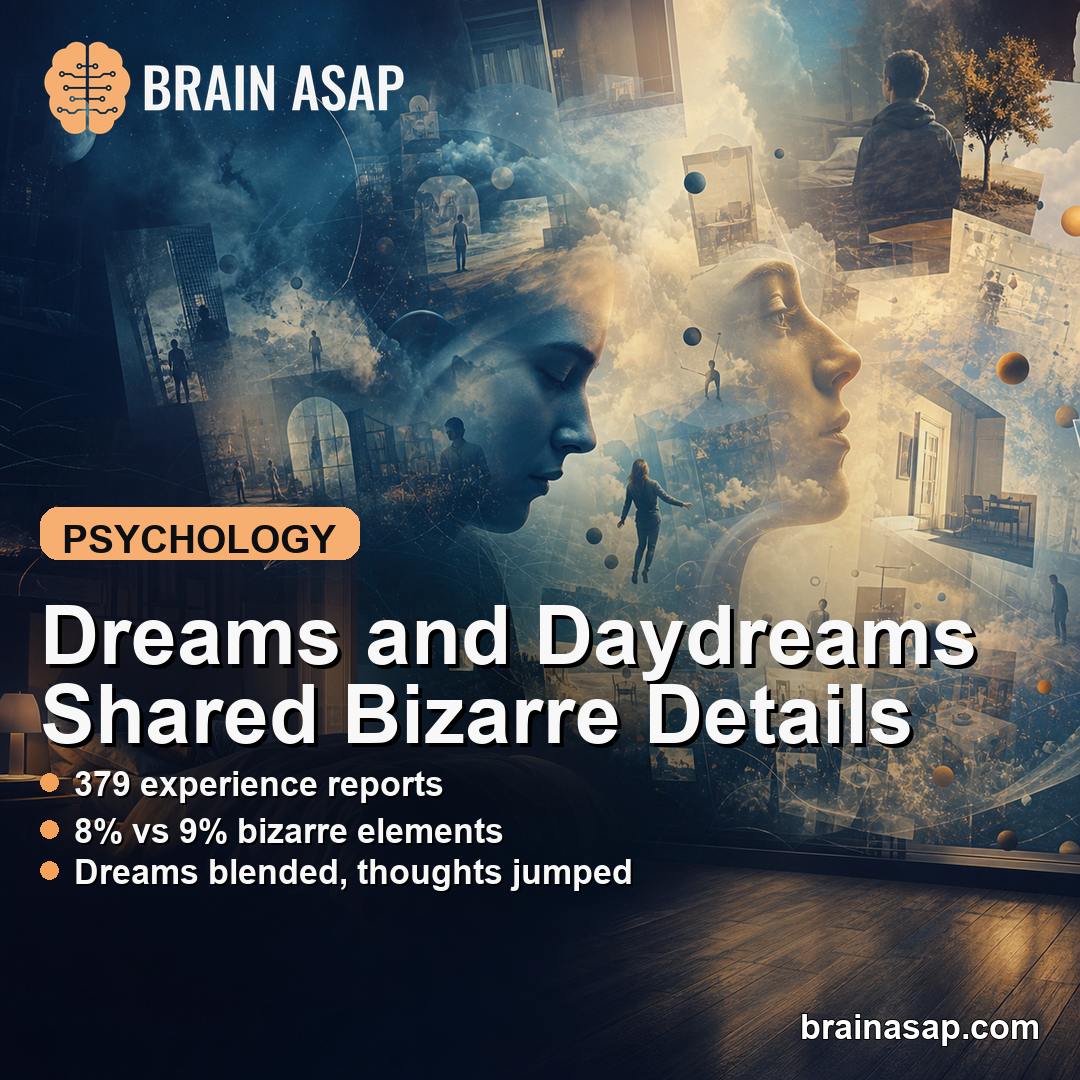
TL;DR: A 2026 study in Consciousness and Cognition found that waking mind wandering and nighttime dreaming had nearly the same density of bizarre elements, even though dreams were more likely to be rated as bizarre whole reports.
Key Findings
- 379 experience reports: Researchers analyzed daily audio descriptions of one dream and one waking mind-wandering episode from 21 participants.
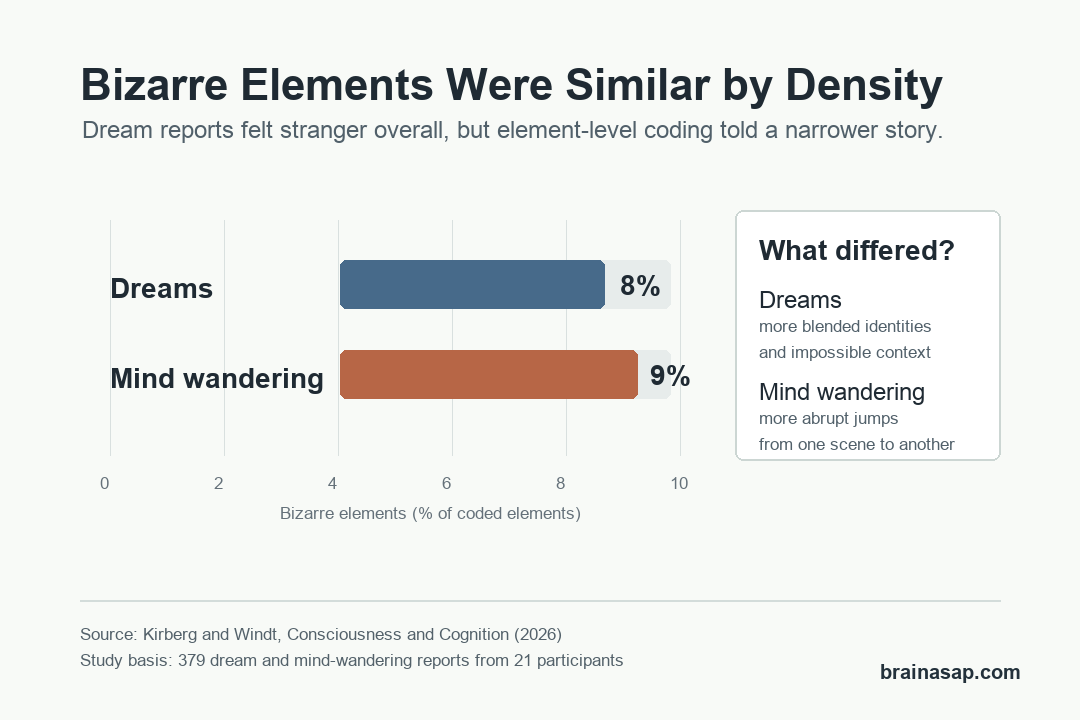
- Similar bizarre-element density: About 8% of dream elements and 9% of mind-wandering elements were coded as bizarre.
- Dream reports scored stranger overall: Roughly half of dream reports contained numerous bizarre elements, compared with about one-third of waking mind-wandering reports.
- Different kinds of strangeness: Dreams showed more incongruity and vague identities or settings, while waking mind wandering showed more abrupt discontinuity.
- Shared social simulation: People, actions, and social interactions appeared in both states, suggesting overlap in how the mind builds offline scenes.
Source: Consciousness and Cognition (2026) | Kirberg and Windt
Dreams Were Not Simply More Bizarre Than Daydreams
Dream bizarreness is usually treated as a sleep-specific clue: the flying, fused identities, impossible rooms, and sudden scene changes that separate many dreams from ordinary waking experience.
Kirberg and Windt tested a narrower question. Instead of asking whether a whole report was globally strange, they counted the individual people, places, actions, and objects inside each report, then asked how many of those elements were unusual.
That distinction changed the result. Dreams scored higher for whole-report bizarreness, but the element-by-element density was almost the same in the two states: 8% of dream elements and 9% of mind-wandering elements were bizarre.
The finding still separates dreams from waking thoughts. The common claim that dreams are simply packed with more strange content depends on the level of measurement.
Researchers Scored Specific People, Places, Actions, and Objects
The study used a self-caught experience-sampling design. Participants recorded a description when they noticed their attention had drifted during the day and after they woke from a dream at night.
The final dataset included 379 audio reports. External judges worked from transcripts, broke each report into content elements, and coded whether each element was ordinary or bizarre.
The coding focused on three main forms of unusual content:
- Incongruity: A person, place, action, or object was mismatched with normal reality, such as an impossible combination or a familiar setting in the wrong context.
- Vagueness: A report included an undefined identity, location, or object that could not be pinned down clearly.
- Discontinuity: The experience jumped abruptly in time, space, identity, or action without a continuous transition.
The method separates two routes to the same global rating. One experience may contain a few highly impossible events, while another may contain many small shifts that add up to a strange overall pattern.
Dreams and Mind Wandering Expressed Strangeness Differently
The strongest result was not that one state was weird and the other was normal. Both states contained unusual content, but the type of bizarreness differed.
Dreams more often produced broad incongruity and vagueness. A dream might place a childhood bedroom inside an unrelated building, blur a character’s identity, or combine features that do not normally belong together.
Waking mind wandering showed more abrupt discontinuity. A daytime thought could jump from one scene to another without a gradual transformation, giving the experience a more fragmented structure.
The source described several contrasts that help interpret the difference:
- Dreams blended elements: Some dream reports included fused identities or smooth transformations, such as one person gradually becoming another.
- Waking thoughts jumped faster: Mind-wandering reports more often replaced one idea or scene with another rather than transforming it gradually.
- Self-change appeared in both: Daytime thoughts sometimes involved altered versions of the self, while dreams pushed those changes into more impossible forms.
The pattern supports a more specific view of spontaneous thought. Sleep may loosen constraints in a way that encourages blended scenes, while wakeful drifting may preserve enough ordinary awareness for sharper jumps between topics.
Actions and Social Worlds Appeared in Both States
The reports were not just floating images. Actions dominated both dream and mind-wandering content, meaning participants often described themselves or others doing things rather than merely seeing disconnected scenes.
Social content also appeared across both states. People and interactions made up about a fifth to a quarter of the material in the reports, which supports the idea that spontaneous thought often simulates social worlds.
For brain and cognition readers, offline simulation is not limited to sleep. Waking attention can drift into constructed scenes, imagined conversations, and impossible or semi-impossible situations while the person is still awake.
The study therefore pushes against two oversimplified interpretations:
- Dream-only strangeness: Dreams are not the only spontaneous state where unusual elements appear at measurable density.
- Same-state equivalence: Dreams and mind wandering are not identical, because their unusual content followed different structural patterns.
- Single-rating shortcuts: Whole-report ratings can miss how much the conclusion changes when researchers count specific content elements.
Small Sample and Home Reports Limit the Claim
The study was detailed, but not large in participant count. The dataset came from 21 people, although repeated daily reports gave researchers hundreds of experiences to code.
Home reporting also means the study did not verify sleep stage with brain recordings. Late-morning dream recall can favor especially vivid or unusual dreams, so the dream sample may not represent every phase of sleep equally.
Other limits are methodological rather than flaws. Audio descriptions depend on memory, verbal detail, and what participants choose to report. External judging improves consistency, but coding mental content still requires interpretation.
The measured comparison is specific: when researchers counted individual report elements, waking mind wandering had about the same bizarre-element density as dreaming, while dreams still differed in how that bizarreness was organized.
Citation: DOI: 10.1016/j.concog.2025.103965. Kirberg and Windt. The kaleidoscope of bizarreness: The analysis of first-person-reports shows the relationship between dreaming and mind wandering to be complex. Consciousness and Cognition. 2026.
Study Design: Repeated naturalistic self-report study comparing coded dream reports with coded daytime mind-wandering reports.
Sample Size: 21 participants contributed 379 audio reports.
Key Statistic: About 8% of dream elements and 9% of mind-wandering elements were coded as bizarre.
Caveat: Reports were collected at home without sleep-stage verification, and the participant sample was small.