TL;DR: A 2026 study in Health Science Reports found that metoclopramide and several antipsychotics were strongly overrepresented in FDA adverse-event reports for drug-induced dystonia, with many reported cases appearing within the first month after drug initiation.
Key Findings
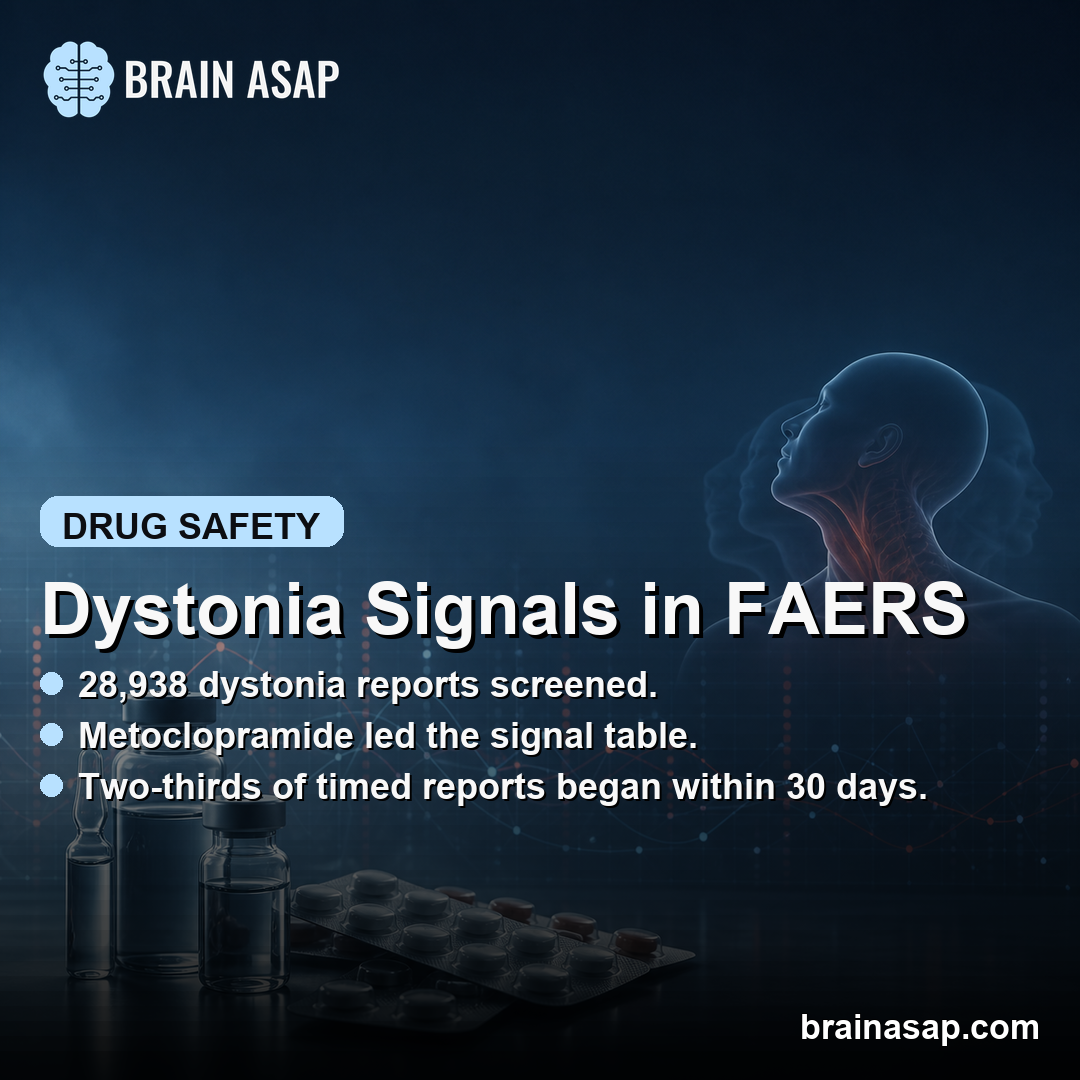
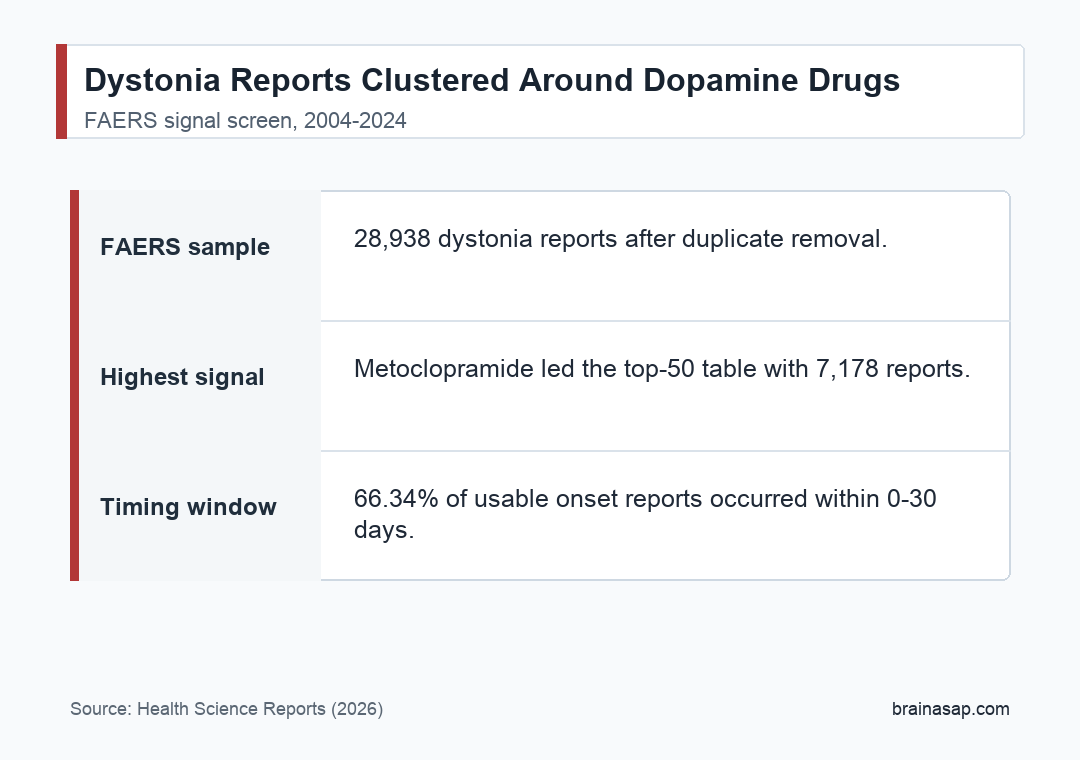
- 28,938 dystonia reports: Researchers analyzed FDA Adverse Event Reporting System records from the first quarter of 2004 through the third quarter of 2024.
- Metoclopramide led the reporting table: The nausea drug had 7,178 reports and the strongest reporting odds ratio among the top 50 drugs flagged by all four methods.
- Antipsychotics were prominent: Aripiprazole, risperidone, quetiapine, olanzapine, haloperidol, paliperidone, ziprasidone, and related agents appeared repeatedly in the top reported drugs.
- Onset was often early: Among reports with usable timing data, the median time to dystonia onset was 5 days, and 66.34% occurred within 0-30 days.
- Combination patterns appeared: Aripiprazole plus risperidone was the most frequently reported two-drug dystonia combination in the interaction screen.
Source: Health Science Reports (2026) | Chen et al.
Drug-Induced Dystonia Is a Movement Disorder Warning, Not a Mild Side Effect
Dystonia means sustained or intermittent muscle contractions that can force abnormal postures, repetitive movements, eye deviation, jaw or neck spasms, or other involuntary motor symptoms. When dystonia is drug-induced, the medication exposure is suspected as a trigger or contributor.
The 2026 study focused on the FDA Adverse Event Reporting System, or FAERS, a public database of medication safety reports. FAERS cannot prove that a drug caused a reaction, but it can show which drug-event pairs are reported far more often than expected.
Researchers used four statistical safety-screening methods instead of one: reporting odds ratio, proportional reporting ratio, Bayesian confidence propagation neural network, and multi-item gamma Poisson shrinker.
A drug had to meet all four statistical criteria before researchers treated it as a positive dystonia association.
The conservative screen is important because spontaneous-report databases are noisy. Reports can be shaped by prescribing volume, publicity, litigation, duplicate reporting, and missing clinical details.
FAERS Included 27,618 Patients With Dystonia Reports
Researchers started with more than 21.9 million FAERS patient reports and removed duplicate patient reports. The dystonia screen yielded 28,938 reports involving 27,618 patients.
The descriptive profile showed why the safety pattern deserves attention:
- Hospitalization: 32.86% of reports included initial or prolonged hospitalization.
- Disability: 25.61% of reports included disability.
- Life-threatening events: 3.71% included a life-threatening outcome.
- Deaths: 2.87% included death, although FAERS cannot determine whether dystonia itself caused death.
The United States accounted for 56.12% of reports. Female patients made up 54.84% of reports, and the largest known age band was 18-44 years.
Missing data were common. Nearly 44.98% of reports had unknown age, and only a subset had usable timing data for onset analysis.
Metoclopramide Had the Strongest Dystonia Reporting Pattern
Metoclopramide, a dopamine-blocking medication used for nausea, vomiting, and gastric motility problems, had the largest number of dystonia reports and the strongest disproportionality pattern. Researchers counted 7,178 reports and reported an ROR of 155.90.
That ROR should not be read as metoclopramide causing dystonia in 155 times as many patients. It means dystonia was reported disproportionately often with metoclopramide compared with other drug-event reporting patterns in FAERS.
The next strongest reporting patterns among frequently reported drugs included dopamine-blocking or dopamine-modulating agents:
- Prochlorperazine: ROR 76.75, with 79 reports in the top-50 frequency table.
- Haloperidol: ROR 37.26, with 756 reports.
- Ziprasidone: ROR 28.99, with 479 reports.
- Aripiprazole: ROR 14.73, with 1,595 reports.
The pattern fits the clinical biology. Many high-ranking drugs affect dopamine transmission, and dopamine blockade is a known pathway for acute dystonic reactions and other extrapyramidal symptoms.
Antipsychotic Reports Concentrated Around Dopamine-Active Drugs
Among the most frequently reported drugs, aripiprazole had 1,595 reports, risperidone had 1,366, quetiapine had 940, olanzapine had 837, and haloperidol had 756.
Those drugs are not interchangeable. They differ in receptor profile, dose range, clinical indication, and patient population. The study should not be read as a simple ranking of individual patient risk.
The clinical monitoring point is narrower: dystonia reports clustered around drugs that clinicians already monitor for movement-related adverse effects, especially antipsychotics and other dopamine-active medications.
Researchers also identified eight drugs whose package labeling did not list dystonia despite positive FAERS associations in the study: lamotrigine, valproic acid, escitalopram, clonazepam, deutetrabenazine, trofinetide, amantadine, and sevoflurane.
That does not prove those labels are wrong. It means the pattern is worth follow-up, especially when symptoms appear after a medication start, dose change, or combination change.
Most Usable Timing Reports Appeared Within 30 Days
Timing data were available for 5,657 reports. Across those reports, the median time to dystonia onset was 5 days, with an interquartile range from 0 to 91 days.
66.34% of timing-usable reports occurred within 0-30 days after drug initiation.
The early window is clinically important because acute dystonia can be missed if a new movement symptom is treated as anxiety, agitation, pain, or a primary neurologic event without checking recent medication changes.
The top five drugs by report count had different median onset estimates:
- Metoclopramide: median onset 2 days.
- Risperidone: median onset 2 days.
- Aripiprazole: median onset 5 days.
- Olanzapine: median onset 16 days.
- Quetiapine: median onset 19 days.
The study also found a statistically significant difference in time-to-onset patterns across those five drugs.
For a patient, the first days and weeks after starting a dopamine-active drug deserve attention; the medians are not a precise countdown.
Combination Reports Pointed to Antipsychotic and Stimulant Pairings
The interaction screen looked for two-drug combinations co-reported with dystonia more often than expected. The most frequently reported combination was aripiprazole plus risperidone, with 49 reports in the interaction analysis.
Other notable pairs included methylphenidate plus risperidone, aripiprazole plus fluoxetine, quetiapine plus risperidone, and erythromycin plus haloperidol.
Combination findings need caution because FAERS does not provide the full clinical context. A person may be taking multiple drugs because of illness severity, cross-tapering, behavioral crisis, nausea, infection, or another reason that also affects reporting.
Still, the pattern fits a practical prescribing habit: when dystonia appears, review the whole medication list, not only the most recent prescription.
The Right Use of This Study Is Monitoring, Not Panic
This was not an incidence study. FAERS does not count every exposed patient, so researchers could not calculate how often dystonia occurs per prescription, per dose, or per person-year.
The study also cannot prove causality for a specific drug. Litigation-driven reporting may inflate some findings, and the researchers specifically warned that the apparent metoclopramide pattern may be influenced by reporting bias.
The study is still useful because it names a practical safety pattern:
- Check recent starts and dose changes: new dystonia symptoms often appeared early in reports with usable timing.
- Watch dopamine-active drugs closely: metoclopramide, antipsychotics, and related agents dominated the reporting table.
- Review combinations: antipsychotic pairings and interacting drug combinations may deserve extra scrutiny.
- Escalate serious symptoms: neck, jaw, eye, throat, or breathing-related spasms can be urgent and should not be dismissed.
Study boundary: the analysis detects disproportional reporting patterns, not confirmed drug causation or patient-level absolute risk.
For clinicians and patients, the direct takeaway is medication-context awareness. A sudden abnormal posture, eye deviation, jaw spasm, neck contraction, or severe involuntary muscle movement after a medication change should prompt a medication safety review quickly.
Citation: DOI: 10.1002/hsr2.72194. Chen et al. Identifying High-Risk Medications for Drug-Induced Dystonia: A 20-Year Retrospective Real-World Pharmacovigilance Study Based on FAERS. Health Science Reports. 2026;9:e72194.
Study Design: Retrospective pharmacovigilance safety-screening study using FDA Adverse Event Reporting System reports from Q1 2004 through Q3 2024.
Sample Size: 28,938 dystonia reports involving 27,618 patients after duplicate removal and screening.
Key Statistic: Metoclopramide had 7,178 dystonia reports and the strongest ROR pattern among the top 50 drugs flagged by all four methods; 66.34% of timing-usable reports occurred within 0-30 days.
Caveat: FAERS cannot estimate absolute incidence or prove causality because reporting is voluntary, incomplete, and vulnerable to reporting bias.