TL;DR: A 2026 study in Epigenetics found that DNA methylation clocks, which estimate biological aging from chemical marks on DNA, gave substantially older age estimates in saliva than in two blood-derived samples from 91 early-to-mid-adult participants.
Key Findings
- The sample included 91 adults: Researchers analyzed participants from a twin and sibling study with a mean age of 30.9 years.
- Three sample types were compared: Saliva, buffy coat (BC; the white-cell layer from blood), and peripheral blood mononuclear cells (PBMC; immune cells separated from blood) were tested.
- Fifteen DNA methylation clocks were used: These algorithms estimated methylation age or aging pace from DNA methylation patterns.
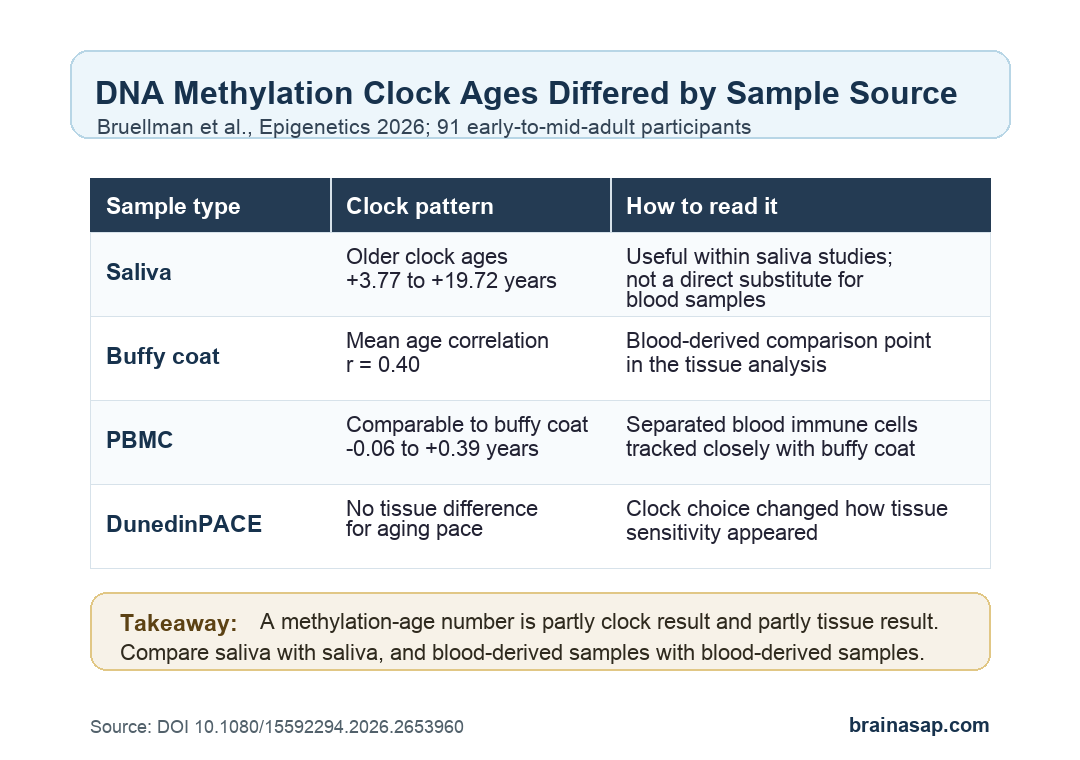
- Saliva produced older clock ages: Saliva-based estimates were 3.77 to 19.72 years higher than buffy-coat estimates across many clocks.
- Blood-derived samples were closer: PBMC and buffy coat estimates were comparable for the prioritized clock measures.
Source: Epigenetics (2026) | Bruellman et al.
DNA methylation clocks are often used as biological-aging readouts. They look at methylation, a chemical mark on DNA that can change with development, environment, disease, and aging, then estimate an age-like value or pace-of-aging measure.
The new study focused on an important measurement problem: a clock result can depend on which tissue or cell source supplied the DNA.
Brain and cognitive-aging studies often use convenient stored samples, especially saliva or blood, even when the target outcome is much more complex than the sample itself.
Saliva, Buffy Coat, and PBMC Samples Were Compared
Researchers used data from the Colorado Adoption/Twin Study of Lifespan behavioral development and cognitive aging, known as CATSLife1. The analysis included 91 people, including unpaired participants, siblings, and twins.
The participants were in early-to-mid adulthood, with a mean age of 30.90 years and an age range of 28.07 to 41.13 years.
That age range fits a central question in methylation-aging research: whether early adult measurements can identify trajectories before late-life disease appears.
The study compared three biological sample types:
- Saliva: An easy-to-collect sample that contains a mixture of cell types and is common in large behavioral studies.
- Buffy coat: The blood layer enriched for white blood cells after centrifugation.
- PBMC: Peripheral blood mononuclear cells, a more specifically separated blood immune-cell fraction.
All three can be reasonable sources for DNA methylation work. The question was whether they produce interchangeable biological-aging estimates.
Fifteen DNA Methylation Clocks Tested Tissue Effects
The researchers calculated 15 DNA methylation clocks using the same broad dataset. These included older clocks trained mainly on chronological age and newer clocks trained on health-related outcomes or aging pace.
Several clock names are common in aging research. Hannum, Horvath, and PhenoAge estimate methylation age.
PCGrimAge is tied more closely to mortality and health-related risk. DunedinPACE estimates the pace of biological aging rather than an age in years.
The technical processing was extensive:
- 273 primary samples: The design began with three sample types from 91 people.
- EPIC array methylation data: DNA methylation was measured with an Illumina array.
- Strict quality control: Eleven saliva samples from nine people were removed for missingness, while all buffy coat and PBMC samples passed.
- Cell-type adjustment: The analysis adjusted methylation values for estimated cell composition.
After quality control, the final analysis included 91 buffy coat samples, 91 PBMC samples, and 82 saliva samples.
Saliva Clock Ages Were Higher Than Blood-Derived Estimates
Across all 15 clocks, chronological age and methylation age were only moderately correlated. Mean Spearman correlations were r = 0.37 for saliva, r = 0.40 for buffy coat, and r = 0.34 for PBMC.
The tissue comparison was clearer. In mixed-effects models, saliva showed higher DNA methylation ages than buffy coat across many clocks.
The reported saliva differences ranged from 3.77 to 19.72 years versus buffy coat, with p values below 0.001.
For specific prioritized clocks, saliva-based estimates were higher by:
- 12.51 years for Hannum compared with buffy coat.
- 7.42 years for Horvath compared with buffy coat.
- 16.41 years for Horvath2 compared with buffy coat.
- 9.10 years for PCGrimAge compared with buffy coat.
- 19.72 years for PhenoAge compared with buffy coat.
- 3.77 years for ZhangQ compared with buffy coat.
PBMC and buffy coat were much closer. The PBMC-versus-buffy-coat estimates ranged from -0.06 to 0.39 years and were not statistically different in the main comparison.
DunedinPACE Was the Main Saliva Exception
DunedinPACE behaved differently from the age-in-years clocks. This measure is scaled around 1.0, where values above 1.0 suggest faster biological aging per chronological year.
In this sample, the average intercept suggested DunedinPACE = 1.304, consistent with an accelerated pace-of-aging estimate in the model. But DunedinPACE did not differ by sample type: saliva versus buffy coat was not significant, and PBMC versus buffy coat was also not significant.
That result does not make saliva interchangeable for every methylation clock. It shows that the answer depends on the clock. Some measures may be less sensitive to saliva-versus-blood differences than others.
Twin Similarity Was Stronger in Blood-Derived Samples
The twin and sibling design gave the study another consistency check. Identical twins share nearly all inherited DNA sequence, while fraternal twins and siblings share less.
If a methylation clock is measuring a stable biological pattern, twin similarity can help show whether the measure behaves consistently.
Across clock measures, monozygotic twin pairs had a meta-analytic correlation of r = 0.49, while dizygotic twin pairs had a correlation of r = 0.38. But identical-twin similarity varied by tissue.
For identical twins, saliva had lower average similarity than blood-derived samples:
- Saliva: mean r = 0.33.
- Buffy coat: mean r = 0.64.
- PBMC: mean r = 0.49.
The newer PCGrimAge and DunedinPACE clocks showed more consistent zygosity correlations across tissues. The multi-tissue ZhangQ clock also showed comparable identical-versus-fraternal twin correlations.
The Main Lesson Is Tissue Specificity, Not a Better Aging Score
Measurement source sets the interpretation. Saliva-based methylation clocks should not be treated as direct substitutes for blood-based clocks when the goal is to compare biological-aging estimates across studies or tissues.
Within one tissue type, saliva can still work. A saliva-only study can compare saliva samples with other saliva samples.
Comparison becomes weaker when saliva results are interpreted as if they should match buffy coat, PBMC, or other blood-derived sources.
The study also does not prove that any clock measured brain aging directly. Methylation clocks are peripheral biological measures.
They can be relevant to cognitive-aging research, but they are not brain scans, clinical diagnoses, or direct measures of neuronal aging.
For early-adult aging research, the methodological point is direct: sample type belongs in the interpretation. A methylation-age number is partly a clock result and partly a tissue result.
Citation: DOI: 10.1080/15592294.2026.2653960. Bruellman et al. Differential DNA methylation clock ages across buffy coat (BC), peripheral blood mononuclear cells (PBMC), and saliva in individuals in early-to-mid adulthood. Epigenetics. 2026;21:2653960.
Study Design: Cross-tissue DNA methylation clock comparison using mixed-effects models and twin/sibling correlation analyses.
Sample Size: 91 early-to-mid-adult participants; final methylation analyses included 91 buffy coat samples, 91 PBMC samples, and 82 saliva samples after quality control.
Key Statistic: Saliva-based methylation ages were 3.77 to 19.72 years higher than buffy-coat estimates across many clocks, while PBMC and buffy coat were comparable.
Caveat: The sample was modest and early-to-mid-adult; methylation clocks are peripheral biological measures, not direct measures of brain aging or clinical cognitive decline.