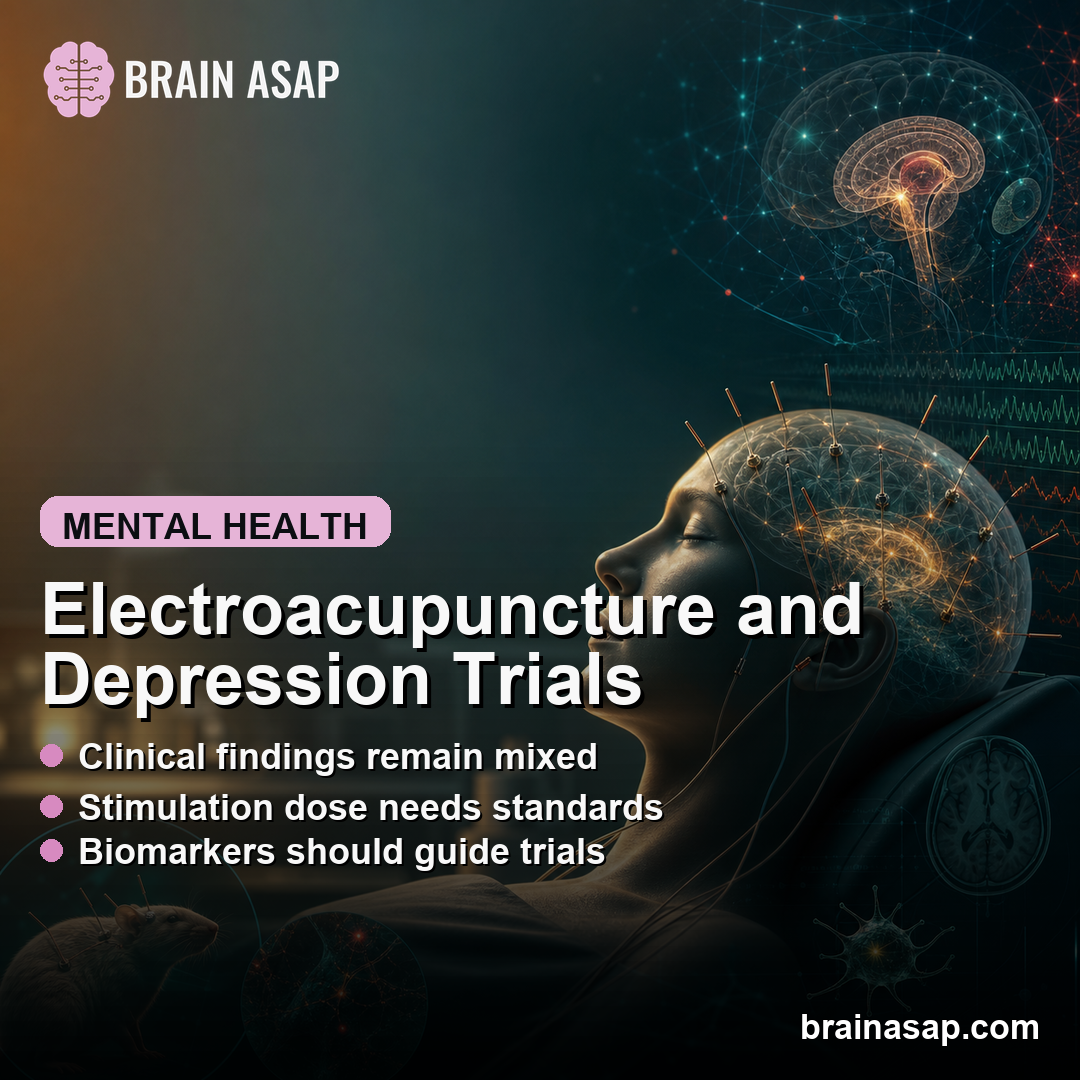
TL;DR: A 2026 review in Neuropsychiatric Disease and Treatment argued that electroacupuncture (EA), acupuncture delivered with small electrical stimulation, has depression-related mechanism evidence, but clinical trials need biomarker-guided patient groups, standardized stimulation dose, and objective outcomes before EA can be treated as precision depression care.
Key Findings
- Clinical evidence remains uneven: some randomized trials and reviews reported symptom improvement, but sham-controlled and international findings were mixed.
- Depression heterogeneity is central: the review emphasized that symptom-based diagnoses can hide different inflammatory, circuit, sleep, and metabolic subtypes.
- EA dose is not well defined: frequency, current intensity, waveform, pulse width, session length, electrode placement, and deqi sensation are not reported consistently.
- Objective endpoints are needed: the proposed pathway uses functional near-infrared spectroscopy (fNIRS), electroencephalography (EEG), heart-rate variability, inflammatory markers, sleep data, and digital behavior measures beside depression scales.
- Precision EA is still conceptual: the review called for prospective validation before syndrome labels, biomarkers, and stimulation settings guide patient care.
Source: Cao et al. Neuropsychiatric Disease and Treatment. 2026.
Electroacupuncture is often discussed as a depression treatment because it can combine a physical acupuncture protocol with adjustable electrical stimulation. The review treated that flexibility as both the main promise and the main problem.
The review did not claim that EA is ready to replace antidepressants or psychotherapy. It argued that the field has too many mechanism clues and too little agreement about how those clues should be converted into trial design.
Electroacupuncture Depression Trials Show Mixed Clinical Signals
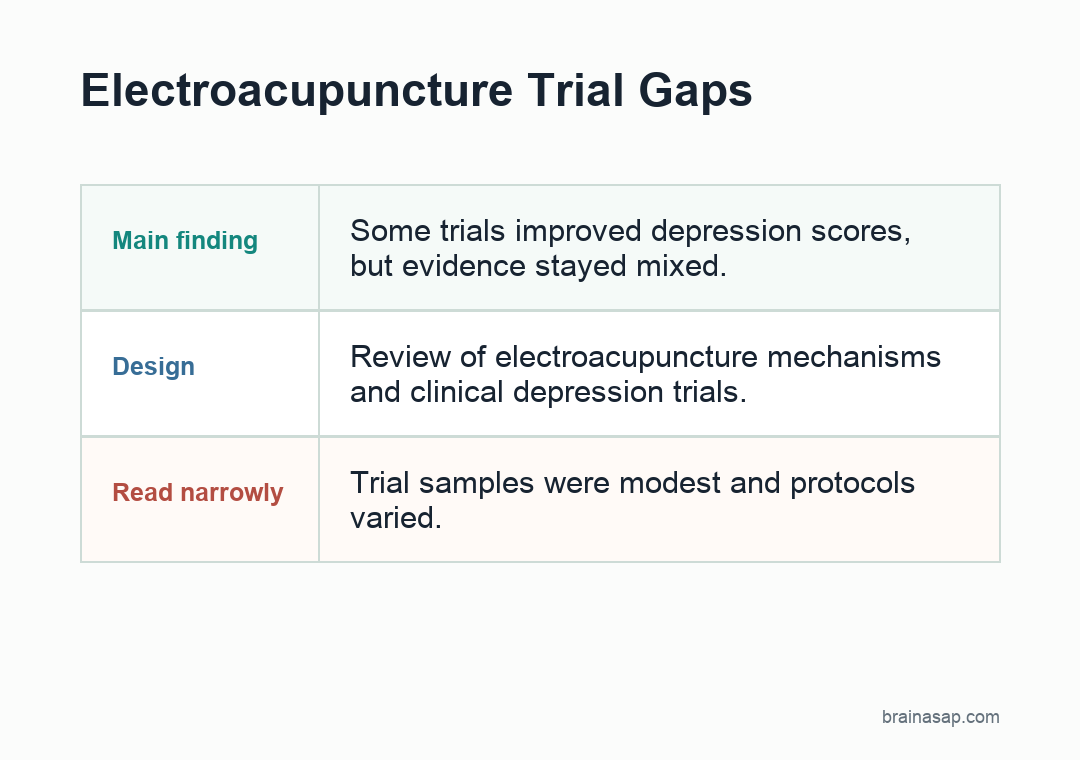
The clinical evidence summarized in the review was not a simple positive story. Some studies reported depression-score improvement in post-stroke depression, perimenopausal depression, insomnia with depression, and pain-related emotional symptoms.
Other studies found neutral or mixed effects when EA was compared with sham or placebo-style procedures.
EA trials are hard to blind. A patient may feel needle insertion, electrical sensation, or the treatment ritual itself.
Even a sham procedure can produce sensory input, attention, expectation, and contact with a practitioner.
The review highlighted several recurring trial-design issues:
- Control-group variation: studies used sham acupuncture, medication comparison, standard care, or mixed controls.
- Small or moderate samples: representative trial sizes ranged from 65-270 participants, which limits subgroup claims.
- Short follow-up: long-term relapse prevention and maintenance data remain thin.
- Subjective outcomes: depression scales such as HAMD are useful, but they do not explain which biological pathway changed.
In plain terms, the review treated EA as a plausible neuromodulation strategy whose strongest evidence still depends on better testing. The next question is not only whether symptoms improve, but which patients improve, under which stimulation settings, and through which measurable mechanism.
Depression Subtypes May Decide Who Responds to EA
The review put depression heterogeneity at the center of the translation problem. Major depression is diagnosed through symptoms, but two people with the same diagnosis may differ in inflammation, sleep disruption, stress biology, reward-circuit function, cognition, medication exposure, and comorbid illness.
EA is often framed as multi-target. If one patient has a mainly inflammatory profile and another has a mainly sleep-rhythm or autonomic profile, a single stimulation protocol may blur real effects instead of revealing them.
Cao et al. proposed moving from broad diagnosis to patient stratification. The proposed stratification would combine clinical phenotype with measures such as:
- Inflammatory markers: IL-6, TNF-alpha, IL-1 beta, and CRP could identify immune-activated depression subgroups.
- Neural measures: fNIRS, functional MRI (fMRI), EEG, and frontal alpha asymmetry could track prefrontal and limbic-circuit patterns.
- Autonomic and sleep data: heart-rate variability, wearable sleep metrics, and activity rhythms could define rhythm or stress-response phenotypes.
- Digital behavior signals: smartphone and wearable data could give higher-frequency outcome tracking than clinic scales alone.
This is not yet validated clinical triage. The review was careful that the proposed mapping between traditional syndrome categories and biological endophenotypes remains hypothesis-driven.
Its value is that it gives future trials testable groups instead of treating depression as one uniform condition.
EA Dose Needs Physical Parameters, Not Just Acupoint Names
One of the review’s clearest points was that EA dosage is still poorly operationalized. A drug trial can specify milligrams, timing, and route.
An EA study must specify more variables, and many of them have not been measured or reported consistently.
The review named a minimum reporting set for future studies. Frequency and session duration are not enough.
Researchers should also report current intensity, whether current is peak-to-peak or root-mean-square, pulse width, waveform, electrode placement, skin preparation, impedance monitoring, ramp-up and ramp-down periods, and whether stimulation is intermittent or continuous.
The subjective acupuncture sensation known as deqi adds another layer. Deqi can include soreness, numbness, distension, or heaviness after needle insertion.
It may matter clinically, but it is difficult to standardize across patients and practitioners.
A useful future EA trial would therefore separate three linked pieces:
- Physical dose: the actual electrical and procedural parameters delivered.
- Biological response: measurable changes in inflammatory, neural, autonomic, or sleep endpoints.
- Clinical response: depression-scale change, function, relapse, adherence, and adverse events.
Without all three, a trial can show improvement but still leave clinicians unsure whether the result came from a specific EA mechanism, a nonspecific treatment effect, or an underreported protocol difference.
Biomarker-Guided EA Is a Research Agenda, Not a Treatment Rule
The review proposed a closed-loop translation model. Clinical studies would identify measurable depression subtypes, reverse-translation studies would test matching animal or mechanistic models, parameter studies would tune stimulation settings, and confirmatory clinical trials would test whether the optimized protocol changes both biomarkers and symptoms.
The model is sensible because it keeps mechanism and clinical outcome connected. It also prevents a common overreach: assuming that animal findings about hippocampal plasticity, microglial activation, or inflammatory signaling automatically predict human depression response.
The strongest practical takeaways are conservative:
- Do not treat EA as one uniform intervention: acupoints, electrical settings, treatment course, and patient subgroup all change the claim.
- Do not rely on symptom scales alone: HAMD or similar scales should be paired with objective mechanism-linked endpoints.
- Do not skip implementation factors: clinic access, reimbursement, adherence, provider training, and patient acceptance can change real-world usefulness.
- Do not call precision EA proven yet: the review describes a framework that still needs prospective trials.
The most important point is the boundary. EA for depression has enough mechanistic and clinical activity to justify better trials.
It does not yet have the standardized dose, validated biomarkers, and long-term evidence needed for predictable precision treatment.
Citation: DOI: 10.2147/NDT.S598864. Cao et al. Mechanism-Driven Translation of Electroacupuncture for Depression: Bridging the Gap Between Preclinical and Clinical Research. Neuropsychiatric Disease and Treatment. 2026;22:598864.
Study Design: Narrative review and conceptual translation framework for electroacupuncture research in depression.
Sample Size: No new patient sample; the review summarized preclinical studies, randomized trials, and systematic reviews.
Key Statistic: Representative clinical trials in the review ranged from 65 to 270 participants, with mixed control designs and short follow-up.
Caveat: Precision electroacupuncture remains a proposed research framework, not a validated clinical selection rule.