TL;DR: A 2026 Frontiers in Behavioral Neuroscience study reported that inaudible infrasound shifted mood toward unease and raised stress-hormone markers under controlled conditions, offering a physiological explanation for some room-specific fear sensations without supporting supernatural claims.
Key Findings
- Inaudible infrasound shifted mood: Controlled exposure produced measurable mood changes — toward unease, anxiety, and a felt sense of presence — without participants being able to hear the sound consciously.
- Stress hormones rose: Cortisol and related markers increased during infrasound exposure compared to silent control conditions, indicating real physiological stress activation.
- Effect was dose- and frequency-dependent: The shift in mood and stress hormones tracked the intensity and specific low-frequency band of the infrasound exposure.
- No conscious detection: The exposure was below the conscious-hearing threshold for the majority of participants, but the body responded anyway.
- Environmental exposure could matter: The data offer a possible physiological mechanism for unease in some buildings, where HVAC systems, traffic, wind turbines, fans, or architecture can produce low-frequency infrasound.
Source: Frontiers in Behavioral Neuroscience (2026)
For decades, paranormal investigators and acoustic engineers have noticed something strange: certain rooms trigger unease, watchfulness, or a sense that something is “off” — and those rooms often contain infrasound, low-frequency sound below 20 Hz that humans can’t consciously hear.
The hypothesis has been that infrasound creates the bodily signature of fear without the brain knowing why.
The Frontiers paper finally tested it carefully. Conscious hearing requires sound waves above roughly 20 Hz to register as audible tones.
Below that, the auditory cortex doesn’t generate the conscious percept of sound. But the body still detects the pressure waves through:
The result: a person feels physiologically activated and emotionally uneasy without being able to explain why.
The brain attributes the unexplained dread to whatever environmental cue is salient — the dim lighting, the old building, the strange shadow.
Infrasound creates the body of the fear; the brain supplies a story to fit.
How the Frontiers Study Tested the Hypothesis
The team controlled the conditions tightly:
- Controlled infrasound exposure at varying intensities and low-frequency bands, with silent and audible-tone control conditions.
- Mood and subjective state measurement via validated self-report scales before, during, and after exposure.
- Stress hormone measurement via salivary cortisol and related markers across the exposure window.
- Conscious detection testing to confirm participants couldn’t reliably hear the infrasound stimulus.
The pattern that emerged matched the folk observation: mood shifted toward unease, stress hormones rose, and the bodily signature of subliminal threat appeared — all without participants being able to identify what was producing it.
What This Means for Modern Environments
Infrasound isn’t a paranormal artifact — it’s a common feature of the built environment. Sources include:
- HVAC systems and large mechanical equipment in office buildings, hospitals, and industrial sites.
- Wind turbines — a known source of low-frequency emissions that have been associated with reported sleep disturbance and unease in nearby residents.
- Traffic and transit infrastructure — heavy vehicles, freight trains, and certain road surfaces produce sustained low-frequency pressure variation.
- Architectural resonance — large enclosed spaces like cathedrals, gymnasiums, and atria can amplify ambient infrasound.
For occupants, the experience is the same as the lab demonstration: a vague unease, raised stress hormones, and an inability to identify the source.
If infrasound is a real, measurable contributor to mood and stress in everyday environments, indoor air quality and lighting standards have an analog in indoor acoustic standards that don’t yet exist for infrasound exposure.
Why “Haunted Location” Reports Get a More Charitable Reading Now
People report feelings of presence, unease, fear, and being watched in certain rooms — particularly old buildings, basements, and large stone-walled spaces. These reports have historically been dismissed as suggestion, imagination, or pareidolia.
The Frontiers data suggest a more specific interpretation.
Many of the buildings most associated with paranormal reports also have acoustic features — large hollow volumes, mechanical equipment, structural resonance — that produce infrasound.
The bodily symptoms of fear can be triggered by inaudible sound in those spaces, and the brain, lacking another explanation for its physiological state, reaches for a supernatural narrative.
This isn’t a debunking.
It’s a reframing.
The fear people experience in “haunted” locations may be physiologically real even when its supernatural attribution is incorrect. The body is responding to something — just not to a ghost.
The Honest Boundary on This Result
- The detailed methods need full-paper review. The brief abstract describes the mood and cortisol findings without specifying exposure parameters, sample size, or effect size detail. Those numbers matter for interpreting how strong the effect actually is.
- Lab exposure isn’t the same as building exposure. Real-world infrasound varies in frequency, intensity, duration, and accompanying audible sound. Whether everyday-environment exposure produces the same effects requires field studies.
- Individual variation likely changes response size. Some people are probably more sensitive to infrasound than others — through vestibular function, autonomic reactivity, or other factors.
- Wind turbine controversies are a separate question. Whether residential infrasound exposure from wind turbines causes sleep disturbance and chronic stress is a politically charged debate where this paper’s lab finding is one piece of evidence among many.
Infrasound Has Environmental Health Implications
The wider implication is that auditory perception isn’t the only way sound affects the brain. Sound waves below the conscious threshold still reach the body and still drive measurable physiological responses.
That has implications for:
- Workplace and architectural design — accounting for low-frequency emissions from mechanical systems in spaces where people work for hours.
- Sleep environment — chronic low-level infrasound exposure may contribute to poor sleep without occupants identifying the cause.
- Stress models — testing low-frequency sound as an environmental exposure in chronic-stress research.
- Sensory neuroscience — the dissociation between conscious auditory perception and bodily-sound response is a clean test case for theories of subliminal perception.
The finding doesn’t make ghosts real. It does make the body’s response to inaudible sound real — and that’s a more specific conclusion than either the paranormal or the dismissive version of the story.
Citation: DOI: 10.3389/fnbeh.2026.1729876. Sound of Fear: Infrasound Mimics Supernatural Feelings. Frontiers in Behavioral Neuroscience. 2026.
Study Design: Controlled laboratory infrasound exposure with mood and stress-hormone measurement; participants tested at sub-conscious-detection thresholds with silent and audible control conditions.
Sample Size: See full publication for participant count and exposure parameters.
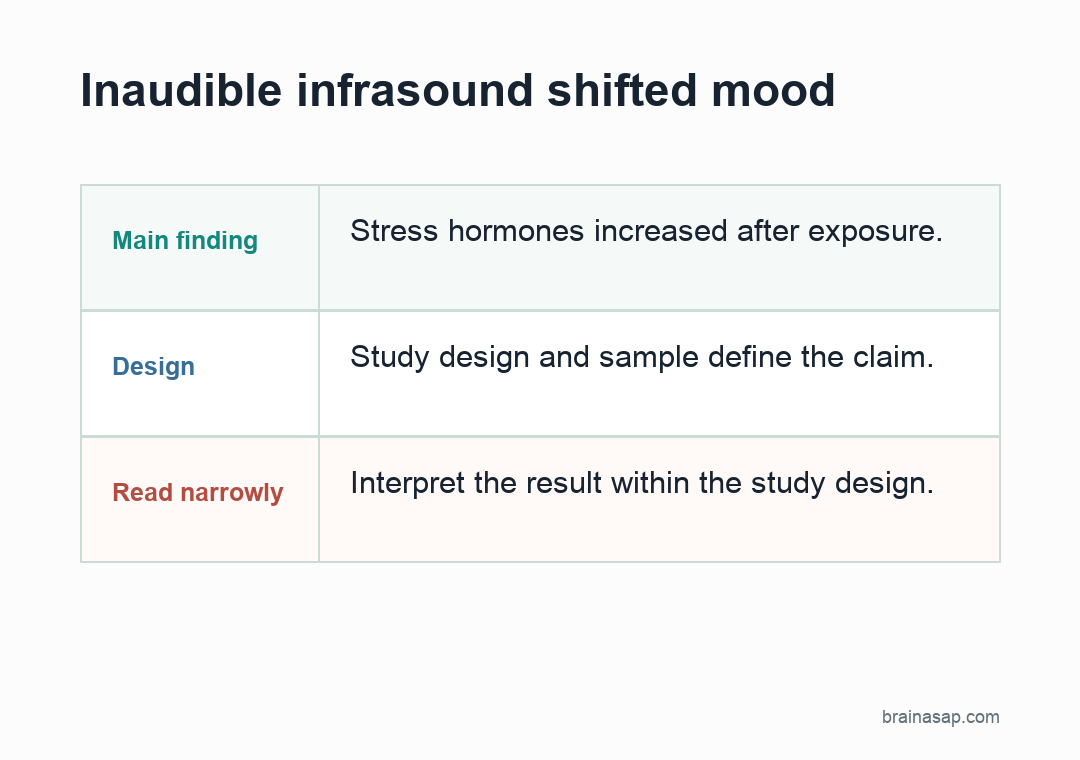
Key Statistic: Inaudible infrasound exposure produced measurable shifts in mood toward unease and elevated stress hormones (including cortisol) without participants being able to consciously detect the stimulus.
Caveat: Detailed effect sizes, sample size, and exposure parameter specifics require full-paper review; lab-controlled exposure may differ in important ways from real-environment infrasound; individual variation in infrasound sensitivity not characterized.