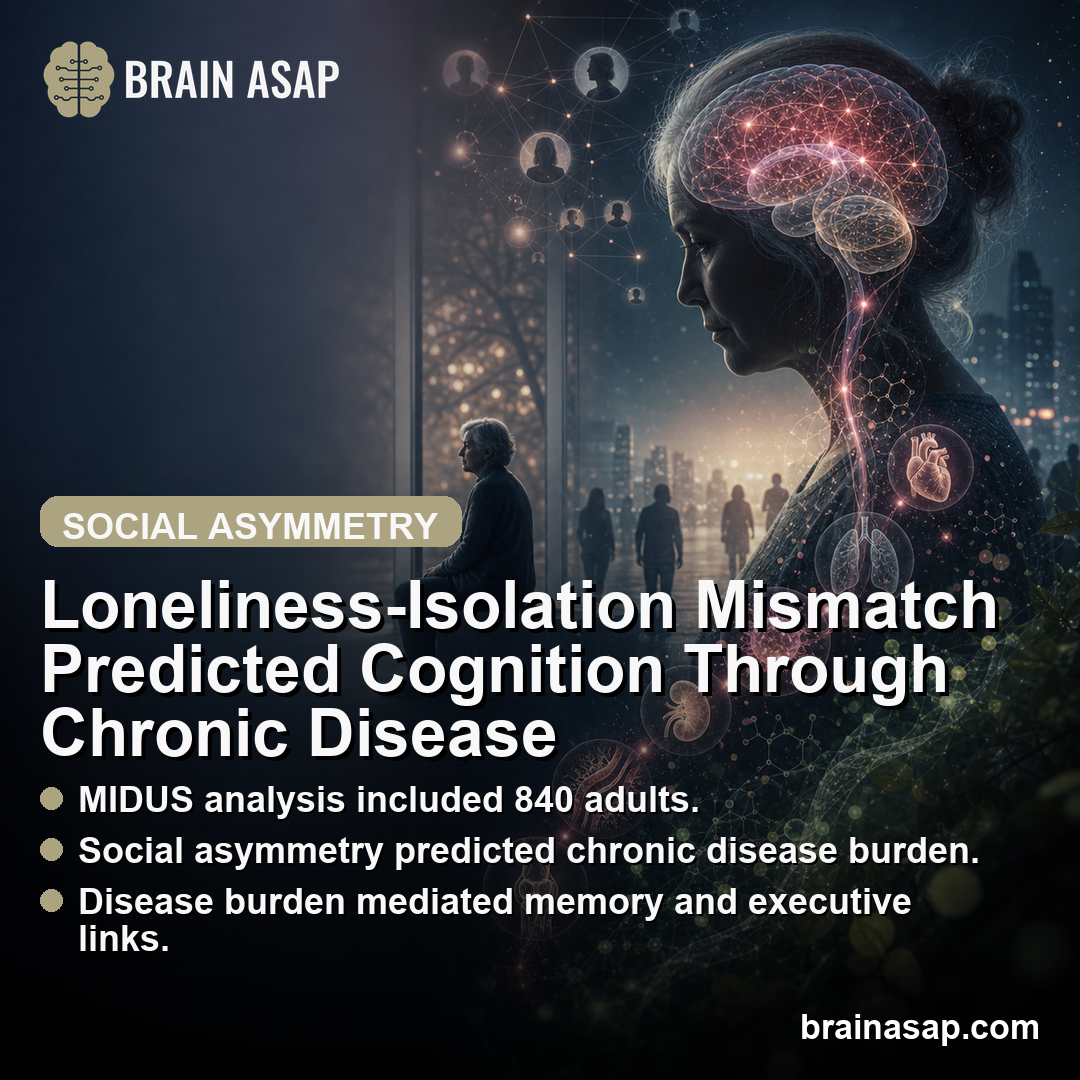
TL;DR: A 2026 MIDUS mediation study in Brain, Behavior, & Immunity – Health found that social asymmetry was associated with greater chronic disease burden, while chronic disease burden mediated links between social asymmetry and episodic memory and executive function, while allostatic load did not.
Key Findings
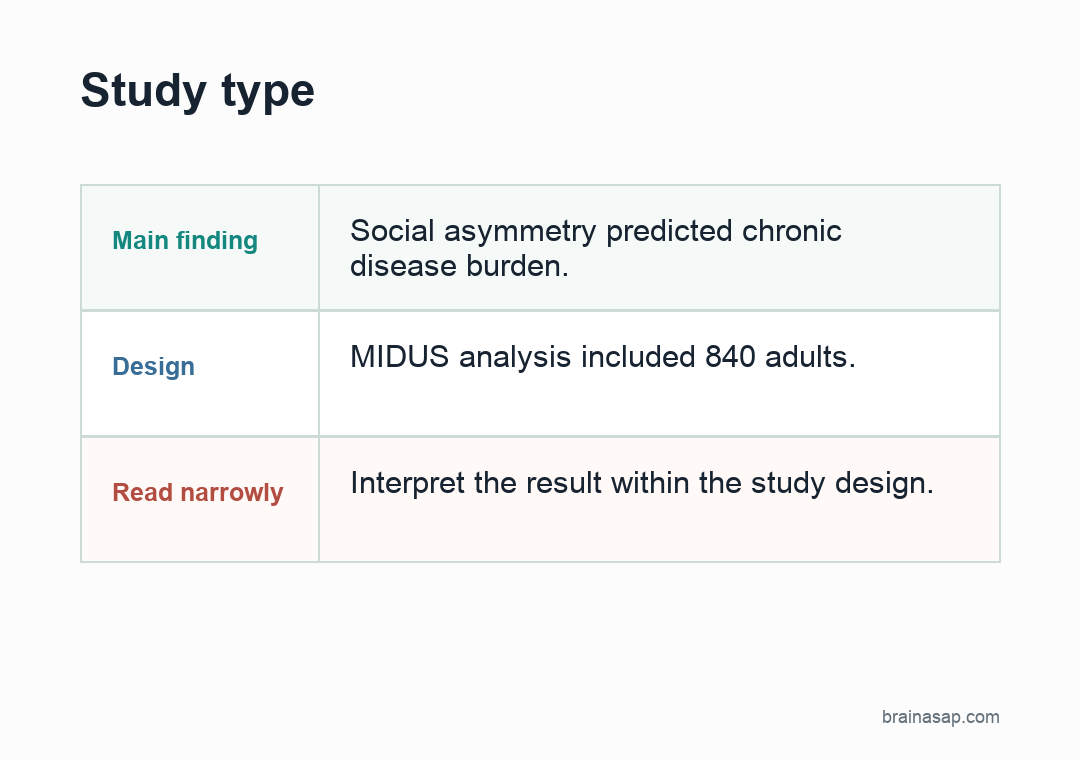
- Study type: a structural equation modeling study of social asymmetry, chronic disease burden, allostatic load, and cognition.
- People studied: 840 adults from the MIDUS Biomarker Project.
- Main result: Social asymmetry was associated with greater chronic disease burden.
- Second result: Chronic disease burden mediated links between social asymmetry and episodic memory and executive function, while allostatic load did not.
- Caution: Mediation modeling supports a pathway hypothesis but does not prove causal sequence.
Source: Brain, Behavior, & Immunity – Health (2026) | Cintron et al.
Loneliness and objective social isolation do not always match. Some people are socially isolated but not lonely, while others feel lonely despite having social contact.
The study tested whether that mismatch, called social asymmetry, related to cognition through chronic disease burden or allostatic load.
Core result: this is a pathway claim: social asymmetry was associated with greater chronic disease burden, and that burden helped explain links with memory and executive function.
MIDUS Data Separated Loneliness From Social Isolation
Design: a structural equation modeling study of social asymmetry, chronic disease burden, allostatic load, and cognition. People studied: 840 adults from the MIDUS Biomarker Project.
The study separated loneliness from social isolation, then tested whether their mismatch related to cognition through chronic disease burden or allostatic load. The reason is feeling lonely and being socially isolated are not the same exposure.
- Loneliness: Subjective social disconnection.
- Isolation: Objective social contact and network structure.
- Chronic disease: Accumulated diagnosed disease burden.
- Allostatic load: Physiological wear-and-tear biomarker composite.
Social Asymmetry Related to Chronic Disease Burden
The main result is that social asymmetry related to chronic disease burden. That gives the cognition finding a health-pathway interpretation rather than a purely social explanation.
Chronic disease burden mediated links between social asymmetry and episodic memory and executive function. Allostatic load did not appear to be the main pathway.
The loneliness–isolation mismatch was associated with cognition through chronic disease burden in this model; the cross-sectional design cannot establish which factor came first.
- Population or model: 840 adults from the MIDUS Biomarker Project.
- Design: a structural equation modeling study of social asymmetry, chronic disease burden, allostatic load, and cognition.
- Primary anchor: Social asymmetry was associated with greater chronic disease burden.
- Second layer: Chronic disease burden mediated links between social asymmetry and episodic memory and executive function, while allostatic load did not.
- Boundary: Mediation modeling supports a pathway hypothesis but does not prove causal sequence.
Measurement detail: Mediation modeling can organize a pathway hypothesis. It cannot prove the sequence by itself, especially when health, social life, and cognition influence one another over time.
Best reading: loneliness-isolation mismatch may relate to cognition partly through chronic disease burden. The finding is not a simple loneliness-causes-cognitive-decline claim.
Follow-up: Follow social asymmetry, disease burden, and cognition over time to test direction. This would show whether the finding holds when the sample, method, or setting changes.
Interpretation: Social asymmetry means mismatch between loneliness and objective isolation.
In this analysis, that mismatch related to cognition mainly through chronic disease burden, not allostatic load.
Terms like loneliness, social isolation, cognition get fuzzy when separated from the evidence. Here, they stay tied to the reported sample, the measurement strategy, and the specific outcome being described.
The model supports a pathway hypothesis, not a proven causal sequence.
Longitudinal studies need to track social asymmetry, disease burden, and cognition in order.
Use chronic disease burden as the main follow-up target from this MIDUS mediation analysis.
Measurement detail: Social asymmetry is different from counting social contacts alone. It captures cases where felt loneliness and objective isolation point in different directions, which can identify people whose health burden would be missed by either measure alone.
Cognitive context: Episodic memory and executive function are practical aging outcomes. Linking them to disease burden gives future studies a concrete pathway to test before making intervention claims.
Public-health context: The result also argues against measuring loneliness and isolation as interchangeable exposures. Screening tools need to preserve the difference between felt disconnection and objective network size.
Chronic Disease Mediated Memory and Executive Function Links
Mediation modeling can organize a pathway hypothesis. It cannot prove the sequence by itself, especially when health, social life, and cognition influence one another over time.
The restrained interpretation is that loneliness-isolation mismatch may relate to cognition partly through chronic disease burden. The finding is not a simple loneliness-causes-cognitive-decline claim.
The allostatic-load contrast is useful because it narrows the proposed pathway instead of naming every stress-related mechanism at once.
Allostatic Load Was Not the Main Pathway
Main limitation: mediation modeling supports a pathway hypothesis but does not prove causal sequence.
- Mediation: The model cannot prove the pathway is causal.
- People studied: MIDUS participants may not represent all older adults.
- Measurement: Social experience changes over time.
- Intervention: Reducing disease burden is harder than identifying the pathway.
Causal direction remains the main caveat. Worse health can shape social life, and cognition can also change social engagement.
Cognitive Aging Research Should Track Social Mismatch
Practical takeaway: cognitive-aging research should track mismatch between felt loneliness and actual social isolation.
- Best use: Use chronic disease burden as the clearest mediator in this analysis.
- Do not overread: Do not treat the mediation model as proof of a one-way causal chain.
- Next question: Follow social asymmetry, disease burden, and cognition over time to test direction.
That keeps the result precise: not just loneliness, not just isolation, but the mismatch between them.
Citation: DOI: 10.1016/j.bbih.2026.101232. Cintron et al. Discrepancies in loneliness and social isolation predict cognitive impairment through chronic disease burden. Brain, Behavior, & Immunity – Health. 2026.
Study Design: A structural equation modeling study of social asymmetry, chronic disease burden, allostatic load, and cognition.
Sample Size: 840 adults from the MIDUS Biomarker Project.
Key Statistic: Social asymmetry was associated with greater chronic disease burden.
Caveat: Mediation modeling supports a pathway hypothesis but does not prove causal direction.