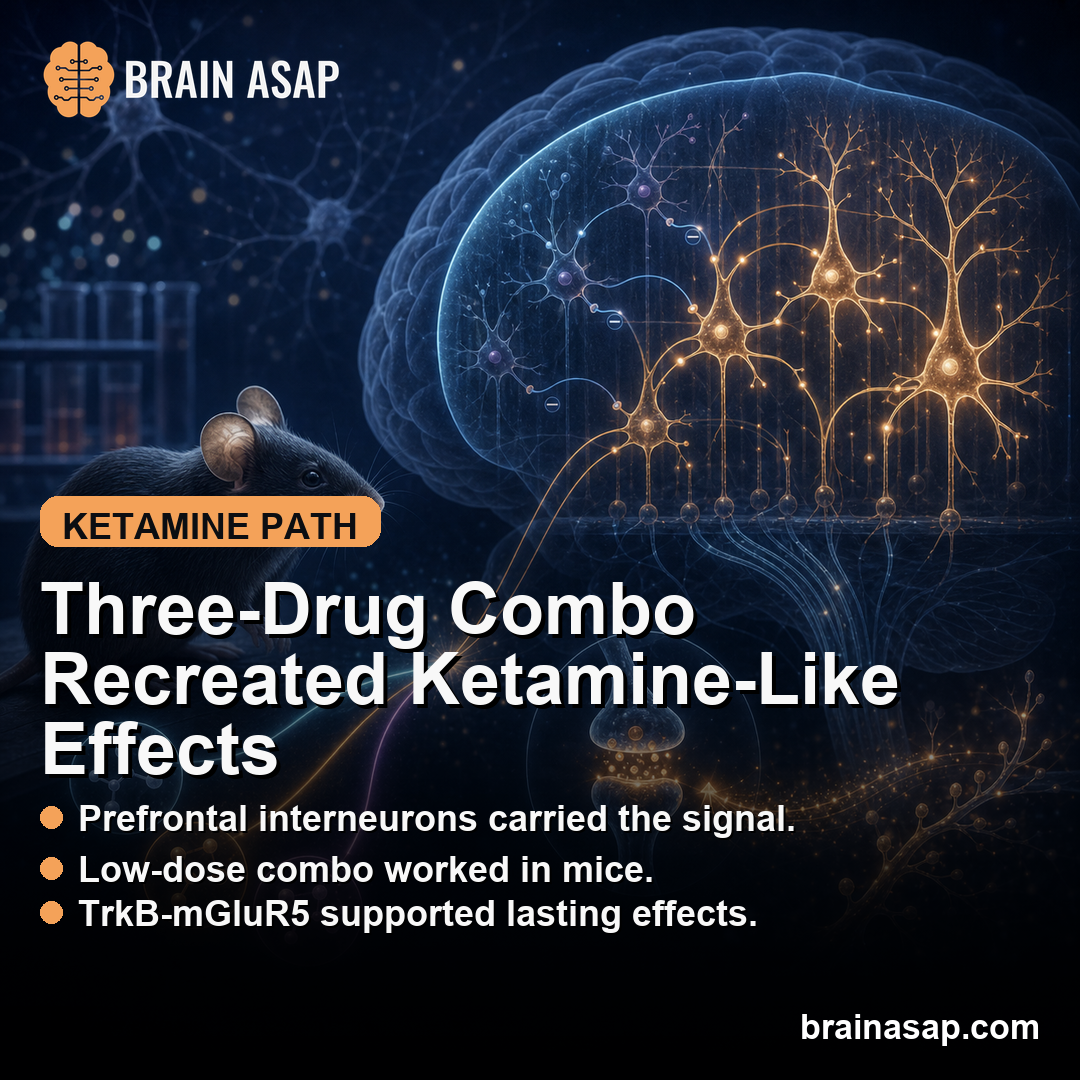
TL;DR: A 2026 mouse study in Cell traced ketamine’s rapid antidepressant-like effect to mu-opioid receptors on somatostatin-positive interneurons in the medial prefrontal cortex. Low-dose multi-GPCR targeting reproduced ketamine-like effects in mice, but the exact three compound names were not listed in the public source material verified here.
Key Findings
- Cell target: ketamine’s rapid mouse effect depended on mu-opioid receptors enriched on somatostatin-positive interneurons in the medial prefrontal cortex.
- Circuit effect: chronic stress made those interneurons over-inhibit prefrontal pyramidal neurons; ketamine briefly reduced that inhibition.
- Timing: the prefrontal reactivation lasted about 15-20 minutes, but appeared sufficient to start longer recovery processes.
- Combination strategy: the Cell paper describes low-dose targeting of multiple GPCRs enriched on these interneurons, including relaxin-3 receptor agonism and prokineticin receptor 2 antagonism.
- Human caveat: the cocktail worked in mouse antidepressant assays; it has not yet shown antidepressant efficacy or safety as a combination in patients.
Source: Cell (2026) | Munguba, Arefin et al.
Ketamine can work faster than standard antidepressants for some people with treatment-resistant depression, but its dissociation, cardiovascular effects, and addiction risk limit how broadly it can be used.
The Weill Cornell team asked a narrower question: which receptor and cell-type event starts ketamine’s fast effect, and can that event be reached with lower-dose drug combinations?
Ketamine’s Rapid Effect Ran Through Prefrontal Interneuron Brakes
The Cell study focused on somatostatin-positive interneurons, a class of inhibitory cells in the medial prefrontal cortex. These cells help regulate nearby pyramidal neurons, which are important for cortical output.
In the depression-related stress model, those interneurons became overactive. The practical result was simple: the brake on prefrontal output became too strong.
- Stress effect: stronger inhibitory drive from somatostatin-positive interneurons.
- Ketamine effect: activation of mu-opioid receptors linked to reduced interneuron inhibition.
- Network effect: pyramidal neurons in the prefrontal cortex could briefly reactivate.
That brief release matters because the source material says prefrontal activity returned for roughly 15-20 minutes. The paper argues that this short window may be enough to trigger a broader cortical recovery program.
The Three-Drug Claim Needs Careful Wording
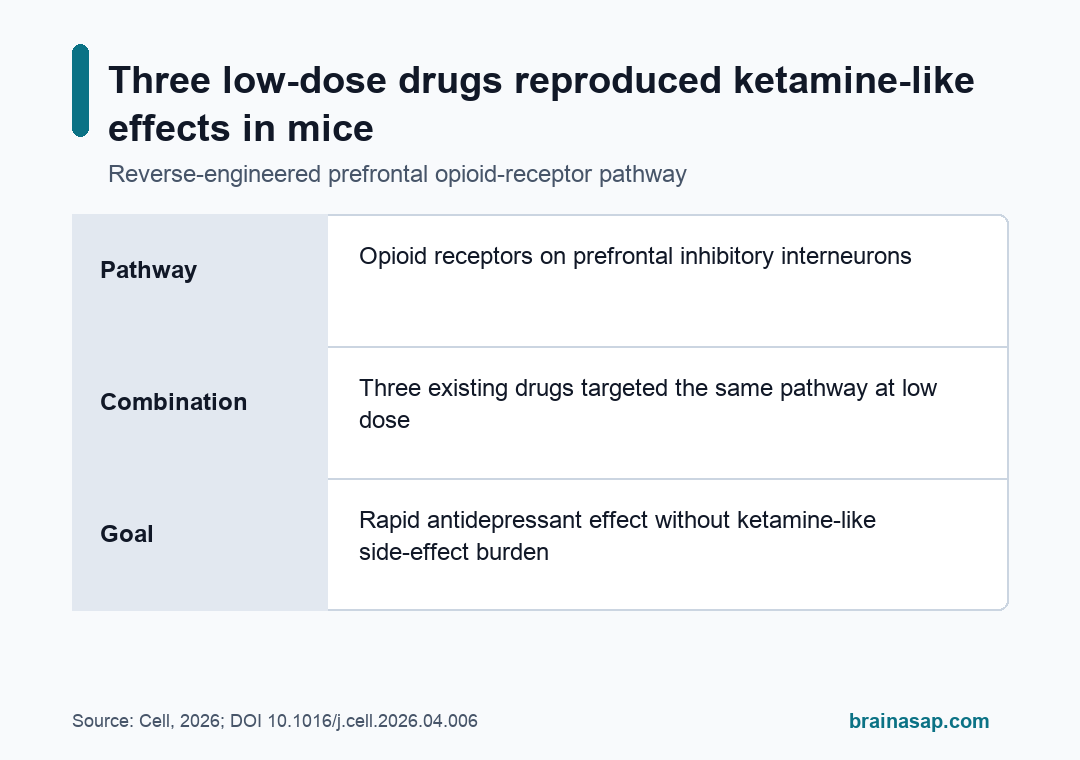
The study did test a three-drug low-dose strategy in mice, but the public Weill Cornell/Neuroscience News source verified here does not name the three compounds.
The more defensible way to describe the result is at the target level:
- Mu-opioid receptor pathway: ketamine’s rapid behavioral effect depended on MOR signaling in these interneurons.
- Relaxin-3 receptor agonism: the Cell abstract/intro names this as one validated GPCR strategy.
- Prokineticin receptor 2 antagonism: the same source names this as another validated GPCR strategy.
- Multi-GPCR cocktail: the final mouse cocktail targeted several GPCRs enriched on somatostatin-positive interneurons, aiming for effect at lower doses.
The key point is not that a ready-made patient regimen exists. It is that the team used circuit biology to choose low-dose targets instead of pushing one broad drug harder.
Longer Effects Involved TrkB and mGluR5
A companion Science Advances study addressed a different question: how ketamine’s benefit can last longer than the drug’s acute action.
That work linked the maintenance phase to cross-talk between TrkB and mGluR5 after BDNF signaling.
- BDNF release: ketamine and other antidepressants can trigger brain-derived neurotrophic factor.
- TrkB activation: BDNF activates the TrkB receptor.
- mGluR5 interaction: TrkB-mGluR5 signaling helped strengthen synaptic connections.
- Built-in restraint: removal of some mGluR5 receptors from the cell surface may help prevent excessive weakening signals.
That makes the overall model two-part: an acute interneuron-disinhibition step followed by synaptic maintenance biology. Both remain preclinical mechanisms, not proof that a new human antidepressant combination works.
The Translation Is Still Early
- Mouse assays are not clinical depression: tail suspension, novelty-suppressed feeding, and related readouts are screening tools, not patient outcomes.
- The combination is not proven in humans: the low-dose cocktail reproduced ketamine-like effects in mice, but patient efficacy is still untested.
- The exact compound list was not in the verified public source: the honest description is receptor-level unless the full paper or trial record is checked for named agents.
- Lower dose does not automatically mean safe: a multi-drug safety profile has to be tested directly.
- Ketamine is still broader than this pathway: NMDA, MOR-linked disinhibition, BDNF, TrkB, and mGluR5 biology all appear in the broader mechanism discussion.
Why This Still Matters
The useful advance is not hype about a finished replacement for ketamine. It is the method: start with a specific stressed circuit, identify receptor targets enriched on the relevant cell type, then test whether lower-dose combinations can recreate the desired network effect.
If that approach translates, it could give researchers a faster path toward rapid antidepressants with fewer dissociative, cardiovascular, and abuse-liability concerns than ketamine. That remains a clinical-trial question, not a settled treatment claim.
Citation: DOI: 10.1016/j.cell.2026.04.006. Munguba H, Arefin A et al. Mechanism-guided identification of antidepressant G protein-coupled receptor drug targets. Cell. 2026.
Study Design: Mechanistic mouse neuroscience study using receptor pharmacology, prefrontal cortex circuit analysis, RNA sequencing, and antidepressant-like behavioral assays; companion Science Advances study examined TrkB-mGluR5 maintenance biology.
Sample/Model: Mouse models of depression-like behavior and prefrontal cortex somatostatin-positive interneuron analyses.
Key Result: Ketamine’s rapid mouse antidepressant-like effect depended on mu-opioid receptors enriched on medial prefrontal somatostatin-positive interneurons; multi-GPCR low-dose targeting reproduced ketamine-like effects in mice.
Caveat: The verified public source did not name the exact three compounds; the combination has not yet been shown to work as an antidepressant regimen in humans.