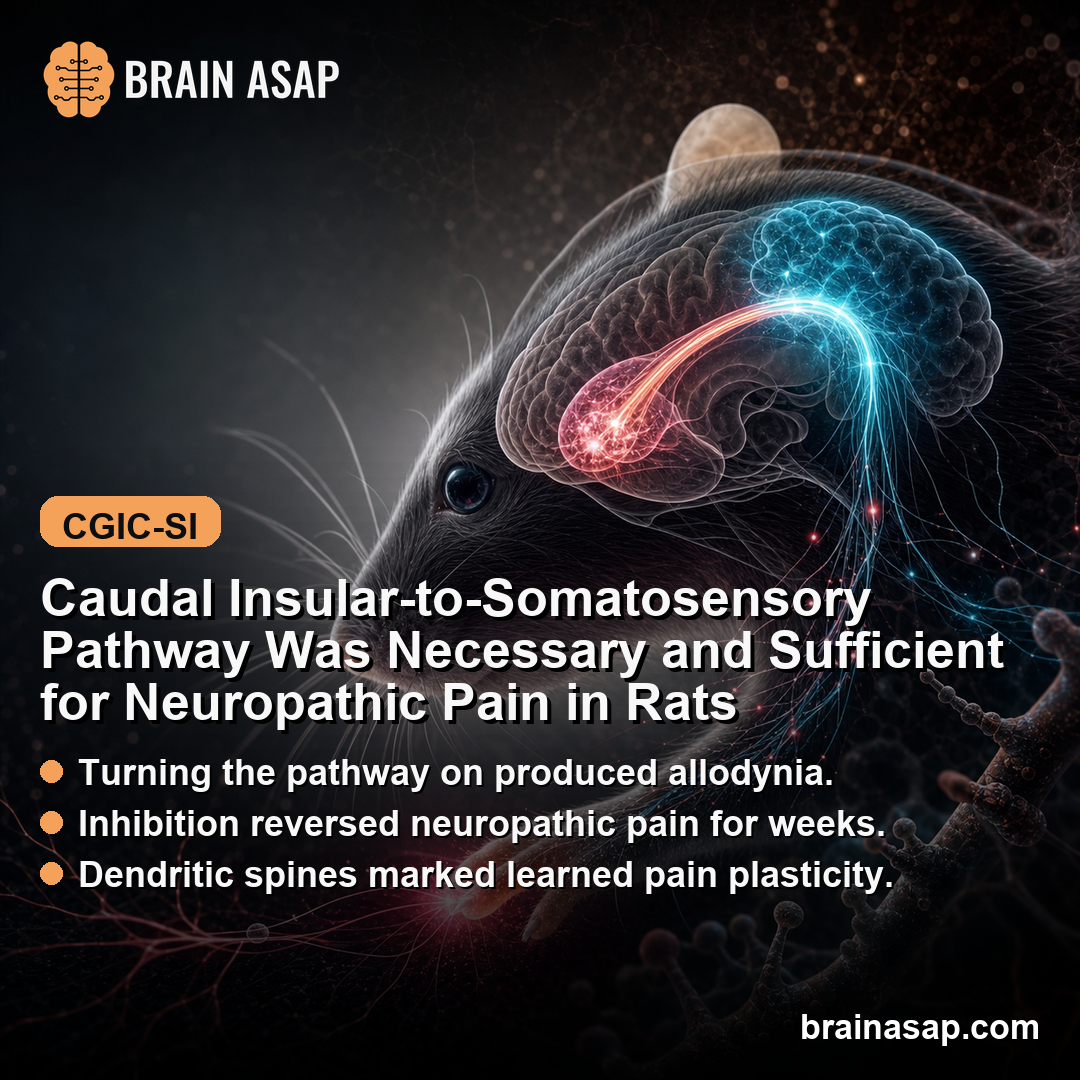
TL;DR: A 2025 rat study in The Journal of Neuroscience found that caudal granular insular cortex (CGIC) projections to primary somatosensory cortex (SI) were required for neuropathic pain behavior, while activating the same pathway produced allodynia, or pain from harmless touch, in healthy rats.
Key Findings
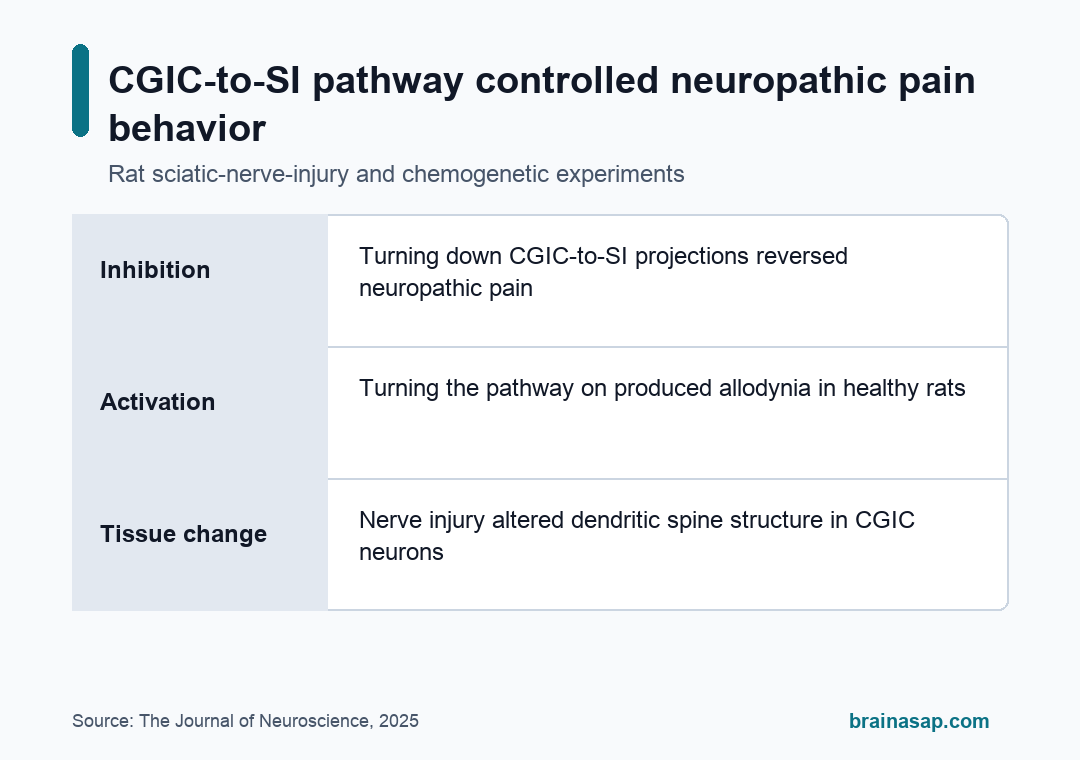
- CGIC-to-SI projections are necessary for neuropathic pain: Multiweek chemogenetic inhibition of caudal granular insular cortex projections to primary somatosensory cortex produced enduring reversal of neuropathic pain in rats with sciatic nerve injury.
- Stimulating CGIC-to-SI in healthy rats produced allodynia: DREADD-induced excitation of this pathway in non-neuropathic rats induced pain from harmless touch — directly demonstrating the pathway is sufficient to generate chronic pain features.
- Nerve injury changes CGIC dendritic spine morphology: Sciatic nerve injury produced specific plasticity changes in dendritic spine architecture of CGIC neurons projecting to SI, providing an anatomical correlate of the pain transition.
- c-Fos lit up the pain network: CGIC activation increased c-Fos expression in CGIC, SI, and pain-responsive laminae in spinal cord dorsal horn — the cortical circuit reached down into spinal pain processing.
- SI is doing more than passive touch processing: The findings extend recent evidence that primary somatosensory cortex actively modulates incoming nociceptive and touch information, with CGIC-to-SI input shaping that gating during the transition to chronic pain.
Source: The Journal of Neuroscience (2025) | Ball et al.
Acute pain has clear protective biology: peripheral nerves fire, signals travel through the spinal cord, and the brain registers injury or threat. Chronic pain is different because pain persists or develops without ongoing tissue damage.
The Ball team identified a cortical circuit that helps explain that transition in a rat nerve-injury model.
Why “Allodynia” Is the Symptom That Defines Chronic Neuropathic Pain
Allodynia means perceiving harmless touch as painful. A light brush on the skin, normally innocuous, instead triggers pain.
It is one of the disabling features of chronic neuropathic pain, including pain after nerve injury, diabetic neuropathy, postherpetic neuralgia, and related conditions.
Allodynia isn’t just turned-up acute pain. It reflects a systemic remodeling of how the nervous system processes touch:
- Spinal cord changes: Neurons in pain-processing laminae become hyperexcitable.
- Brainstem and thalamus changes: Relay nuclei amplify rather than gate signals.
- Cortical changes: Somatosensory and other cortical regions reorganize their representation of the affected body area.
The Ball paper specifically targets the cortical contribution and shows that one defined cortical circuit — CGIC to SI — is doing more of the work than anyone had localized before.
CGIC-to-SI Tests Showed Necessity and Sufficiency
Pain research has many correlational findings: a brain region activates during chronic pain, or a connectivity pattern differs in chronic pain patients. The Ball team tested the CGIC-to-SI pathway in both directions.
Direction 1 — Necessity: Direction 2 — Sufficiency:
- Healthy-rat activation: Healthy rats with no nerve injury received DREADD-induced excitation of the same CGIC-to-SI pathway.
- Induced allodynia: The healthy rats developed pain from harmless touch and increased c-Fos expression throughout the pain-processing network, including spinal cord.
Both directions point to the same conclusion: CGIC-to-SI projection activity is part of the cause of chronic pain, not just a downstream sign of it.
What “Multiweek Reversal” Means That Acute Pain Drugs Can’t Match
Most pain medications produce short-term relief. NSAIDs, opioids, and other analgesics block pain perception during the active drug window, but withdrawal returns the pain. The Ball finding is structurally different:
- The chemogenetic inhibition was sustained over multiple weeks.
- Pain reversal was enduring — outlasting the immediate intervention period.
- The implication is that chronic neuropathic pain may be sustained by ongoing CGIC-to-SI activity. Suppressing that activity for long enough can let the nervous system reset toward non-pain processing.
The rat data suggest that the chronic-pain state is actively maintained by ongoing circuit activity, not simply fixed after the original injury.
Human translation still requires direct testing, but the experiment gives researchers a defined cortical pathway to evaluate.
Dendritic Spine Plasticity Linked the Pathway to Pain Learning
One anatomical finding is central. Sciatic nerve injury produced specific changes in dendritic spine morphology of CGIC neurons projecting to SI.
Dendritic spines are the small protrusions on neurons where synaptic input arrives, and their morphology reflects synaptic strength and connectivity history.
The implication is that chronic pain does not just reflect ongoing CGIC-to-SI activity in unchanged anatomy. It reflects a structural learning event.
The cortex has restructured itself in response to the original injury, and that restructured anatomy keeps producing pain output even after the original injury heals.
This fits the broader framing of chronic pain as a learning disorder — the nervous system has learned to be in pain, and that learning is held in physical synaptic changes.
What This Means for Where Chronic Pain Treatment Should Aim
Several treatment implications follow from the Ball findings:
- Cortical targets matter for chronic pain. Most current pain treatment focuses on peripheral and spinal targets. The CGIC-to-SI pathway is a defined cortical target with demonstrated causal role.
- Sustained intervention may be needed for sustained relief. Multiweek pathway suppression produced lasting reversal — short-term blockade may not be enough to reset chronic pain states.
- Non-invasive cortical stimulation has a clearer target. Repetitive transcranial magnetic stimulation, transcranial direct current stimulation, and similar methods could be aimed at the insular-somatosensory pathway with more rationale than current general-cortex stimulation protocols.
- Pain-related neuroplasticity is the broader mechanism. Treatments that promote favorable neuroplasticity — including some psychotherapies that have shown chronic pain efficacy — may work through similar circuit-restructuring routes.
Sex-inclusive methodology should be standard.
The Ball study tested both male and female rats. Pain research has historically been done predominantly in male animals, which limits translation because:
- Pain prevalence: Human women have higher prevalence than men for many chronic pain conditions.
- Mechanism differences: Pain mechanisms can differ by sex at the neural and immune levels.
- Treatment responses: Some pain medications have different efficacy profiles by sex.
The Ball team’s inclusion of both sexes makes the findings more likely to generalize to the actual human chronic pain population, not just the male half.
The Honest Limits of a Rat Cortical Circuit Paper
- Rat cortical organization differs from primate cortex. The CGIC-to-SI pathway exists in primates and humans, but circuit-level details and proportional contributions may not transfer cleanly.
- Chemogenetic intervention isn’t a feasible human treatment. The DREADD approach requires viral delivery and ligand-controlled receptor expression — useful for mechanism but not a near-term clinical tool.
- Sciatic nerve injury isn’t all chronic pain. Other chronic pain conditions (fibromyalgia, complex regional pain syndrome, central post-stroke pain) may involve different circuit dynamics.
- “Enduring reversal” duration needs human-translation context. What’s “enduring” in a rat may be a few weeks; whether human pathway interventions could produce similar sustained reversal requires direct testing.
CGIC-to-SI pathway gives chronic pain a defined cortical target.
Chronic pain treatment still lacks precise circuit targets for many patients. The Ball study offers a relatively rare combination of features for chronic pain research:
- A specific anatomical target (CGIC-to-SI projections).
- Bidirectional causal evidence (both necessity and sufficiency).
- Structural plasticity correlates (dendritic spine morphology changes).
- Sex-inclusive methodology.
- An “enduring” rather than transient effect from intervention.
That combination gives researchers a defined pathway to test. If the same pathway operates similarly in humans, chronic pain treatment may have a cortical circuit to aim at rather than only a broad brain region or peripheral receptor.
The translation work is the next hard problem, but the target is now defined in this rat model.
Citation: DOI: 10.1523/JNEUROSCI.1306-25.2025. Ball et al. Caudal Granular Insular Cortex to Somatosensory Cortex I: A Critical Pathway for the Transition of Acute to Chronic Pain. The Journal of Neuroscience. 2025.
Study Design: Sciatic nerve injury rat model of neuropathic pain in male and female rats; circuit-specific mGreenLantern expression to map CGIC-to-SI projections; DREADD chemogenetic excitation and inhibition of CGIC and CGIC-to-SI pathway specifically; behavioral and electrophysiological readouts plus immediate-early gene (c-Fos) expression analysis; dendritic spine morphology assessment in CGIC-to-SI projection neurons.
Sample/Model: Male and female rats with sciatic nerve injury vs sham controls — see full publication for sample sizes per experiment.
Key Statistic: CGIC-to-SI signaling was necessary for neuropathic pain behavior; multiweek chemogenetic inhibition produced enduring reversal, while stimulating the same pathway in healthy rats produced allodynia and elevated c-Fos throughout the pain network.
Caveat: Rat circuit study; chemogenetic intervention is a research tool, not a clinical treatment; sciatic nerve injury is one chronic pain model among many; human translation requires confirmation that homologous pathway operates similarly.