Old Autonomy Wounds Made COVID Conspiracies Stickier
TL;DR: COVID conspiracy beliefs became stronger when restrictive situations reactivated memories of lost autonomy, suggesting that misinformation can feel persuasive because it repairs an old sense of being controlled.
Key Findings
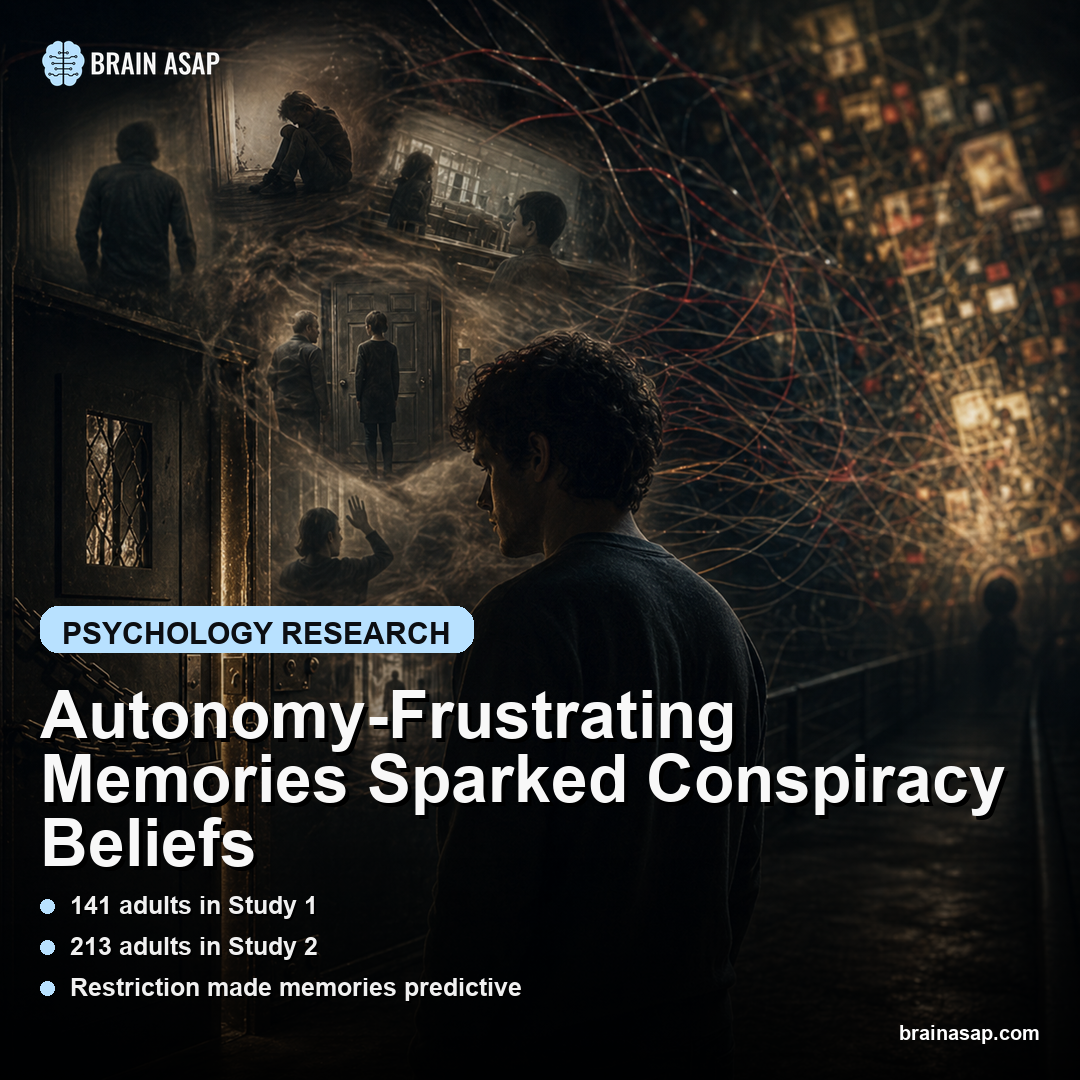
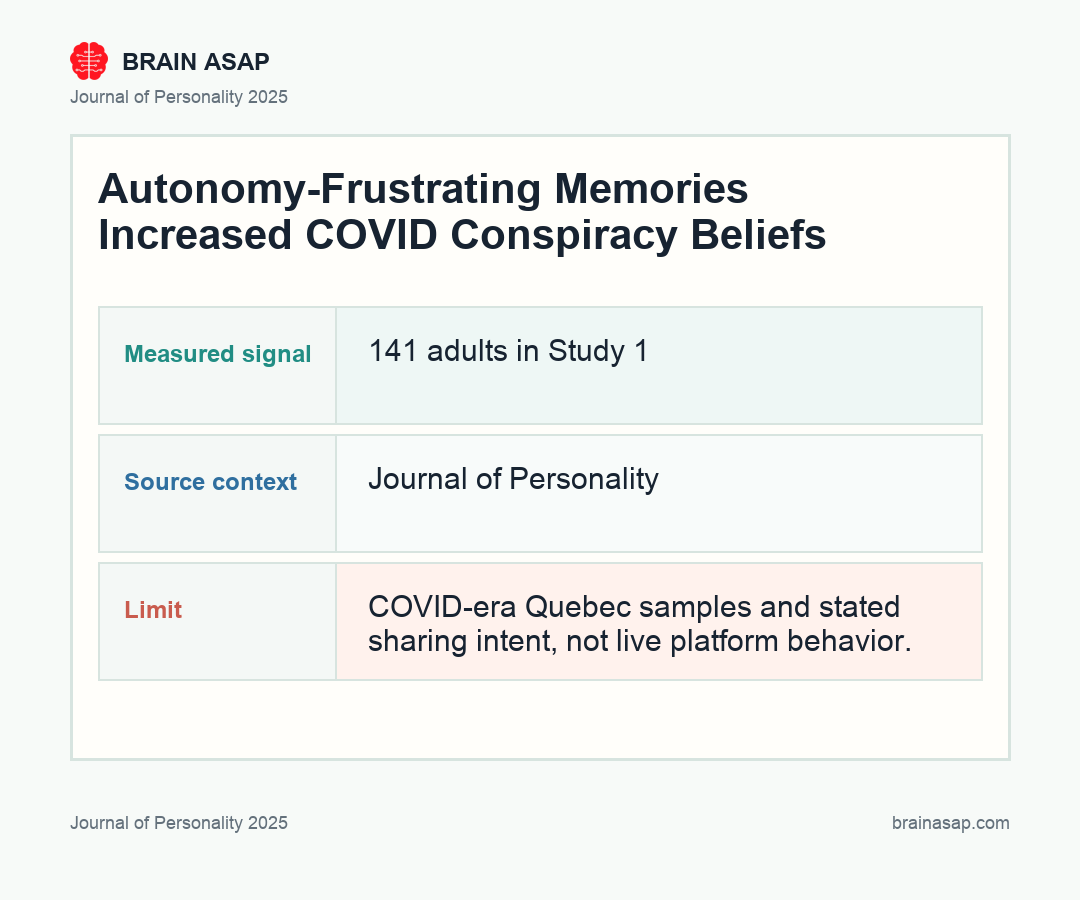
141 Quebec adults linked restriction to later belief: In Study 1, participants read a mask-rule scenario, described the memory it triggered, and reported COVID conspiracy endorsement one week later.
Autonomy-frustrating memories mattered only under restriction: Memories high in autonomy frustration predicted stronger conspiracy belief after moderate or harsh restriction stories, but not after the no-restriction control story.
213 adults tested the memory mechanism directly: Study 2 used a yoked-control subliminal priming design, comparing participants primed with their own autonomy-frustrating memories, someone else’s memory, or autonomy-satisfying memories.
60 ms memory primes changed reactions: Autonomy-frustrating memory keywords flashed too briefly to consciously read increased endorsement of a bogus conspiracy theory, anger toward it, and willingness to spread it.
Reactance was part of the personality backdrop: People higher in trait reactance and everyday autonomy frustration tended to show stronger conspiracy endorsement.
Source: Journal of Personality (2025) | Leonard et al.
Conspiracy theories are usually treated as information failures: someone saw the wrong post, trusted the wrong source, or lacked the right facts. This Journal of Personality paper adds a more personal layer. A false claim may become emotionally sticky when it gives a person an explanation for why they felt controlled before and why they feel controlled now.
The Mask Scenario Was Really a Memory Trigger
The first experiment looked simple on the surface. Participants in Quebec read a short story about Alex entering a grocery store without a mask during the COVID-19 pandemic. Depending on condition, Alex either faced no restriction, a moderate refusal, or a harsher denial of access.
The real target was not the mask rule by itself. The researchers wanted to know what kind of personal memory the scenario pulled up. After reading the story, participants described whatever memory came to mind and rated how much that memory frustrated basic psychological needs, especially the need for autonomy.
A rule can be annoying in the moment, but a rule that reactivates an old memory of being controlled may land differently. It can feel less like one policy and more like the return of a familiar loss of agency.
Autonomy Frustration Predicted Belief Only When Freedom Felt Restricted
One week later, participants reported their endorsement of seven COVID-related conspiracy beliefs. The key pattern was not that negative memories always predicted conspiracy thinking. It was more specific than that.
When the grocery-store story involved moderate or high restriction, autonomy-frustrating memories predicted stronger later conspiracy endorsement. When the story involved no restriction, that predictive link disappeared. The same kind of memory became politically and psychologically relevant only when the current situation echoed it.
This is why the finding is more interesting than a generic “angry people believe conspiracies” story. The study points to a fit between environment and memory. A freedom-restrictive cue seems to make old autonomy frustration easier to use as an interpretive lens.
The authors also measured broader personality and need variables. Psychological reactance means the pushback people feel when they think their freedom is being threatened. People higher in that trait showed stronger conspiracy endorsement, as did people with more general autonomy frustration in daily life.
A 60-Millisecond Prime Made the Memory Claim Harder to Wave Away
Study 1 could still be read as correlation. Maybe people who already liked conspiracy theories described different memories, or maybe the memory ratings were just another measure of mood. Study 2 pushed the mechanism harder.
Participants again described memories after reading a freedom-restrictive vignette. A week later, they returned for a visual task in which memory-related keywords appeared for only 60 milliseconds. That is quick enough to prime the memory without giving people a normal chance to read and reflect on the word.
The design used a useful control: some participants were primed with their own memory, while others were primed with someone else’s memory or with autonomy-satisfying memory material. The yoked-control setup asks whether the effect came from that person’s own autonomy-frustrating memory, not just from seeing any emotionally charged words. Afterward, everyone saw a fake Twitter-style post presenting a bogus COVID-related conspiracy claim.
The autonomy-frustrating prime shifted the response. Compared with control conditions, it increased endorsement of the bogus claim, anger in response to it, and willingness to disseminate it. The memory cue made the false claim feel more believable and more shareable.
Conspiracy Beliefs Offered a Crude Sense of Control
The theory behind the paper comes from self-determination theory, which argues that people have basic psychological needs for autonomy, competence, and relatedness. Autonomy means feeling that one’s actions are self-endorsed rather than imposed.
When autonomy is frustrated, people may look for ways to restore agency. A conspiracy theory can offer a crude version of that repair. It transforms a confusing restriction into an explanation with villains, motives, and hidden control.
That does not make the conspiracy true, rational, or harmless. It explains why correction can be so difficult. If the belief is doing emotional work, facts alone does not necessarily remove its appeal.
The paper’s mechanism also helps explain why some public-health messages backfire. A rule communicated as pure command can collide with a person’s history of being pushed around. The same rule framed with choice, transparency, and respect may be less likely to activate the defensive pathway.
COVID Samples and Fake Sharing Keep the Claim Narrow
The authors were careful about scope. Both studies were conducted in Quebec during the COVID-19 period, and the conspiracy measures were COVID-specific. That means the result should not be automatically generalized to every kind of conspiracy belief, from elections to climate to medicine.
There is also a selection issue. People with very high mistrust of science can have been less likely to join the research in the first place. If so, the sample may underrepresent the most hardened conspiracy communities.
Study 2 measured willingness to disseminate a fake claim, not actual behavior on a live social platform. Real-world sharing also depends on audience, identity, platform incentives, and social risk. Still, willingness to spread the claim is not trivial; it is one step closer to behavior than private belief alone.
- Strongest evidence: The 60 ms priming experiment supports a causal role for autonomy-frustrating memory activation.
- Main boundary: The studies speak most directly to COVID-era restrictions in Quebec adults.
- Communication lesson: Reducing misinformation may require restoring agency, not only correcting facts.
- Communication risk: Heavy-handed correction can recreate the same autonomy threat that made the false claim feel useful.
Fact Checks Need to Avoid Recreating the Autonomy Threat
The takeaway is not that every conspiracy believer is secretly processing childhood memories. The narrower point is that old experiences of being controlled can shape which explanations feel satisfying when a new restriction appears.
A fact check that says “you are wrong” may accidentally recreate the same autonomy threat that made the false claim appealing. A better intervention might combine evidence with language that preserves choice: here is what is known, here is why, here is what remains uncertain, and here is what you can decide for yourself.
The paper makes conspiracy belief feel less like a purely intellectual glitch and more like a defensive interpretation of constraint. That does not excuse harmful misinformation. It gives communicators a sharper target: not just the false claim, but the psychological need the false claim is pretending to meet.
Paper: Priming Need-Frustrating Memories Sparks Conspiracy Beliefs: A Self-Determination Theory Perspective. Journal of Personality. 2025. DOI: 10.1111/jopy.70032
Authors: Leonard et al.
Study Design: Two-study social-psychology design combining COVID restriction vignettes, memory recall, one-week follow-up, and subliminal memory priming.
Sample Size: Study 1: 141 Quebec adults from the general population, average age about 40. Study 2: 213 Quebec adults, average age about 45.
Key Statistic: In Study 2, autonomy-frustrating memory keywords flashed for 60 ms increased bogus-conspiracy endorsement, anger, and willingness to disseminate compared with control priming conditions.
Important Caveat: The experiments show that autonomy-frustrating memories can raise conspiracy endorsement under controlled conditions, not that every conspiracy belief comes from one memory pathway.