Metformin’s Secret Weapon: How the Brain Controls Blood Sugar
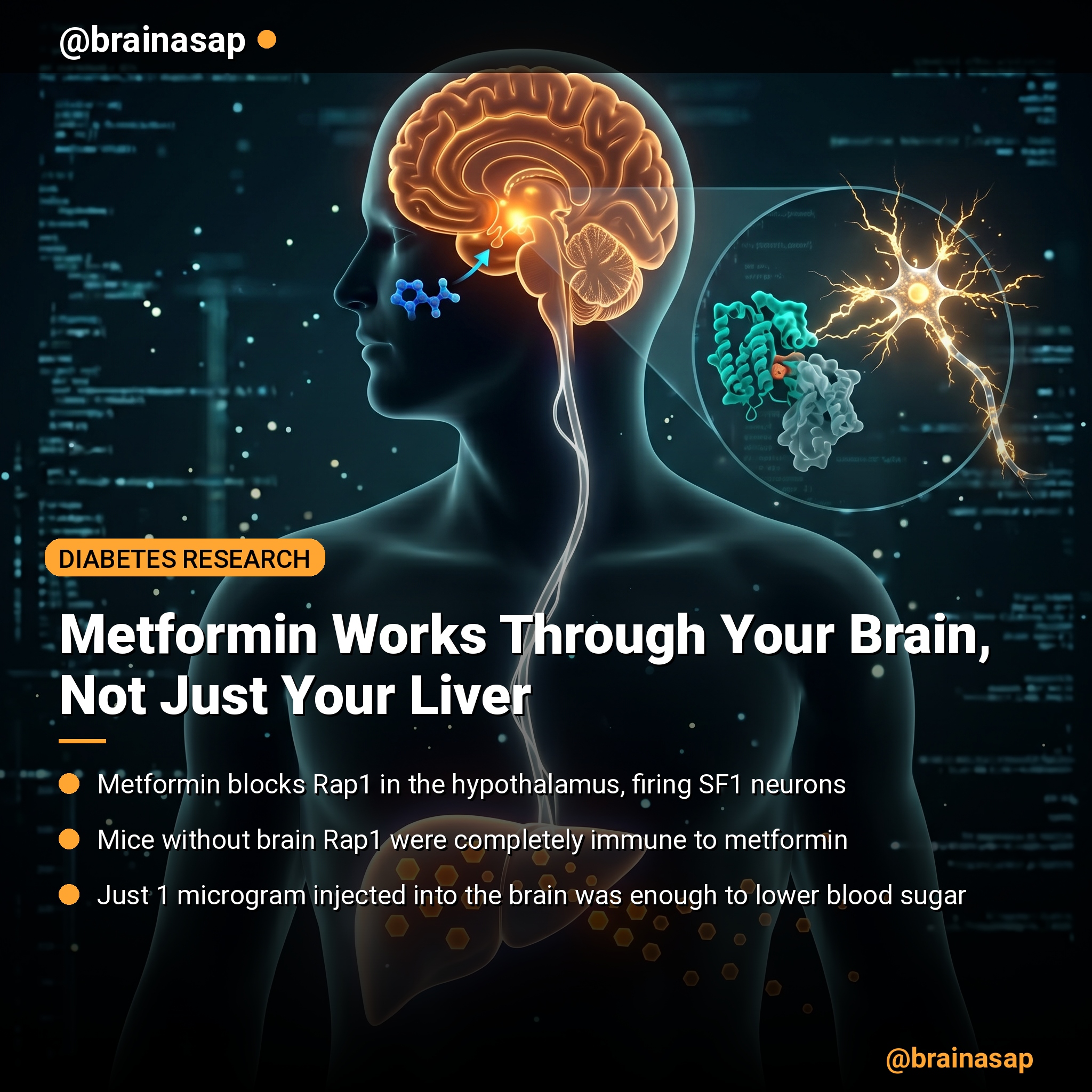
TL;DR: Metformin’s glucose-lowering effect depends on a brain signaling pathway—it inhibits Rap1 in the hypothalamus, activating neurons that tell the liver to stop overproducing glucose.
For decades, metformin has been the first-line drug for type 2 diabetes, working so reliably that millions take it daily. Yet its precise mechanism—how it actually lowers blood sugar—has remained surprisingly murky. Researchers knew it reduced glucose output from the liver and improved gut function, but those stories never quite added up to the full picture.
Now, a team at Baylor College of Medicine has discovered that metformin’s effect depends on something nobody expected: a signaling pathway in the brain’s hypothalamus that controls whole-body glucose metabolism. The revelation not only solves a four-decade mystery but opens a new frontier for targeting diabetes at the neurobiological level.
Key Findings
- Rap1 knockout mice resistant to metformin: Mice with forebrain-specific deletion of Rap1 (a small GTPase) were completely resistant to metformin’s glucose-lowering effects, despite responding normally to five other classes of antidiabetic drugs.
- Central metformin effect at ultra-low doses: Centrally administered metformin—injected directly into the brain at doses as low as 1 microgram—reduced blood glucose in diet-induced obese mice, leptin-deficient ob/ob mice, and streptozotocin-induced models, independent of food intake.
- VMH SF1 neuron activation: Metformin selectively activated neurons in the ventromedial hypothalamus (VMH) expressing steroidogenic factor 1 (SF1), depolarizing 76.6% of recorded SF1 neurons and increasing their firing frequency.
- Rap1 inhibition is essential: Metformin directly inhibited active (GTP-bound) Rap1 in the hypothalamus; forced expression of constitutively active Rap1 completely blocked metformin’s antidiabetic effect.
- Dose-dependent mechanism: Brain Rap1 deletion attenuated the glycemic response to clinically relevant low-dose metformin (50-100 mg/kg) but not suprapharmacological doses (200-250 mg/kg), suggesting bypassing mechanisms at higher concentrations.
- Brain-specific, peripheral-independent: The effect operates through brain-specific mechanisms independent of hepatic or gut actions; neither peripheral Rap1 nor other pathways (AMPK-dependent or otherwise) could compensate.
Source: Science Advances (2025) | Lin, Lu, Fu et al.
The Metformin Mystery: A Peripheral Drug with an Unexpected Brain
Metformin has been standard diabetes treatment for so long that its mechanism feels resolved. And those effects are real. Yet they’ve always seemed insufficient to explain the drug’s full clinical impact:
- Reduce hepatic glucose production through AMPK activation
- Enhance insulin sensitivity
- Adjust the microbiome
Some patients on metformin improve while others barely respond. Some studies of metformin’s hepatic action show robust effects; others find nothing. The inconsistency hinted at missing pieces. What if the brain was orchestrating the response all along?
A Selective Defect: The Rap1 Knockout Clue
Hsiao-Yun Lin and colleagues started with a deceptively simple observation: mice lacking Rap1 (Ras-related protein 1, a small GTPase) in the forebrain showed a selective defect—they were deaf to metformin but not to other diabetes drugs.
This wasn’t a general failure of glucose control. These Rap1 knockout mice responded normally to rosiglitazone, exendin-4, dapagliflozin, sulfonylureas, and insulin. But metformin? No effect.
The specificity was striking: metformin engages a Rap1-dependent neural pathway that other drugs bypass entirely.
The Hypothalamus as a Glucose Sentinel
The next question was anatomical: where in the brain does Rap1-dependent metformin action occur? The team used immediate early gene mapping (c-Fos induction) to track which neurons fire in response to centrally administered metformin.
The answer was precise: the ventromedial hypothalamus (VMH), a nucleus that regulates glucose homeostasis through connections to the sympathetic nervous system and liver. Metformin activated VMH neurons at doses as low as 1 microgram—extraordinarily low, suggesting the brain is exquisitely sensitive to metformin.
Importantly, adjacent hypothalamic regions (dorsomedial hypothalamus and arcuate nucleus) showed no response. The drug’s action was surgically specific.
Within the VMH, metformin selectively activated neurons expressing SF1 (steroidogenic factor 1), a transcription factor marking a small population of neurons with well-documented roles in glucose regulation. When the researchers patched SF1 neurons in brain slices and applied metformin directly, they recorded:
- Depolarization rate: 36 of 47 neurons (76.6%) showed depolarization in response to metformin (1–100 micromolar).
- Firing increase: Spontaneous action potential firing increased by 2.8 ± 2.1 Hz, a robust, dose-dependent effect.
- Mechanism: The drug was physically changing the electrical state of these neurons, making them fire faster.
Rap1 Inhibition: The Molecular Handshake
But how? Four hours after central metformin administration, the team measured Rap1 activity in hypothalamic lysates using a GTP-binding assay.
Metformin significantly reduced GTP-bound active Rap1—in other words, metformin directly inhibits Rap1. Normal Rap1 (when active) suppresses VMH SF1 neuron firing and drives glucose production. Metformin inhibits Rap1, releasing that brake, allowing VMH SF1 neurons to depolarize and activate, signaling the liver to stop glucose output.
Proof Through Genetic Reversal
To test this model, the researchers expressed constitutively active Rap1 in the brain—a form that metformin could not inhibit. These mice were completely resistant to metformin’s glucose-lowering effects, just like the Rap1 knockout animals.
The result was clean: inhibit Rap1 with metformin, or keep Rap1 locked active, and either way the pathway breaks. This converging genetic evidence confirmed that Rap1 inhibition is metformin’s primary neural mechanism.
[Insert image: pathway diagram showing metformin → Rap1 inhibition → VMH SF1 neuron activation → glucose reduction]
Clinically Relevant Doses: A Caveat That Matters
Here’s where the work gains real therapeutic weight. Most prior metformin studies in rodents used suprapharmacological doses that obscured the real mechanism. Lin and colleagues deliberately used clinically relevant doses and found:
- Clinical-range dosing (50–150 mg/kg): Produced serum levels of ~23 micromolar (matching patient concentrations of 10–40 micromolar). Rap1 knockout mice were completely resistant; controls responded robustly.
- Suprapharmacological dosing (200–250 mg/kg): Produced serum levels of 200–400 micromolar, far exceeding clinical concentrations. Even Rap1 knockout mice showed glucose improvement.
- The implication: At suprapharmacological doses, metformin bypasses Rap1 via alternative pathways (hepatic AMPK, mitochondrial mechanisms) that are too high-dose to be clinically relevant. This explains why older studies appeared contradictory.
The Broader Picture: A Neural Pharmacology of Metabolism
The implication of this work extends beyond metformin. It repositions the brain—not the liver or gut, but the hypothalamus—as a primary therapeutic target for metabolic disease.
For years, diabetes drugs have been classified by their peripheral sites of action: hepatic glucose output, insulin secretion, kidney reabsorption, and so on. This study suggests that the central nervous system doesn’t just modulate these effects at the margins; it may orchestrate them.
Metformin’s clinical success might owe less to its famous hepatic actions and more to its ability to recruit a small population of hypothalamic neurons that hold a key to systemic glucose control.
Opening New Drug Development Avenues
It also raises a provocative question: how many other diabetes drugs work partly or entirely through the brain? And could future therapies be designed to directly target VMH SF1 neurons or downstream effectors—potentially with greater specificity and fewer peripheral side effects?
The brain has long been underutilized in metabolic medicine, treated as a bystander. Lin’s work suggests it should be viewed as an architect.
From Discovery to Practice: What Comes Next
The immediate clinical message is reassuring: the brain’s role in metformin action is engaged at standard therapeutic doses and involves physiologically relevant mechanisms (neuronal excitability, not toxic effects).
This discovery doesn’t require metformin reformulation. Instead, it opens doors for drug development. Future agents could target Rap1 or its downstream effectors in VMH SF1 neurons, offering more selective glucose-lowering with fewer off-target effects.
For patients, the main takeaway is simple: metformin works, in part, because your brain is listening. Your hypothalamus responds to the drug and signals your liver to stop overproducing glucose, allowing your body to restore balance.
It’s a reminder that metabolism is an orchestra, and the brain is both conductor and musician. Decoding these neural circuits, as Lin and colleagues have done, opens a map to metabolic control that reaches far beyond a single drug.
Full Citation:
Lin, H. Y., Lu, W., He, Y., Fu, Y., Kaneko, K., Huang, P., De la Puente-Gomez, A. B., Wang, C., Yang, Y., Li, F., Xu, Y., & Fukuda, M. (2025). Low-dose metformin requires brain Rap1 for its antidiabetic action. Science Advances, 11, eadu3700. DOI: 10.1126/sciadv.adu3700
Affiliations: USDA/ARS Children’s Nutrition Research Center, Department of Pediatrics, Baylor College of Medicine, Houston, TX, USA, and affiliated institutions.
Funding: Supported by grants from the National Institutes of Health and the USDA.