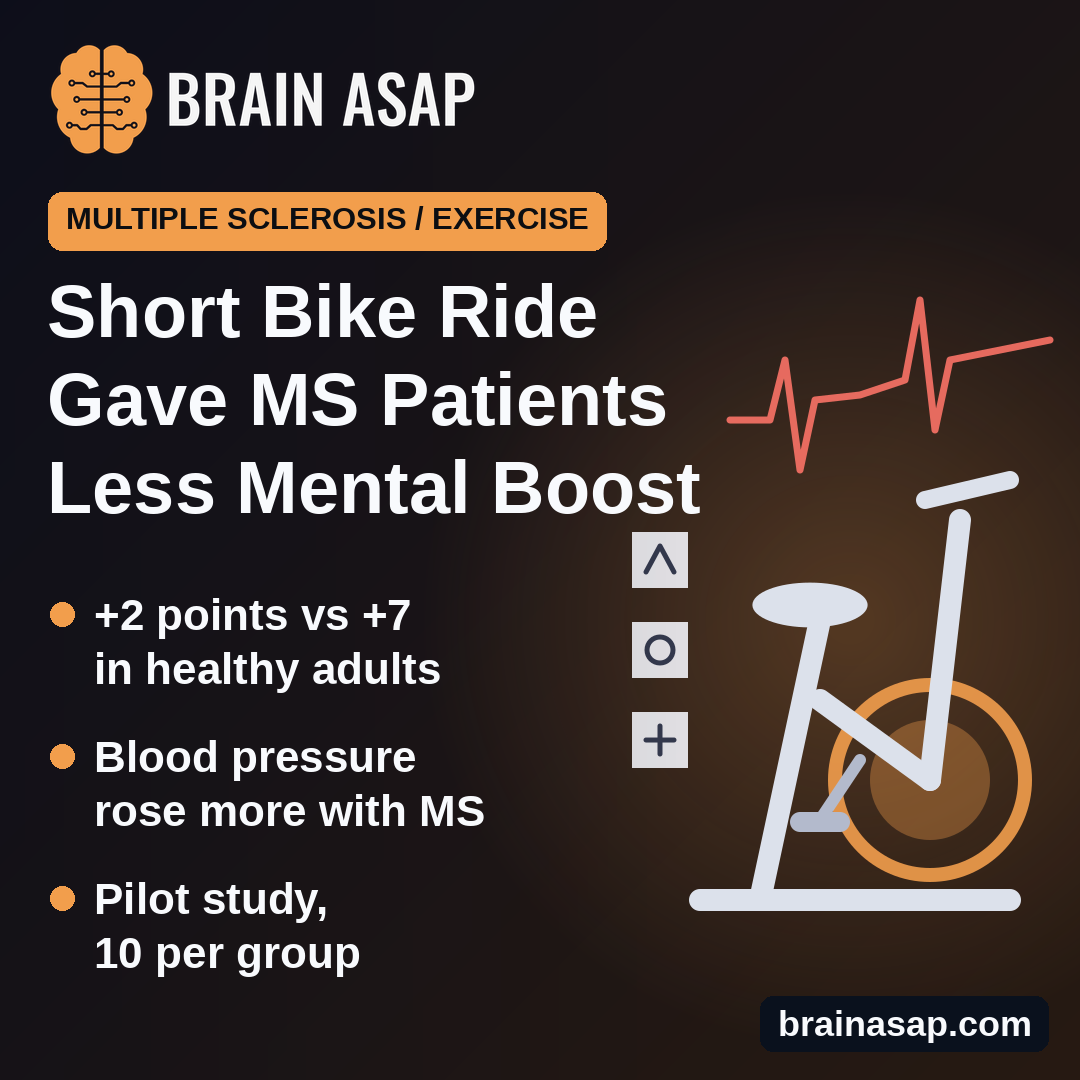
TL;DR: In a tiny pilot study, a few minutes on an exercise bike boosted thinking speed scores by about 7 points in healthy adults but only about 2 points in people with relapsing-remitting multiple sclerosis. With 10 people per group, it is an early clue, not a firm result.
Key Findings
- 20 adults: 10 with relapsing-remitting MS, 10 healthy people matched for age and sex.
- Slower at baseline: People with MS scored lower on a thinking speed test (49 vs 62).
- Smaller gain after cycling: +1.9 points with MS vs +7.0 in healthy adults.
- Bigger blood pressure jump: Systolic rose 54 vs 42 mmHg during the same workload.
- Tilting and handgrip: No clear group differences.
Source: Diseases (2026) | Racosta et al.
Slower thinking speed is one of the most common and frustrating symptoms of multiple sclerosis. Researchers increasingly suspect that blood flow and the nervous system’s control of heart rate and blood pressure play a role. One way to probe that is to stress the circulation in different ways and see what happens to thinking.
Neurologists at Western University in London, Ontario, ran exactly that test in a small pilot.
Tilts, a Hard Squeeze and a Short Ride
Ten people with relapsing-remitting MS (mild disability, all on long-term treatment) and 10 healthy volunteers, mostly women in their 30s, went through four challenges. The two tilt tests alternated order; handgrip and cycling followed:
- Head-up tilt: Lying on a table tilted to 70 degrees for 5 minutes.
- Head-down tilt: Tilted 10 degrees head-down for 5 minutes.
- Handgrip: Squeezing at a quarter of maximum strength for 4 minutes.
- Cycling: A stationary bike session of about 7 minutes, sized to give everyone the same workload based on heart rate.
Between challenges, they took the Symbol Digit Modalities Test, a 90-second spoken test that matches symbols to numbers and is widely used to track thinking speed in MS. Heart rate and blood pressure were recorded beat by beat.
Exercise Lifted Healthy Scores Much More
As expected, people with MS started slower, about 49 correct answers versus 62. Tilting and handgrip produced no clear group differences. Cycling did:
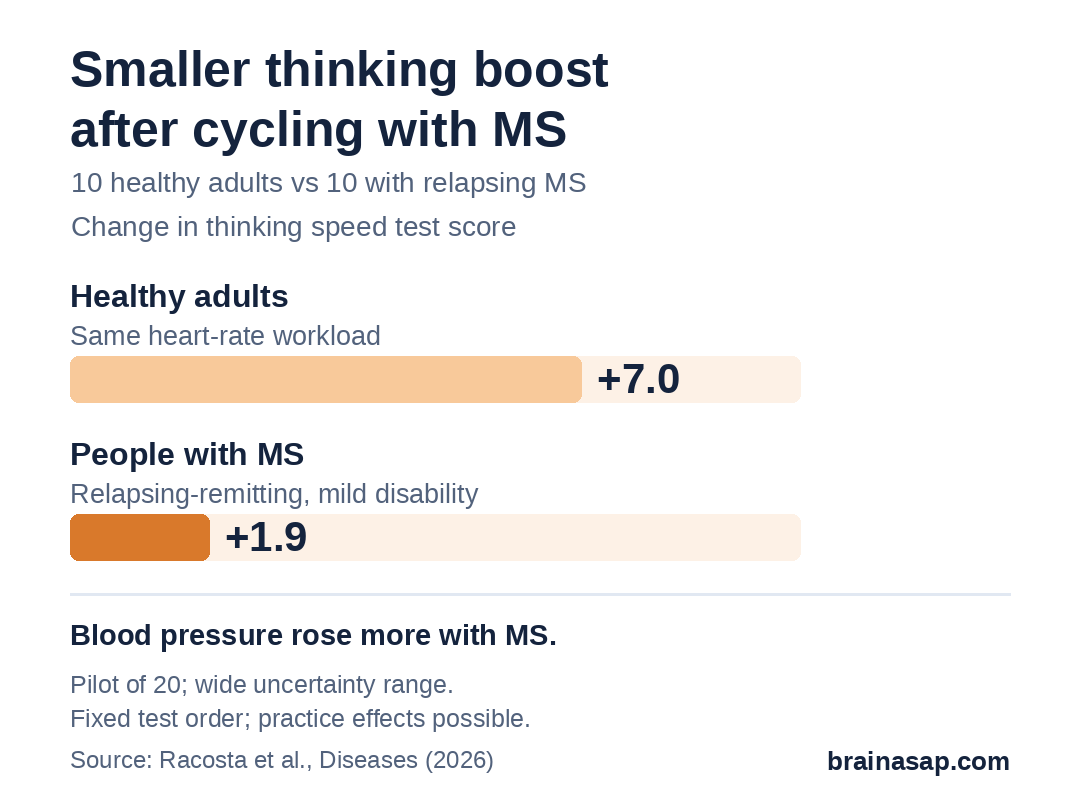
Part of any rise could reflect practice, since everyone took the test several times in the same order, a limitation the authors acknowledge.
Blood Pressure Rose More With MS
Even though both groups did the same heart-rate-based workload, systolic blood pressure climbed more in people with MS (about 54 vs 42 mmHg). In healthy adults, a smaller blood pressure rise went with a bigger thinking gain, and higher resting heart rate and blood pressure went with faster baseline scores. Those links did not appear in the MS group.
The authors suggest the normal coupling between circulation and thinking may be altered in MS, but they did not measure blood flow to the brain directly.
A Pilot With Wide Error Bars
- 10 per group: High risk of chance findings in either direction.
- No correction for many comparisons: The authors call the results hypothesis-generating.
- Fixed order: Cycling always came last, mixing practice, fatigue and exercise effects.
- Medications: Different MS drugs, and one person on several heart-affecting drugs.
- Not a treatment test: It says nothing about whether regular exercise helps thinking in MS.
Larger Studies Need to Measure Brain Blood Flow
The question this raises is whether people with MS get less of the quick mental lift that exercise usually gives, and whether blood pressure control explains it. Answering that will take bigger groups, randomized test order and direct measures of brain blood flow during exercise.
Citation: DOI: 10.3390/diseases14090343. Racosta JM, Arocha-Perez J, Seo DH, Ayromlou S, Riccio PM. Cardiovascular–cognitive associations during physiological challenges in relapsing-remitting multiple sclerosis. Diseases. 2026;14:343.
Study Design: Exploratory case-control physiology pilot with fixed-order challenges.
Sample Size: 10 adults with RRMS and 10 age- and sex-matched healthy participants.
Key Statistic: Cycling-related SDMT change 7.0 ± 6.4 (healthy) vs 1.9 ± 4.5 (MS); r = 0.49, 95% CI 0.05 to 0.76, p = 0.03.
Caveat: Very small sample, no multiplicity correction, fixed order and practice effects.