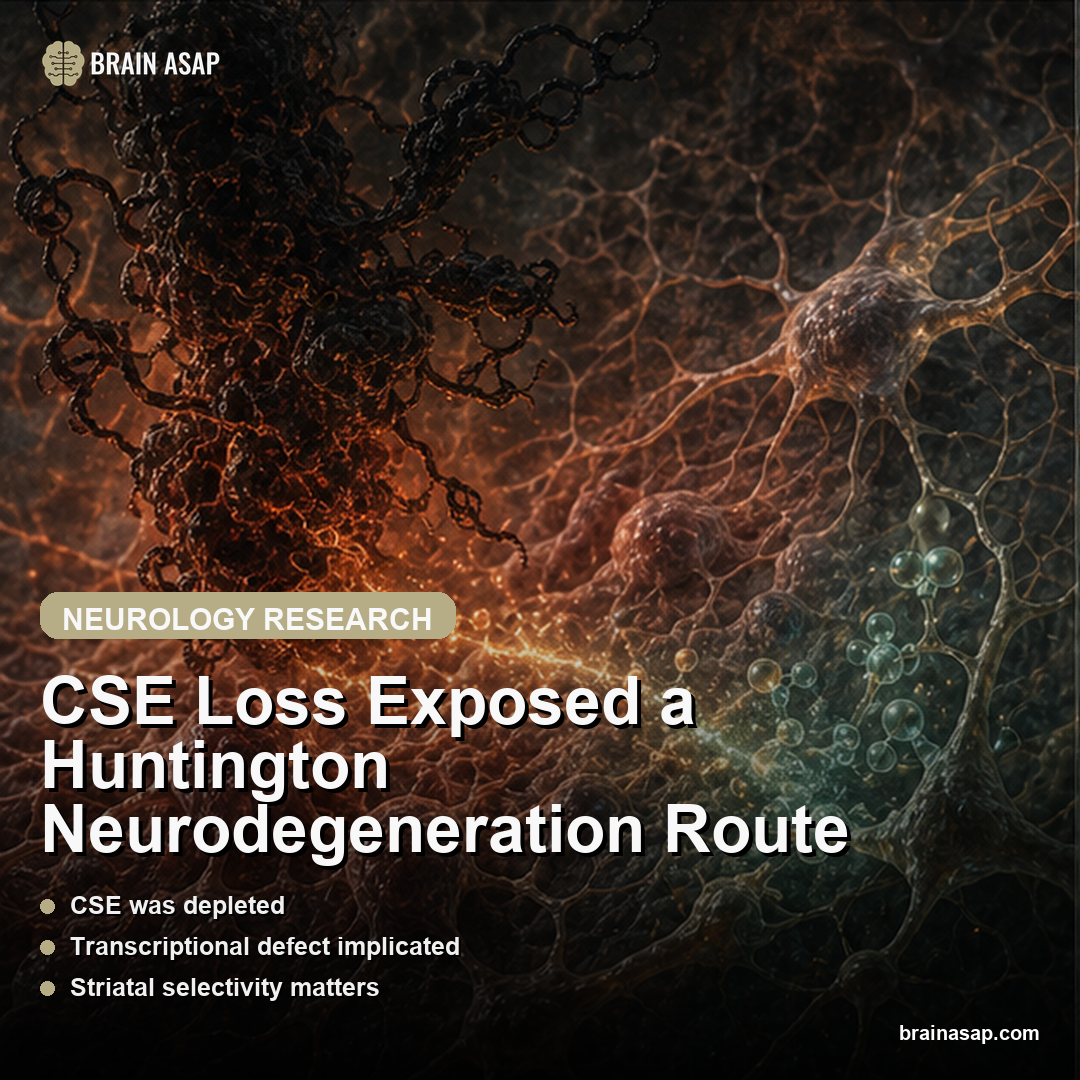
TL;DR: Huntington disease may exploit a metabolic weak point: mutant huntingtin suppresses CSE, depleting cysteine biology in vulnerable striatal tissue, while cysteine rescue reversed abnormalities in models.
Key Findings
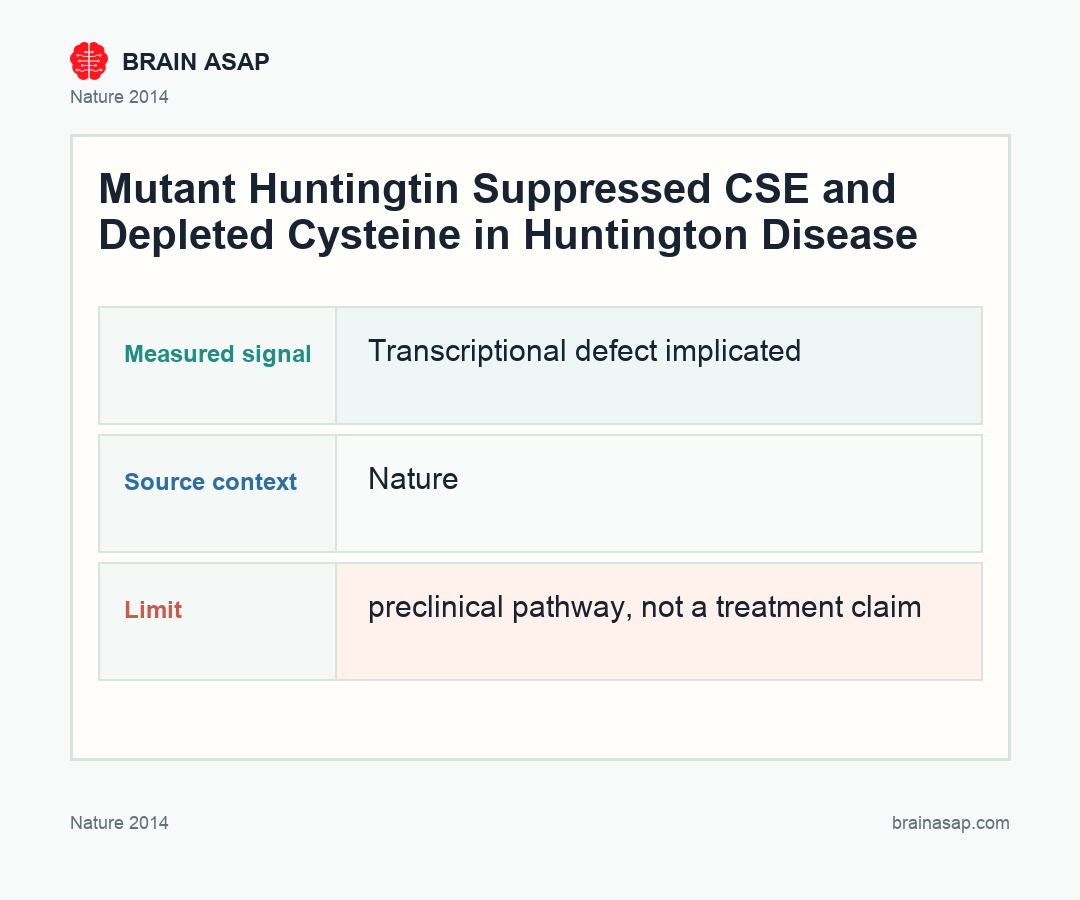
CSE was depleted: The Nature abstract reports major depletion of CSE, the cysteine-biosynthetic enzyme, in Huntington disease tissues.
Transcriptional defect implicated: The defect appeared to occur at the transcriptional level, linked to mutant huntingtin effects on specificity protein 1.
Striatal selectivity matters: The paper frames CSE loss against Huntington’s selective damage to the corpus striatum, the motor-control hub hit hard by the disease.
Cysteine rescue reversed abnormalities: Cysteine supplementation reversed abnormalities in Huntington disease tissue cultures and intact mouse models.
Therapeutic signal stays preclinical: The evidence supports a mechanism and rescue idea, not a ready human treatment.
Source: Nature (2014) | Paul et al.
The puzzle in Huntington disease has never been only the mutant gene. Cystathionine gamma-lyase, or CSE, points to a second question: why do particular neurons become so metabolically vulnerable to the mutation?
The Metabolic Weak Point Behind Mutant Huntingtin
Huntington disease is caused by a mutation in huntingtin, but the mutation does not damage every brain region equally. The striatum is hit with brutal selectivity, which has kept researchers looking for local vulnerabilities that make some neurons less able to cope.
CSE offers one such vulnerability. It helps make cysteine, a sulfur-containing amino acid tied to antioxidant defenses and cellular stress handling.
That framing is useful because Huntington disease has always had a gap between genetic cause and tissue pattern. Every cell carries the mutant huntingtin gene, but the motor and cognitive syndrome reflects the collapse of particular circuits.
A metabolic weakness in striatal tissue gives researchers a way to connect those levels: mutant protein, altered transcription, depleted stress-buffering chemistry, and selective neuronal injury.
CSE Depletion Turned a Gene Mutation Into a Stress Problem
Paul and colleagues reported major depletion of CSE in Huntington disease tissue. Mechanistically, the authors linked that loss to transcriptional disruption: mutant huntingtin appeared to interfere with specificity protein 1, a transcriptional activator for CSE.
That creates a plausible bridge between a genetic mutation and a metabolic failure. The disease signal is not just toxic protein buildup; it is also the loss of a biochemical support system that neurons often need under stress.
Cysteine is central here because it feeds several stress-defense systems. It contributes to glutathione production, redox balance, sulfur metabolism, and the ability of cells to buffer oxidative injury. A striatal neuron losing that support may become more vulnerable to the same mutant huntingtin burden carried elsewhere in the brain.
The transcriptional step is also important because it places CSE loss downstream of mutant huntingtin rather than treating it as a random metabolic abnormality. If mutant huntingtin interferes with a transcription factor that normally supports CSE expression, the enzyme deficit becomes part of the disease mechanism.
Cysteine Rescue Strengthened the Mechanistic Case
The most important line in the abstract is the rescue experiment. Supplementing cysteine reversed abnormalities in Huntington tissue cultures and in intact mouse models.
That does not make cysteine a proven treatment for Huntington disease. It does make the pathway biologically persuasive, because restoring a downstream metabolite softened the phenotype in model systems.
- Upstream hit: mutant huntingtin disrupted transcriptional support for CSE.
- Metabolic consequence: lower CSE reduced cysteine-related stress-buffering capacity.
- Rescue test: cysteine supplementation reversed abnormalities in model systems.
- Translation limit: a rescue signal in cultures and mice still has to clear human dosing, safety, and brain-delivery questions.
The rescue logic is important because it tests directionality. If the pathway were only a marker of dying tissue, adding cysteine would be less likely to improve disease-relevant abnormalities.
The result also separates cysteine biology from a generic nutrition claim. The paper is not saying that Huntington disease is caused by an ordinary dietary shortage. It is saying mutant huntingtin may suppress a biosynthetic route that vulnerable neurons use to maintain redox balance and stress resistance.
That distinction changes the experimental burden. A clinical strategy would need to show target engagement in the nervous system, not simply raise cysteine availability in blood.
Why the Striatum Remains the Central Clue
the findings also point to Rhes, a small protein enriched in the striatum that can bind mutant huntingtin and enhance toxicity. CSE depletion may therefore sit inside a larger map of striatal vulnerability rather than acting as a lone explanation.
Selective neuronal death may come from the collision between a disease mutation and a tissue-specific metabolic context. In Huntington disease, the mutation is everywhere, but the striatum may be less able to absorb the downstream metabolic stress.
That is the broader neurodegeneration lesson. A mutation can be global while the breaking point is local, determined by cell type, metabolic demand, protein-handling capacity, and regional signaling partners.
The striatum is also metabolically busy. Its neurons integrate movement, reward, and habit circuitry, and they operate inside networks where small changes in stress buffering can have large effects on signaling stability.
CSE Loss Still Needs Human Treatment Testing
The model evidence supports a mechanism, not a ready supplement protocol. Human treatment would need dosing, safety, target engagement, brain delivery, disease-stage selection, and evidence that cysteine biology changes outcomes beyond laboratory rescue.
The study still changes the disease map. CSE loss gives Huntington disease a sulfur-metabolism route, and cysteine rescue in models suggests the route is experimentally actionable.
Human testing would need to show more than biomarker movement. Researchers would need evidence that the intervention changes striatal function, motor behavior, cognition, or disease progression while avoiding toxicity from pushing sulfur metabolism too far.
How to Read the CSE-Huntington Evidence
The evidence base is a mechanistic Huntington disease study using human disease tissue, Huntington model systems, and cysteine-rescue experiments. That design supports pathway biology more strongly than clinical recommendation.
The important boundary is translational. Reversing abnormalities in tissue culture and mouse models does not establish whether oral, injectable, or diet-based cysteine manipulation can safely change human Huntington disease progression.
The core finding is CSE depletion in Huntington disease tissue and cysteine rescue in cultures and mouse models. That is enough to justify deeper testing of sulfur metabolism, but not enough to recommend self-directed cysteine supplementation.
Clinical translation would also have to account for disease timing. A metabolic support strategy may work differently before major striatal degeneration than after neuronal loss is already extensive.
Where the Paul Result Fits Next
The larger value is the way CSE connects mutant huntingtin to a concrete metabolic support pathway. Huntington disease is still genetic at its root, but this result makes the downstream damage look less like a black box and more like a pathway that can be stressed, measured, and potentially buffered.
The next step is experiments that clarify whether cysteine support changes disease-relevant outcomes beyond model-system rescue. Any human-facing claim would need dosing, safety, target engagement, and disease-stage logic.
Those experiments could include patient-derived neurons, striatal organoids, and animal studies that measure whether CSE restoration changes oxidative stress, synaptic function, motor phenotypes, and survival. The strongest version would test whether restoring the pathway helps before irreversible striatal loss, when a metabolic buffer still has tissue to protect.
The pathway also gives researchers a sharper biomarker question. If CSE loss is central to the mechanism, future studies should be able to track cysteine-related redox markers, CSE expression, or downstream stress responses alongside motor and cognitive outcomes.
Paper: Cystathionine gamma-lyase deficiency mediates neurodegeneration in Huntington's disease. Nature. 2014;509:96-100. DOI: 10.1038/nature13136
Authors: Paul et al.
Study Design: Mechanistic Huntington disease study using human disease tissue, Huntington model systems, and cysteine-rescue experiments.
Sample Size: Human Huntington disease tissue, Huntington model systems, and cysteine-rescue experiments.
Key Statistic: CSE depletion was reported in Huntington disease tissue, and cysteine supplementation reversed abnormalities in cultures and mouse models.