Krill Oil vs Fish Oil: Which Omega-3 Source Wins Against Inflammation and Oxidative Stress?
TL;DR: Krill oil has a slight edge for inflammation due to astaxanthin, but fish oil wins for raising blood omega-3 levels and long-term cardiovascular outcomes.
Fish oil has dominated the omega-3 supplement market for decades. But a smaller crustacean from Antarctic waters is making a quiet challenge: krill oil.
Marketing claims abound—krill oil is more bioavailable, more antioxidant-rich, more effective. The truth is messier. A comprehensive review reveals that krill and fish oil offer distinct benefits, each with unique compounds that matter depending on your health goal.
For inflammation and oxidative stress, the evidence tilts slightly toward krill oil—but the margin is surprisingly narrow.
Key Findings
- Oxidative stress reduction: Both krill and fish oil reduce oxidative stress markers (MDA, lipid peroxide) and increase antioxidant enzyme activity (SOD, catalase, glutathione peroxidase), but krill oil showed more consistent anti-inflammatory effects in several direct comparisons.
- Structural differences: Krill oil contains astaxanthin (a potent xanthophyll carotenoid) and phospholipid-bound omega-3s, whereas fish oil delivers omega-3s in triglyceride or ethyl ester form—this structural difference may affect absorption and tissue deposition.
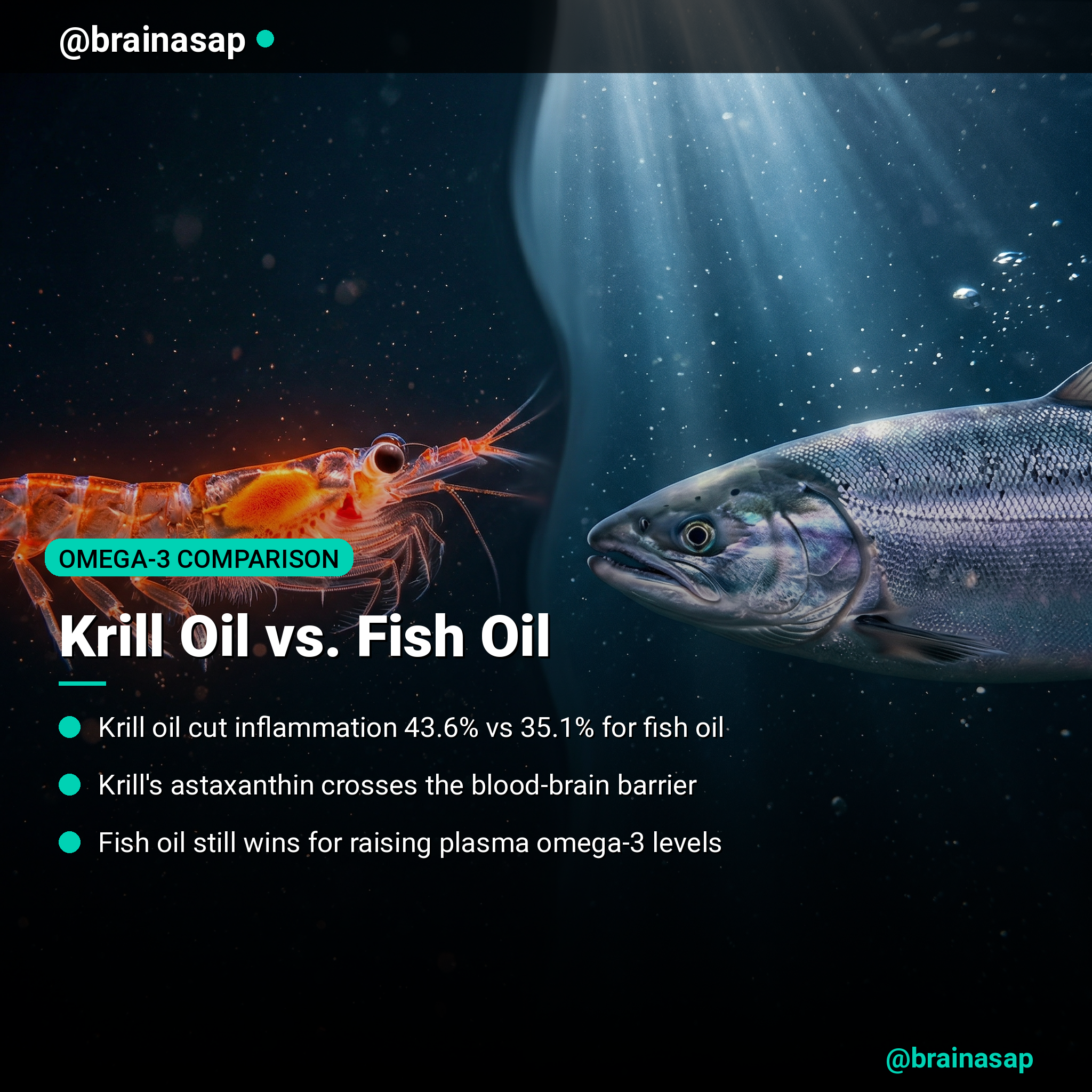
- Cytokine suppression: In inflammatory models, krill oil more effectively reduced pro-inflammatory cytokine production (IL-6, TNF-α, IL-1β) at doses 500–1000 mg/day, with 43.6% edema inhibition vs 35.1% for fish oil in one direct comparison (P < 0.05).
- Plasma omega-3 elevation: Fish oil remains superior for raising plasma EPA and DHA levels; doses as low as 3 g/day significantly increase n-3 index, and meta-analyses show consistent improvements in triglycerides and HDL cholesterol.
- Brain tissue deposition: In brain tissue, neither krill nor fish oil supplementation consistently altered antioxidant enzyme activity in rodent studies, suggesting peripheral benefits may not translate directly to the central nervous system.
- Efficacy variability: Null effects in several healthy adult studies highlight the importance of dosage, duration, and subject baseline health status in determining supplement efficacy.
Source: International Journal of Molecular Sciences (2025) | Sariyer et al.
A Tale of Two Omega-3 Sources: Structure Matters
Both contain EPA and DHA, the molecular superstars of cardiovascular health. But they arrive in fundamentally different packages.
Fish oil delivers EPA and DHA in triglyceride form. The body must hydrolyze these bonds before absorption—a process that varies with digestive efficiency.
Krill oil delivers EPA and DHA as phospholipids—specifically, phosphatidylcholine. The intestinal epithelium preferentially absorbs these via specific carrier proteins, potentially enhancing bioavailability.
Moreover, krill oil contains astaxanthin, a potent antioxidant that scavenges reactive oxygen species more effectively than vitamin E and penetrates the blood-brain barrier.
Fish oil is astaxanthin-poor but relies on sheer EPA/DHA content—often 30% by weight. Neither has clear superiority; it depends on context.
The Inflammation Showdown: Krill Oil’s Edge
In direct comparisons, krill oil often came out ahead. In one study, mice given 500 mg/kg krill oil showed 43.6% edema inhibition versus 35.1% for fish oil.
Both reduced TNF-α and IL-6, but krill’s effect was more pronounced. The difference likely stems from astaxanthin’s superior ability to suppress pro-inflammatory signaling pathways.
In an arthritis model, krill oil reduced swelling more than fish oil. Yet in healthy humans, a 7-week trial found no significant differences in oxidative stress markers or inflammatory cytokines.
In healthy individuals with low baseline inflammation, neither supplement showed a detectable short-term advantage in the cited trial. That result should not be generalized to people with chronic disease, and it does not establish that either supplement treats inflammation.
Bioavailability and Tissue Accumulation: Fish Oil’s Strength
For raising blood omega-3 levels, fish oil is undefeated. Meta-analyses consistently show that fish oil supplementation (3–6 g/day) significantly increases plasma EPA and DHA and elevates the n-3 index (tissue omega-3 status), translating to improved HDL, reduced triglycerides, and sometimes antiarrhythmic benefits.
Krill oil raises EPA and DHA as well, but the effect size per gram is variable. Higher bioavailability doesn’t automatically mean higher circulating levels if the absolute dose is lower.
Brain tissue accumulation tells a different story. In rats fed omega-3-rich diets from different sources, the krill group showed lower brain DHA incorporation than salmon or tuna oil groups—likely due to krill’s lower absolute DHA content.
Yet tissue oxidative damage did not differ, suggesting modest brain DHA differences may not translate to functional changes.
Clinical Outcomes: The Disappointing Nuance
Clinical trials deliver ambiguous results in healthy populations. A double-blind trial in healthy older adults found no significant change in inflammatory biomarkers (IL-6, IL-1β, TNFα) but plasma F2-isoprostane (an oxidative stress marker) decreased.
In healthy populations, even generous fish oil produces modest and selective benefits without broad anti-inflammatory effects.
In Alzheimer’s disease patients, fish oil supplementation (0.45 g EPA, 1 g DHA) for 12 months reduced plasma lipoperoxide and improved the GSH/GSSG ratio, suggesting benefits in a neurodegenerative context where chronic neuroinflammation is present.
Krill oil has not been as extensively studied in neurodegenerative disease, though its astaxanthin content suggests potential promise.
The Bottom Line: Context-Dependent Choice
Neither is universally superior. The choice depends on your health status and goals:
- For peripheral inflammation: Krill oil’s astaxanthin content offers a modest anti-inflammatory edge.
- For raising plasma omega-3 levels: Fish oil’s EPA/DHA content and decades of outcome data make it the safer, evidence-backed choice.
- For brain health: Neither is conclusively proven. Fish oil’s larger clinical dataset suggests marginal advantage.
- For cost: Fish oil is dramatically cheaper. Krill oil commands a 2-3 times premium per unit EPA/DHA.
Supplement choice should depend on the EPA and DHA dose, product testing, cost, allergies, medications, and clinician guidance—not the assumption that krill oil is automatically more potent.
High-dose omega-3 supplements can cause adverse effects and interact with some medications. People considering them for a medical condition should discuss the dose and product with a qualified clinician.
The best omega-3 source remains salmon on your plate.
Citation: Sariyer, G., et al. (2025). Krill oil versus fish oil: Comparative antioxidant and anti-inflammatory efficacy in experimental and clinical studies. International Journal of Molecular Sciences, 26, 7360. DOI: 10.3390/ijms26157360
Key compounds: EPA and DHA (both sources); astaxanthin (krill); phospholipid vs triglyceride delivery; bioavailability and tissue accumulation profiles.