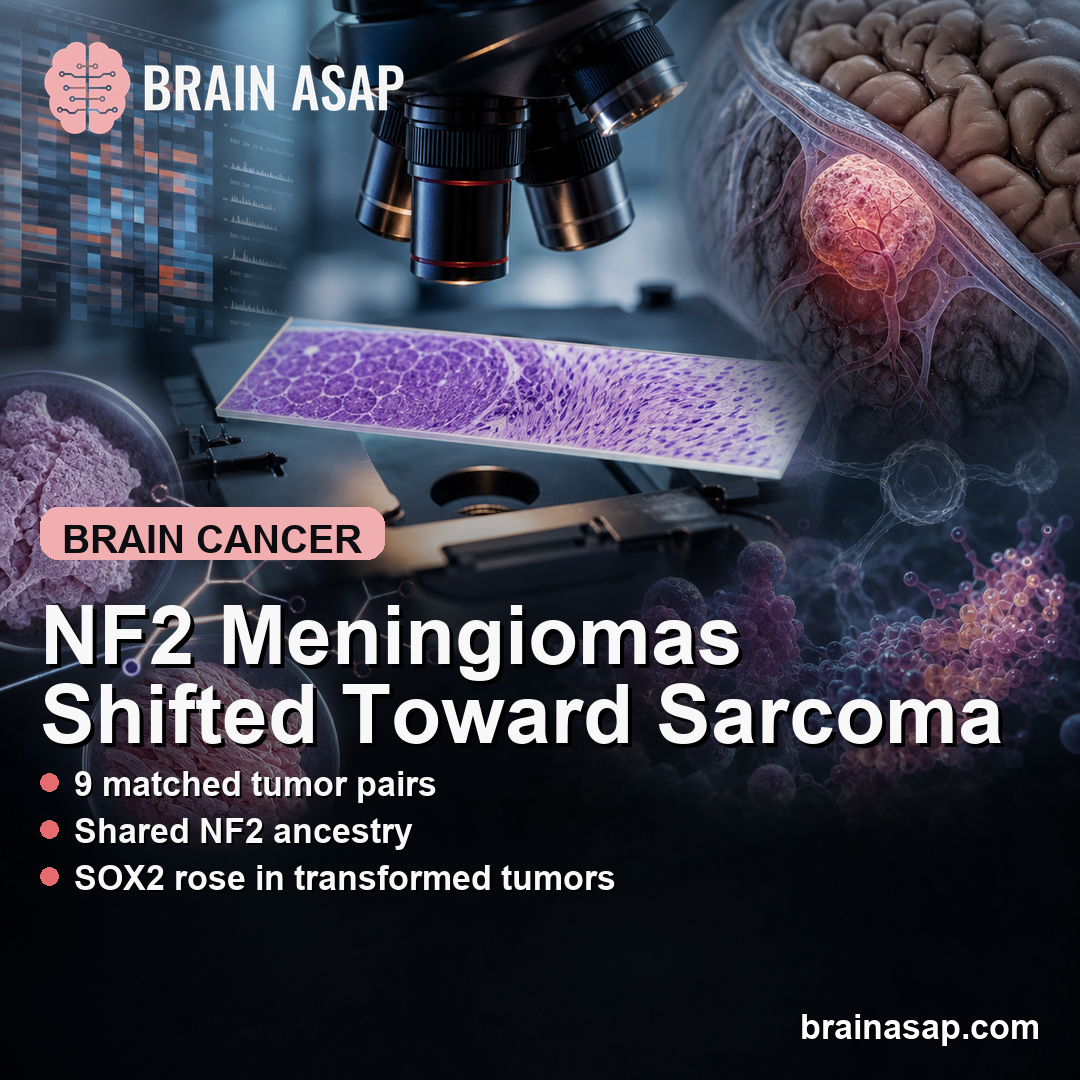
TL;DR: A 2026 study in Acta Neuropathologica found that rare NF2-mutant meningiomas can transform into aggressive sarcoma-like tumors while keeping clonal ancestry but losing normal meningioma molecular identity.
Key Findings
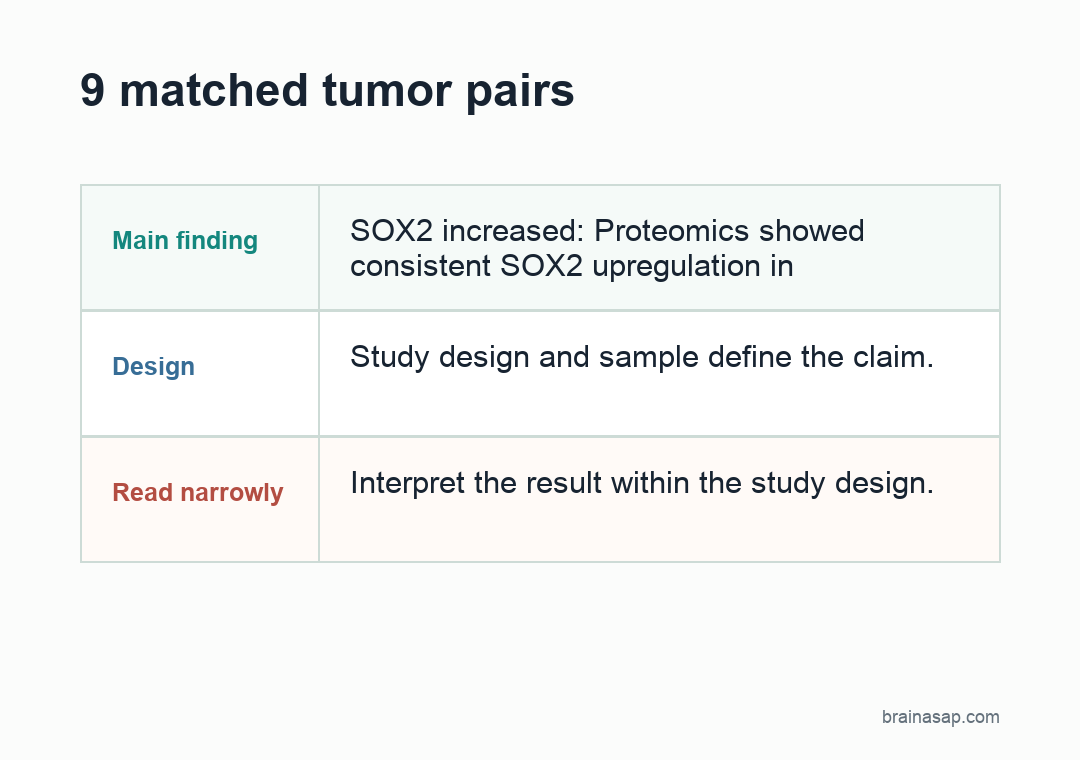
- 9 matched tumor pairs: Researchers analyzed nine matched meningioma-sarcoma pairs with histology, immunohistochemistry, DNA methylation, sequencing, copy-number profiling, and proteomics.
- Shared NF2 ancestry: Sarcomatous recurrences shared identical NF2 alterations and overlapping chromosomal changes with their meningioma precursors.
- 4 non-radiotherapy cases: Sarcomatous transformation occurred in four cases without prior radiotherapy, so the shift was not only a radiation-associated phenomenon.
- Meningioma identity was lost: Recurrent sarcomatous tumors lost meningothelial markers and shifted toward non-meningothelial mesenchymal methylation profiles.
- SOX2 increased: Proteomics showed consistent SOX2 upregulation in sarcomatous tumors compared with their matched primary meningiomas.
Source: Acta Neuropathologica (2026) | Rahmanzade et al.
Meningiomas usually arise from the meninges, the membranes around the brain and spinal cord. Most are not sarcomas, and many behave far less aggressively than malignant brain tumors.
Rahmanzade et al. studied an unusual endpoint: NF2-mutant meningiomas that recurred as sarcoma-like intracranial tumors.
The analysis separated three possibilities: extreme anaplastic meningioma, unrelated sarcoma, or a distinct transformation state.
Matched Meningioma-Sarcoma Pairs Traced Tumor Ancestry
The core dataset included nine matched meningioma-sarcoma pairs. That paired design let researchers compare a patient’s original meningioma with the later sarcomatous recurrence rather than guessing from a single tumor sample.
The team used integrated molecular diagnostics, not morphology alone. The analysis included DNA methylation profiling, next-generation sequencing, copy-number profiling, proteomics, and histopathological review.
- DNA methylation: This epigenetic profiling tested whether recurrent tumors still resembled canonical meningiomas.
- Sequencing: Shared mutations helped establish whether the sarcoma-like tumor came from the earlier meningioma.
- Copy-number profiling: Chromosomal gains and losses provided another clonal fingerprint.
- Proteomics: Protein-level changes helped identify biological programs that emerged during transformation.
The design directly addresses a diagnostic problem. A recurrent intracranial sarcoma can resemble a soft-tissue sarcoma under the microscope, while ancestry shapes classification, prognosis, and future treatment research.
NF2 Alterations Showed Clonal Continuity Despite Identity Loss
The strongest ancestry evidence came from NF2, a tumor-suppressor gene often altered in meningioma. Sarcomatous recurrences shared identical NF2 alterations with their meningioma precursors, along with overlapping chromosomal aberrations.
That means the recurrent tumors were not random new sarcomas appearing in the same region. They were clonally related descendants of the earlier meningiomas.
- Clonal continuity: Shared NF2 and chromosomal patterns tied the sarcoma-like tumors to their paired meningiomas.
- Biological divergence: Despite that ancestry, the recurrences diverged histologically, immunophenotypically, and epigenetically.
- Classification tension: The tumors had meningioma roots but showed malignant sarcoma features rather than conventional high-grade meningioma behavior.
The combination is the finding. These tumors kept the genetic breadcrumb trail of meningioma origin while losing much of the molecular identity that usually makes a meningioma recognizable.
Sarcomatous Transformation Was Not Only a Radiotherapy Effect
Radiation can contribute to secondary sarcomas, so one obvious concern is whether these were mostly treatment-related tumors. The study complicates that explanation: sarcomatous transformation occurred in four cases without prior radiotherapy.
That does not remove radiation as a possible factor in other cases. It does show that NF2-mutant meningiomas can reach this sarcoma-like endpoint without radiation exposure being required.
- Spontaneous possibility: Some transformations occurred without known radiotherapy history.
- Rare endpoint: The transformation appears uncommon, but the matched-pair analysis makes it biologically credible.
- Aggressive phenotype: Sarcomatous recurrences were associated with aggressive growth, early recurrence, and extracranial metastases.
Clinically, behavior carries more weight than the label alone. A tumor with meningioma ancestry but sarcoma-like recurrence and metastasis may not fit comfortably inside ordinary meningioma grading assumptions.
Methylation Profiles Shifted Away From Canonical Meningioma
The identity loss was visible in multiple layers. Sarcomatous recurrences lost meningothelial markers and acquired cytokeratin and myogenic marker expression, meaning the immunohistochemical pattern no longer matched a standard meningioma.
DNA methylation profiling went further. The recurrent tumors shifted away from canonical meningioma signatures toward profiles resembling non-meningothelial mesenchymal tumors.
- Meningothelial markers fell: The recurrent tumors no longer retained the marker pattern expected from ordinary meningioma cells.
- Mesenchymal direction emerged: Methylation profiles moved toward non-meningothelial mesenchymal tumor classes.
- SOX2 rose: Proteomic analysis showed consistent SOX2 upregulation, suggesting a stem-like program during lineage divergence.
SOX2 is a transcription factor linked to stemness and cellular plasticity in several tumor contexts. In this study, its increase supports lineage-state change in the transformed tumors, not only escalation within the usual meningioma grade spectrum.
Integrated Molecular Diagnosis May Matter for Rare Brain Tumors
The study also analyzed an institutional cohort of 316 NF2-mutant intracranial tumors. That broader comparison suggested that sarcomas with inactivating NF2 mutations may sometimes originate from meningiomas even when no precursor is clinically recognized.
The diagnostic consequence is direct. If a sarcoma-like intracranial tumor carries NF2 inactivation, molecular context may help determine whether it represents a transformed meningioma lineage rather than an unrelated sarcoma.
- Small cohort caveat: The matched-pair evidence is detailed but based on nine pairs, so the entity needs continued case accumulation.
- Diagnostic caveat: Molecular profiling helps, but treatment decisions still need clinical, surgical, and pathology context.
- Classification caveat: Current grading schemes may not fully capture sarcoma-like behavior in tumors with meningioma ancestry.
The diagnostic claim is specific. In rare NF2-mutant meningiomas, aggressive sarcoma-like recurrence can preserve clonal ancestry while shedding meningioma identity.
Integrated molecular diagnosis is central in this setting. It may be the only way to name what the tumor has become.
Citation: DOI: 10.1007/s00401-026-03016-3. Rahmanzade et al. Loss of meningothelial identity and mesenchymal fate switching in NF2-mutant meningiomas. Acta Neuropathologica. 2026;151:46.
Study Design: Integrated histopathological and multiomics analysis of matched meningioma-sarcoma tumor pairs, with DNA methylation, sequencing, copy-number profiling, immunohistochemistry, and proteomics.
Sample Size: Nine matched meningioma-sarcoma pairs, plus an institutional comparison cohort of 316 NF2-mutant intracranial tumors.
Key Statistic: Sarcomatous transformation occurred in four cases without prior radiotherapy, and transformed tumors shared identical NF2 alterations with their meningioma precursors.
Caveat: The matched cohort is small because the transformation is rare, so the classification and treatment implications need confirmation as more cases are profiled.