TL;DR: A 2026 medRxiv preprint found that problematic sexual behaviour was associated with non-suicidal self-injury in a university cohort, with the strongest pattern in women.
Key Findings
- 2,666 people were analyzed: The study included 2,189 university participants and 477 clinical patients with problematic sexual behaviour.
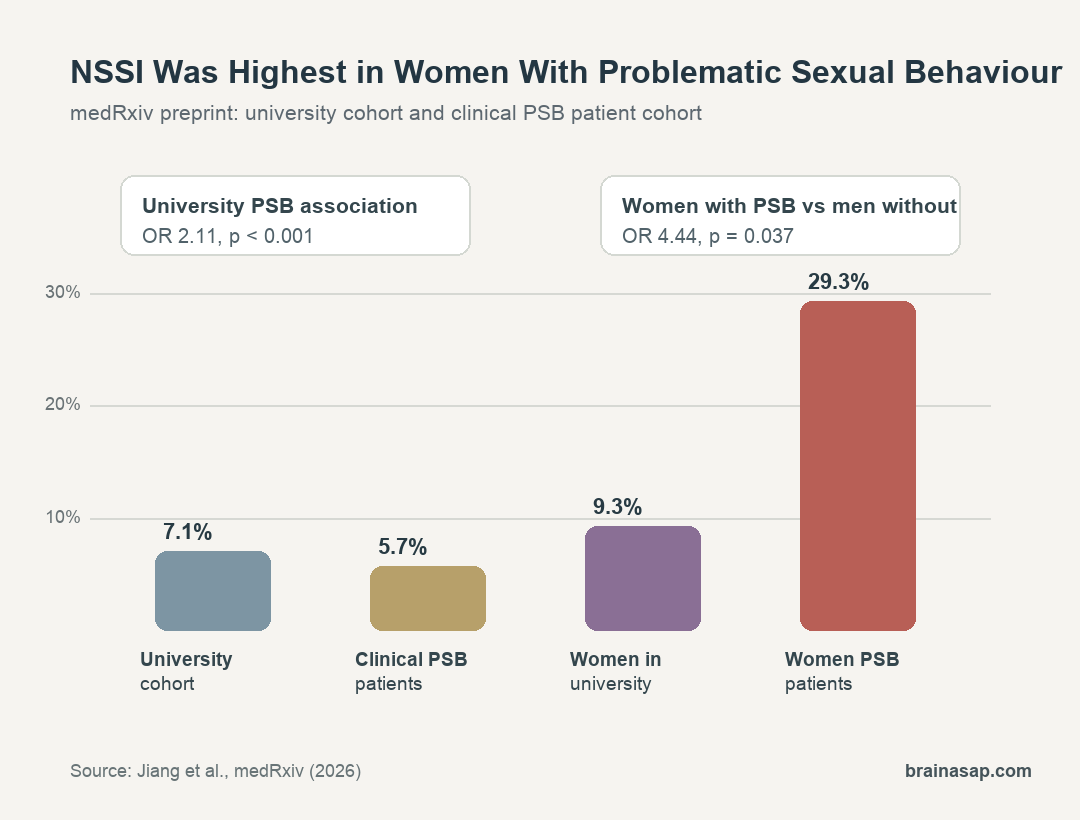
- NSSI rates were similar overall: Non-suicidal self-injury was reported by 7.1% of the university cohort and 5.7% of the clinical PSB cohort.
- Women PSB patients stood out: NSSI was reported by 29.3% of women in the PSB patient cohort versus 9.3% of women in the university cohort.
- University PSB was associated with NSSI: In the university cohort, PSB was linked to NSSI with OR = 2.11 and p < 0.001.
- Preoccupation mattered in women: Among university women, the PSB preoccupation dimension was associated with NSSI at p < 0.001.
Source: medRxiv preprint (2026) | Jiang et al.
NSSI and Problematic Sexual Behaviour Overlapped Most in Women
Non-suicidal self-injury (NSSI) means deliberate self-injury without suicidal intent. The paper treats it as distinct from suicidal behavior, while still clinically serious.
Problematic sexual behaviour (PSB) was measured with the Sexual Addiction Screening Test-Revised Core, a questionnaire focused on compulsive or impairing sexual behavior patterns.
Jiang and coauthors studied whether these two behaviors overlap across a non-clinical university sample and a clinical PSB patient sample.
The total dataset included 2,189 university participants and 477 PSB patients. The main result was not a simple “clinical patients had more NSSI” pattern.
Overall NSSI rates were close: 7.1% in the university group and 5.7% in the clinical PSB group.
Women PSB Patients Had a 29.3% NSSI Rate
The sex-stratified result changed the interpretation. Among women, NSSI was much more common in the clinical PSB cohort than in the university cohort.
The comparison was 29.3% among women PSB patients versus 9.3% among university women. Among men, NSSI rates were low in both groups and did not differ significantly.
The subgroup result puts the PSB-NSSI overlap mainly in women rather than spreading it evenly across all people with problematic sexual behaviour.
- Women PSB patients: elevated NSSI prevalence compared with university women.
- Men in both cohorts: low NSSI rates and no significant cohort difference.
- Clinical sample caution: the PSB patient group was older and predominantly male, which affects overall prevalence comparisons.
The two cohorts were not interchangeable. The university group captured younger adults in a broad campus sample, while the clinical cohort captured people already seeking care for PSB.
This design makes the sex-specific comparison more useful than the overall cohort average.
University PSB Was Linked to NSSI With OR 2.11
In the university cohort, PSB presence was associated with NSSI, with OR = 2.11 and p < 0.001. Younger age, female gender, and childhood trauma were also associated with NSSI.
When the model included a gender-by-PSB interaction, the PSB main effect was no longer significant, but the interaction identified a higher-risk subgroup.
Women with PSB had 4.44 times higher odds of NSSI than men without PSB. The predicted probability of NSSI was 0.17 for women with PSB, compared with 0.075 for women without PSB and 0.036 for men without PSB.
Pairwise comparisons also showed that women with PSB had a higher predicted NSSI probability than women without PSB, men with PSB, and men without PSB.
The study also separated PSB as a yes-or-no screen from PSB symptom dimensions.
A broad positive screen can point to risk, while the dimension scores can help identify which part of the behavior pattern carries the clearest association.
PSB Severity Did Not Track NSSI in Clinical Patients
The clinical PSB cohort did not show the same severity relationship. In PSB patients, PSB severity was not associated with NSSI, with OR = 1.10 and p = 0.25.
NSSI still mattered clinically in that group. Among people already in a PSB patient sample, however, more severe PSB scores did not clearly separate who had NSSI history.
Several cohort features help explain the difference:
- Age difference: the clinical cohort had a mean age of 43.6, while the university cohort had a mean age of 21.9.
- Sex distribution: the clinical PSB cohort was predominantly male, and male NSSI rates were low in this dataset.
- Childhood trauma: trauma was common in both cohorts and strongly associated with NSSI.
Childhood trauma also differed by sex in clinically relevant ways. In the university cohort, NSSI was reported by 10.6% of women with childhood trauma history and 6.0% of men.
In the clinical PSB cohort, childhood trauma history was common among both women and men, which complicates any simple severity-only explanation.
Preoccupation Was the PSB Dimension Linked to NSSI in Women
The researchers also examined PSB dimensions: relationship disturbance, loss of control, preoccupation, and affect disturbance.
The clearest dimension-level association appeared in university women. PSB preoccupation, meaning persistent obsessive thoughts about sexual behavior or fantasies, was associated with NSSI at p < 0.001.
The result fits a broader mental-health interpretation. NSSI and PSB can both involve emotion regulation, distress, shame, and maladaptive coping, but this preprint does not prove one behavior causes the other.
Three caveats are important:
- Preprint status: the paper had not been certified by peer review.
- Cross-sectional design: associations cannot establish timing or causality.
- Self-report measurement: NSSI and PSB were assessed by questionnaires, which can be affected by disclosure and stigma.
A careful clinical response is screening, not diagnosis by assumption. In women presenting with PSB or NSSI, clinicians may need to ask carefully about both domains, trauma history, and current distress.
Citation: DOI: 10.64898/2026.04.17.26351044. Jiang et al. Exploring the Relationship Between Non-Suicidal Self-Injury and Problematic Sexual Behaviour. medRxiv. 2026.
Study Design: Cross-sectional analysis of a university cohort and a clinical problematic-sexual-behaviour patient cohort.
Sample Size: 2,189 university participants and 477 clinical PSB patients.
Key Statistic: Women with PSB in the university cohort had 4.44 times higher odds of NSSI than men without PSB; women PSB patients had 29.3% NSSI prevalence.
Caveat: The preprint is observational and not peer reviewed, so it cannot establish causal direction or guide treatment by itself.