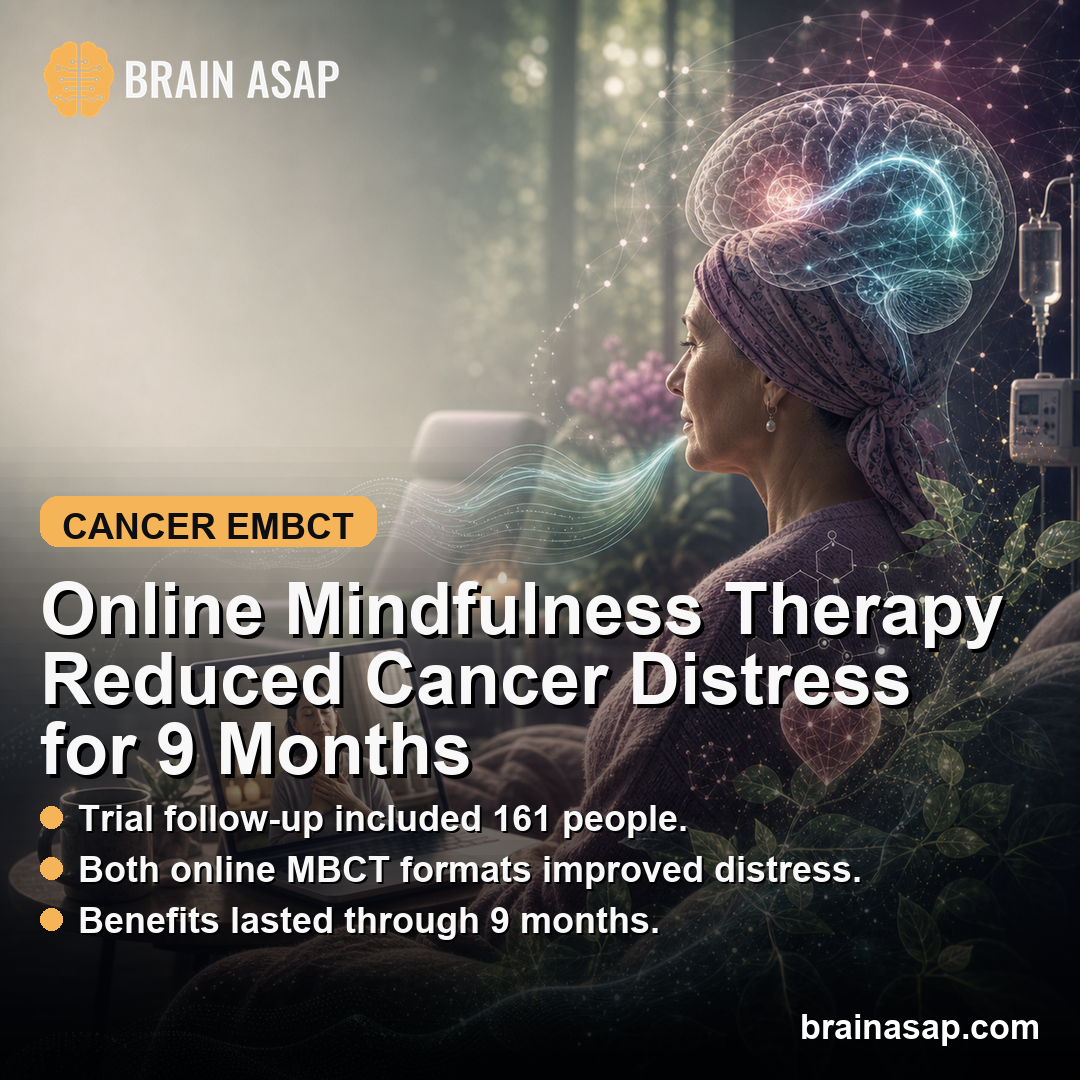
TL;DR: A 2026 secondary randomized-trial analysis in Journal of Medical Internet Research found that both online MBCT formats reduced psychological distress and improved well-being through 9 months, while people with fewer psychological resources appeared to gain larger benefits.
Key Findings
- Study type: a long-term follow-up of two online mindfulness-based cognitive therapy formats for people with cancer.
- People studied: 161 people assigned to group-blended eMBCT or individual-unguided eMBCT.
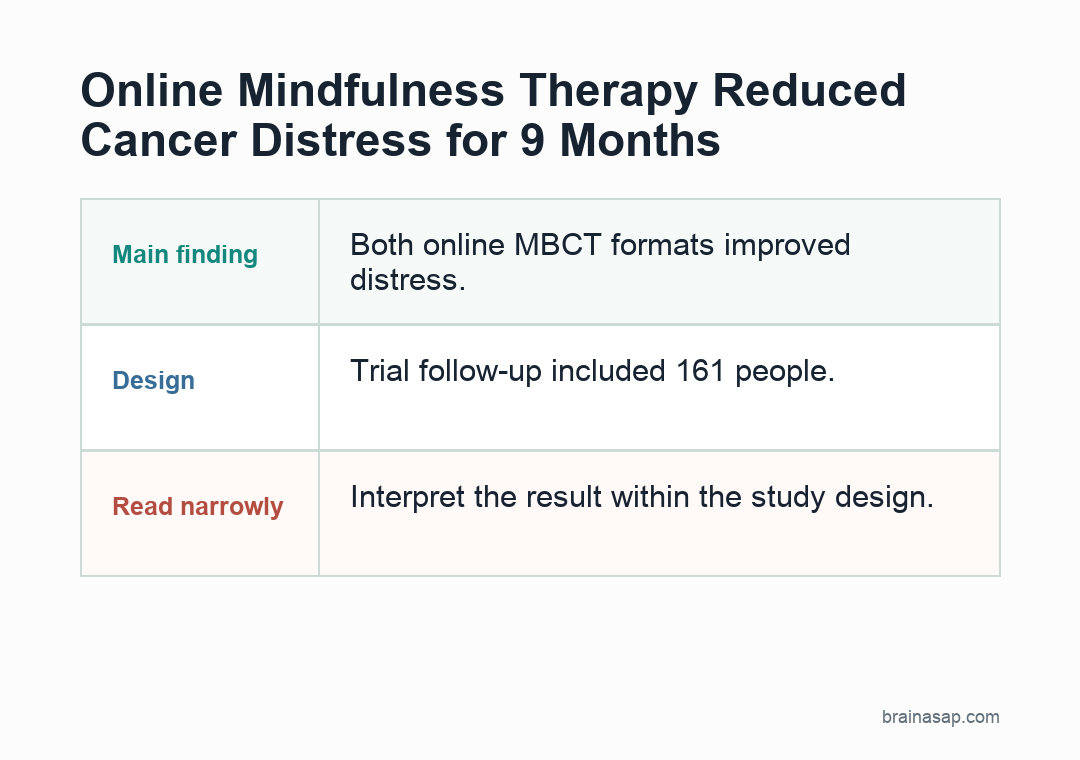
- Main result: Both online MBCT formats reduced psychological distress and improved well-being through 9 months.
- Second result: People with fewer psychological resources appeared to gain larger benefits.
- Caution: The long-term comparison focused on two active online formats rather than a fresh no-treatment control at every time point.
Source: Journal of Medical Internet Research (2026) | Badaghi et al.
Cancer distress often persists after diagnosis and treatment. Fear of recurrence, rumination, fatigue, and reduced well-being can continue even when tumor-directed care is complete.
The study examined whether online mindfulness-based cognitive therapy, or eMBCT, had durable effects. One format was group-blended, while the other was individual and unguided.
Core result: durability: both online MBCT formats reduced psychological distress and improved well-being through 9 months. The comparison is between two active digital formats, not a simple treatment-versus-nothing claim.
Online MBCT Was Tested in Two Cancer Formats
Design: a long-term follow-up of two online mindfulness-based cognitive therapy formats for people with cancer. People studied: 161 people assigned to group-blended eMBCT or individual-unguided eMBCT.
The follow-up compared group-blended online mindfulness-based cognitive therapy with an individual unguided version for people with cancer. That design asks whether benefits persist after the digital intervention.
- Group-blended: Participants received a more socially supported online format.
- Unguided: Participants used a less intensive self-guided format.
- Follow-up: Assessments continued through 9 months.
- Outcomes: Distress, fear of recurrence, rumination, fatigue, and well-being were tracked.
Distress Improvements Lasted to 9 Months
The main result is that distress and well-being improvements lasted to 9 months. That is stronger than a short post-treatment improvement that disappears quickly.
People with fewer psychological resources appeared to gain larger benefits. That could matter for targeting support, but it needs careful confirmation.
The moderation result has clinical value because oncology support programs often have to choose between scalable self-guided tools and more staff-intensive group formats.
The 9-month follow-up matters because cancer-related distress can fluctuate after treatment. A short-term drop in distress is useful, but persistent benefit is the stronger service-design signal.
- Distress: Psychological distress was the main clinical target.
- Fear of recurrence: The study also tracked cancer-specific worry, not only general mood.
- Rumination and fatigue: Follow-up measures captured repetitive thinking and physical symptom burden.
- Well-being: The analysis asked whether symptom reduction was paired with broader improvement.
Measurement detail: Digital therapy studies depend on adherence, expectations, baseline distress, and the comparison condition. Those details shape how much confidence to place in follow-up effects.
Interpretation: Online MBCT can be a durable support option in cancer survivorship care. It should not be framed as replacing clinical mental-health treatment when that is needed.
Next test: Future trials should test which patients need guided group support and which can benefit from unguided formats.
Interpretation: The durable result is the 9-month pattern: both online MBCT formats reduced distress and improved well-being.
The moderator result points to psychological resources as a possible way to match support intensity.
eMBCT means mindfulness-based cognitive therapy delivered online. In this study, the important distinction was not online versus in-person care; it was whether guided group support added durable value beyond an unguided individual format.
The long-term comparison involved two active online formats rather than a fresh no-treatment control at every time point.
This evidence helps select a format for online cancer-support care, but it is not a blanket claim about all digital mindfulness programs.
Care context: Survivorship programs need options that match access, symptom burden, and support needs. A durable online benefit matters most when the format is realistic for the patient.
Use the 9-month follow-up as evidence that benefits were not only immediate.
Future trials should test which patients need guided group support and which can use unguided formats.
That patient-matching question is where the moderator result fits. If people with fewer psychological resources benefit more, services may need to reserve higher-support formats for patients with greater baseline distress or fewer coping resources.
Fewer Psychological Resources Predicted Greater Benefit
Digital therapy studies depend on adherence, expectations, baseline distress, and the comparison condition. Those details shape how much confidence to place in follow-up effects.
Best reading: online MBCT can be a durable support option in cancer survivorship care. It should not be framed as replacing clinical mental-health treatment when that is needed.
The two-format comparison is practical because real services often need to decide how much therapist or group support is necessary.
Digital Cancer Therapy Still Needs Adherence Context
Main limitation: the long-term comparison focused on two active online formats rather than a fresh no-treatment control at every time point. The long-term comparison focused on active online formats.
A no-treatment control at every time point would answer a different comparison.
Online MBCT Can Fit Cancer Survivorship Care
Practical takeaway: online MBCT may fit survivorship care when access and format are matched to patient needs.
- Best use: Use the 9-month follow-up as evidence that benefits were not only immediate.
- Do not overread: Do not read the study as proof that all digital mindfulness formats work equally well for every cancer patient.
- Next test: Test which patients need guided group support and which can benefit from unguided formats.
That is the service-design issue: not whether digital care exists, but which version fits whom.
Citation: DOI: 10.2196/79928. Badaghi et al. Long-Term Outcomes, Moderators, and Predictors in Online Mindfulness-Based Cognitive Therapy for People With Cancer. Journal of Medical Internet Research. 2026.
Study Design: A long-term follow-up of two online mindfulness-based cognitive therapy formats for people with cancer.
Sample Size: 161 people assigned to group-blended eMBCT or individual-unguided eMBCT.
Key Statistic: Both online MBCT formats reduced psychological distress and improved well-being through 9 months.
Caveat: The long-term comparison focused on two active online formats, not a no-treatment control at every follow-up.