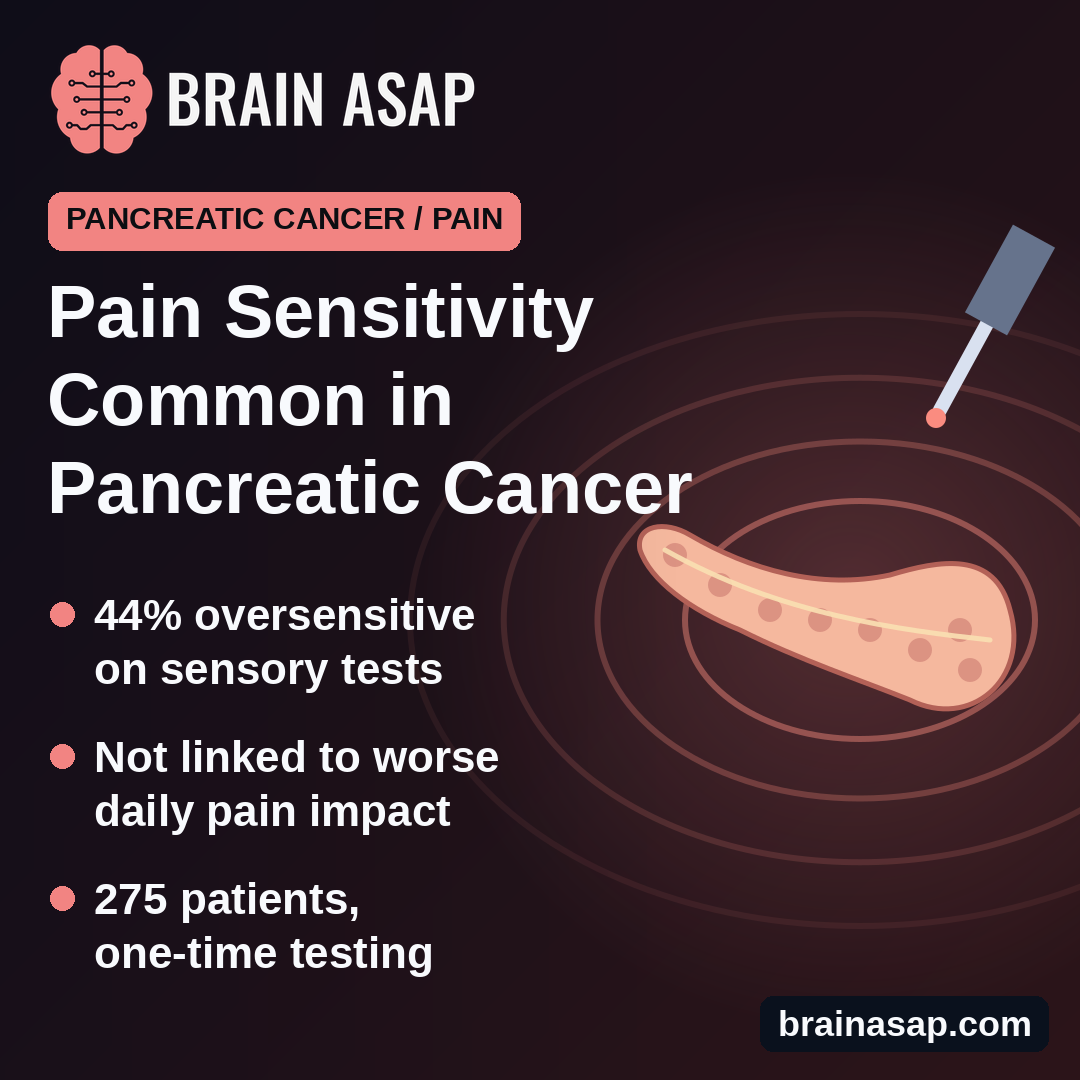
TL;DR: Among 121 people with painful pancreatic cancer, 44% had a heightened sensitivity to pain on standardized testing, much like people with long-term pancreatitis. But in the cancer group, that sensitivity was not consistently linked to worse pain, mood or quality of life.
Key Findings
- 275 patients, 5 hospitals: 153 with chronic pancreatitis and 122 with pancreatic cancer, all in pain.
- Oversensitivity was common: 54% with pancreatitis and 44% with cancer; not a significant difference after adjustment.
- Pancreatitis hurt more: Higher pain scores, more disruption of daily life and more catastrophizing.
- Different meaning in cancer: Oversensitivity did not consistently track worse daily impact, mood or quality of life.
- Snapshot data: Mostly patients from earlier studies, analyzed in a new way.
Source: Frontiers in Pain Research (2026) | Kassik et al.
About 8 in 10 people with pancreatic cancer develop pain, and it can be hard to control. In chronic pancreatitis, a long-term inflammation of the pancreas, doctors have learned that some patients’ nervous systems become oversensitive, amplifying pain signals. That oversensitivity tends to come with worse mood and quality of life.
An international team asked whether the same holds in pancreatic cancer.
Testing How the Nervous System Handles Pain
Researchers at five hospitals in Germany, Denmark and the US studied 153 patients with painful chronic pancreatitis and 122 with painful pancreatic cancer. Each went through pancreas-focused sensory testing: pressure on the skin over the pancreas and elsewhere, repeated pinpricks, and a hand in ice water.
Based on the results, patients were sorted into three pain profiles:
- Normal processing: No unusual sensitivity.
- Local oversensitivity: Heightened pain response mainly over the pancreas area, suggesting changes at the spinal level.
- Widespread oversensitivity: Heightened pain response throughout the body, suggesting changes in the brain and spinal cord.
Patients also filled out questionnaires on pain, anxiety, depression and quality of life.
Oversensitivity in Both Diseases
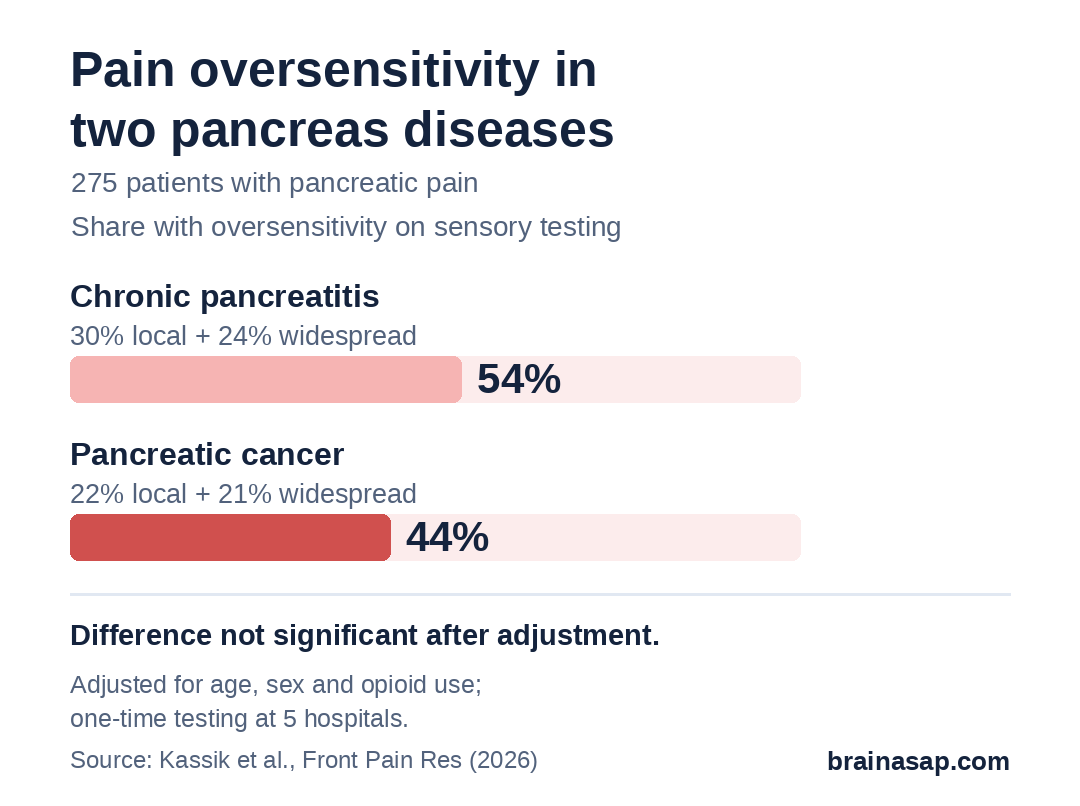
The researchers found oversensitivity in 54% of pancreatitis patients and 44% of cancer patients. The difference was not significant after accounting for age, sex and opioid use. After adjustment, cancer patients could keep a hand in ice water about 13 seconds longer.
In Cancer, Oversensitivity Did Not Track Worse Outcomes
Pancreatitis patients reported more intense pain, more pain getting in the way of daily life, and more catastrophizing than cancer patients. Within the cancer group, those with oversensitivity showed no consistent differences from those with normal processing on pain intensity, interference, catastrophizing, anxiety, depression or quality of life.
A formal test found that the link between oversensitivity and pain interfering with daily life differed between the two diseases. That was the only measure where the diseases split.
Different Patients, Different Stages
- Snapshot: One-time testing cannot show whether oversensitivity grows over time.
- Groups differed: Cancer patients had a much shorter illness, differed in age and background, and came from different centers.
- Alcohol: Many pancreatitis patients had heavy drinking histories, which can affect pain.
- Reused cohorts: All pancreatitis and most cancer patients were in earlier studies.
- No treatment tested: It is unknown whether profiles predict which pain treatments work.
Cancer Pain May Need Its Own Playbook
The takeaway is that pain lessons from chronic pancreatitis may not transfer neatly to pancreatic cancer. The next step is following cancer patients over time to see whether their pain profile changes as the disease progresses, and whether it can guide treatment choices.
Citation: DOI: 10.3389/fpain.2026.1903789. Kassik M-T, Faghih M, Bandhauer C, et al. Pain profiles in pancreatic cancer and chronic pancreatitis: a multicenter cross-sectional analysis. Front Pain Res. 2026;7:1903789.
Study Design: Multicenter cross-sectional analysis using pancreatic quantitative sensory testing.
Sample Size: 275 (153 chronic pancreatitis, 122 pancreatic cancer; 121 classifiable).
Key Statistic: Hyperalgesia 53.6% vs 43.8% (aOR 0.75, 95% CI 0.43 to 1.33); disease-by-hyperalgesia interaction for pain interference β = 1.61 (95% CI 0.27 to 2.95).
Caveat: Cross-sectional; cohorts differ in disease duration, age and center; residual confounding possible.