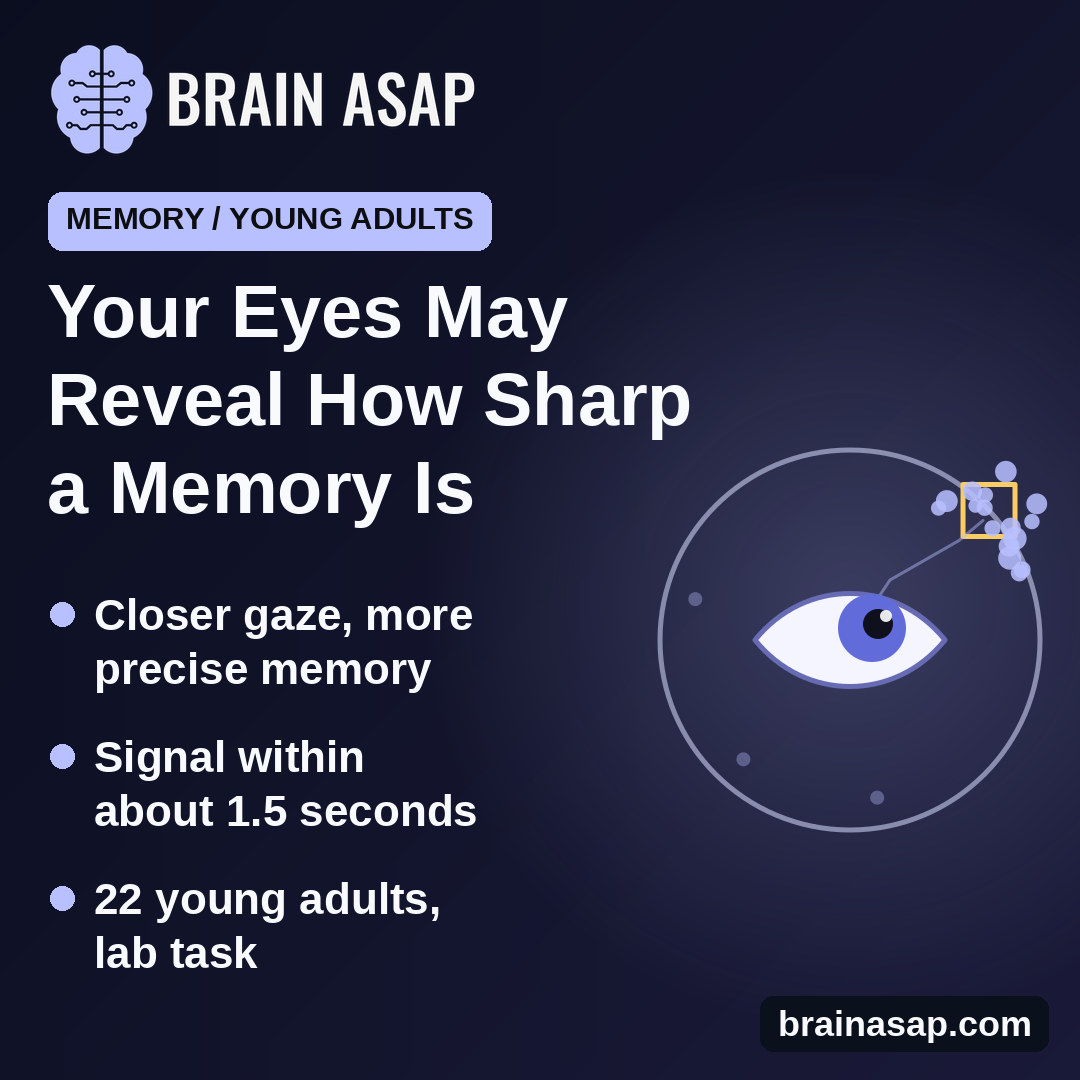
TL;DR: When 22 young adults tried to recall where they had seen everyday objects, their eyes drifted toward the right spot before they answered. The closer their gaze, the more precise their memory turned out to be.
Key Findings
- Eyes found the spot: Gaze landed much closer to an object’s original place when people truly remembered it than when they guessed.
- Closer gaze, sharper memory: Among correct answers, closer looks went with more precise placement.
- Fast signal: The precision link appeared about 1 to 1.5 seconds after the object showed up.
- Separate from the hippocampus: Eye patterns and brain activity each predicted precision on their own.
- Small lab study: 22 healthy young adults in an MRI scanner.
Source: Journal of Cognitive Neuroscience (2026) | Hou et al.
Try to recall where you left your keys, and your eyes may flick toward the kitchen counter before you consciously decide. Memory researchers have known for years that our eyes tend to revisit where things were. What was unclear is whether that glance also reveals how sharp the memory is.
Researchers at the University of Texas at Dallas and the University of Arizona tested this with eye tracking inside an MRI scanner.
Objects Placed Around a Circle
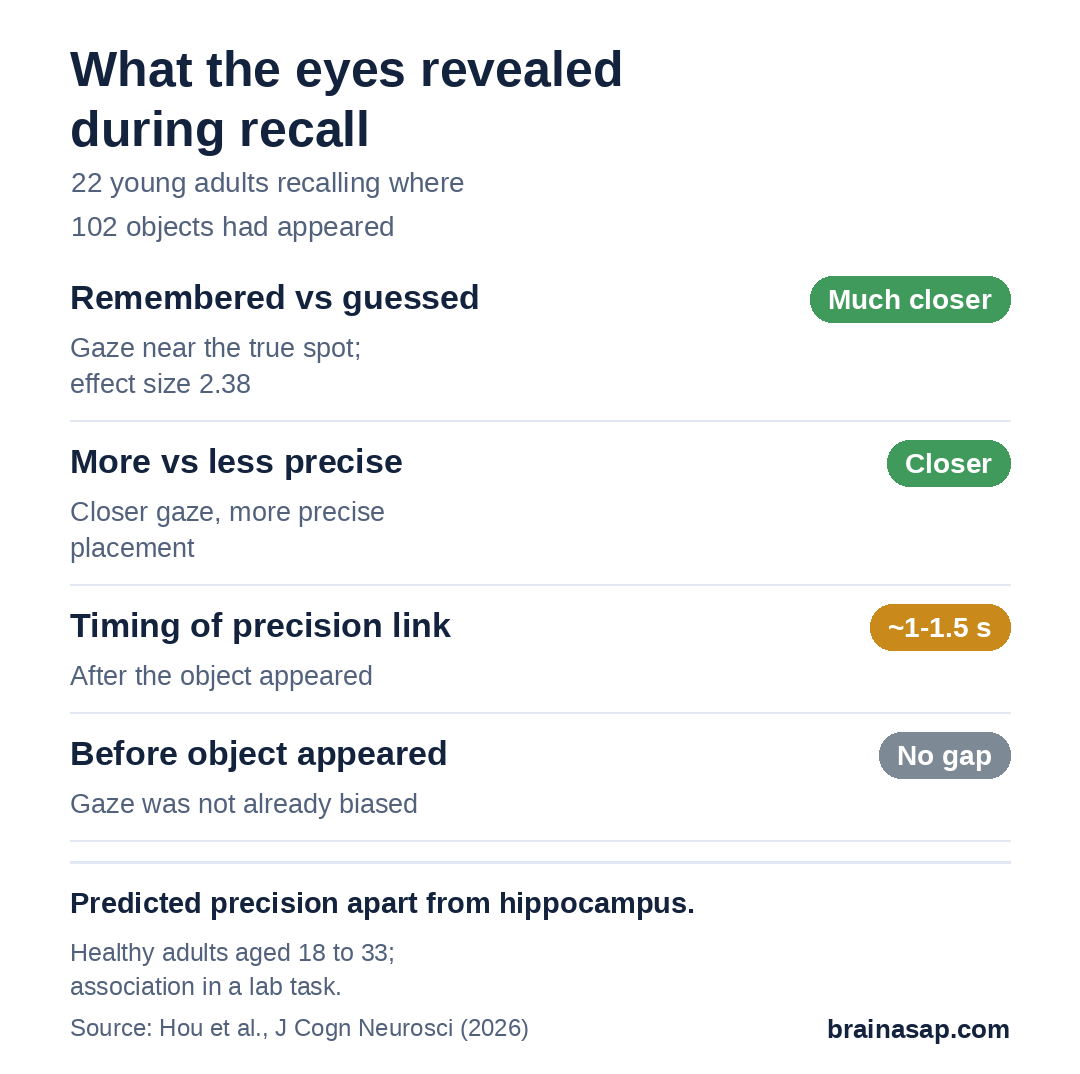
Twenty-four young adults (average age 23) studied 102 pictures of everyday objects, like an apple or a coin. Each appeared for 6 seconds at a random spot on an invisible circle. Eye data from 2 people were dropped for poor calibration, leaving 22.
In the test, each object reappeared in the center, mixed with 34 new ones. People had 3 seconds to silently recall where it had been, then moved a cursor around the circle to that spot, guessing if needed. Their eyes were free to wander the whole time.
The researchers sorted correctly recognized objects into:
- Location remembered: Cursor placed within 36 degrees of the true spot.
- Guesses: Off by 60 degrees or more.
- Remembered trials were further split into high precision (within 16 degrees) and lower precision.
Eyes Landed Near the Right Spot
Before people moved the cursor, their gaze settled much closer to the object’s original location on remembered trials than on guesses. The difference was very large by research standards (effect size 2.38).
Even among correct answers, the eyes told more. When gaze landed closer to the true spot, the final placement was more precise. Gaze patterns were also more alike from trial to trial for well-remembered locations.
Timing Hints at How Recall Unfolds
The gap between remembered and guessed trials showed up for almost the entire recall window. The precision signal arrived later, around 1 to 1.5 seconds after the object appeared. Before the object appeared, there was no difference, suggesting the effect was not simply where people happened to be looking already.
Eyes and Hippocampus Told Separate Stories
Activity in the hippocampus, a key memory structure, also tracked memory precision. But hippocampal activity did not predict where the eyes went, and eye patterns predicted precision even after accounting for it. The authors suggest gaze carries its own information about memory quality.
What This Lab Task Cannot Show
- Same data, new analysis: The brain and memory results came from an earlier report; the eye data are new.
- Small, young and healthy: 22 people aged 18 to 33.
- Association only: It does not show that moving your eyes improves memory.
- Not a clinical test: No one with memory problems was studied.
Could Gaze Become a Quiet Memory Measure?
Because eye tracking is cheap and needs no answer from the person, it is tempting to imagine using gaze to gauge memory in people who struggle to respond. Whether these patterns hold in older adults or people with memory disorders is the open question for the next study.
Citation: DOI: 10.1162/jocn.a.2627. Hou M, Pezanko LR, Srokova S, Hill PF, Ekstrom AD, Rugg MD. Retrieval-related eye movements are predictive of memory precision. J Cogn Neurosci. 2026;38(10):1922-1936.
Study Design: New eye-tracking analysis of an existing object-location memory fMRI dataset.
Sample Size: 24 enrolled; 22 analyzed.
Key Statistic: Fixations closer to studied location for location hits vs guesses, t(21) = 7.85, p < .001, d = 2.38; fixation precision predicted judgment precision (β = 0.13, 95% CI 0.07 to 0.19).
Caveat: Small healthy young sample; correlational lab task.