TL;DR: A 2026 study in Advanced Science found that flexible polyimide brain-implant probes produced lower long-term tissue reactivity than stiff silicon electrodes, while thinner probe designs and skull-detached mounting mattered less than the implant material itself.
Key Findings
- Material mattered most: Flexible polyimide probes triggered less brain-tissue reactivity than stiff silicon electrodes.
- Not reaction-free: Polyimide implants still produced a measurable local response, so the result supports lower reactivity rather than no immune reaction.
- Design tradeoffs narrowed: Making probes thinner or detaching them from the skull had less effect than expected.
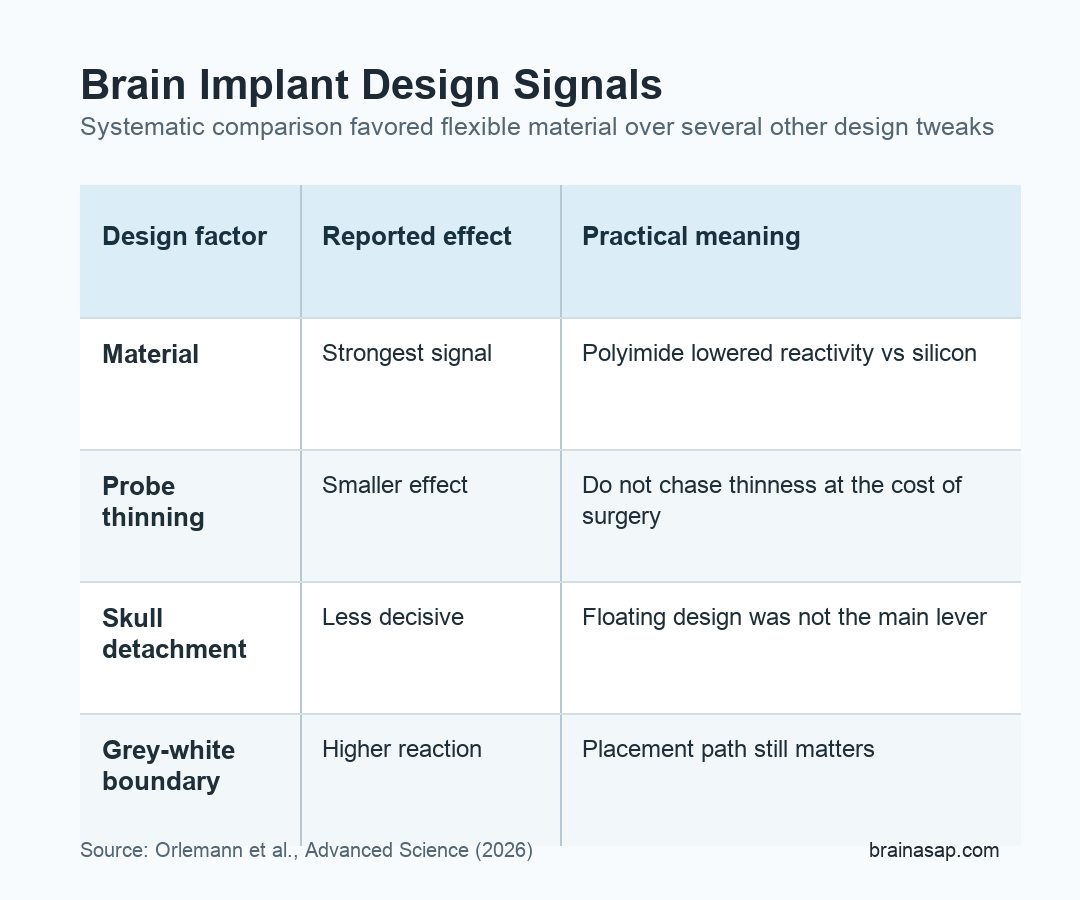
- Boundary disruption stood out: Tissue response increased when implants disturbed the grey-matter and white-matter boundary.
- Visual prostheses are the long-term target: The work is aimed at brain-machine interfaces that need durable cortical stimulation, including implants for blindness.
Source context: The public summary came from Neuroscience News, while the citation and evidence summary below use the underlying Advanced Science paper and DOI.
Brain implants face a direct biological problem: the brain reacts to a foreign object. For devices meant to stimulate cortex over years, that reaction can damage tissue around the implant and reduce how well the device works.
Researchers compared stiff silicon electrodes with flexible polyimide probes, a softer implant material often treated as a promising path for long-term neural interfaces.
The study focused on tissue reactivity, meaning the local immune and scarring response around the implanted probe.
The practical question was not whether a flexible implant is invisible to the brain. The question was whether softer probe materials can reduce the tissue response enough to make long-term brain-machine interfaces more realistic.
Flexible Polyimide Probes Lowered Brain-Tissue Reactivity
Polyimide probes produced lower tissue reactivity than stiff silicon electrodes. Material choice therefore becomes a major design variable for implanted brain devices.
Silicon electrodes have been valuable in clinical and research settings, but they are mechanically mismatched with soft neural tissue.
A stiff object can move differently from the surrounding brain, and that mismatch can contribute to chronic local injury and scarring.
Polyimide is more flexible. In this study, that flexibility translated into a lower measured tissue response, but the response did not disappear.
Researchers still detected reactivity around the flexible probes, so the finding is best read as a meaningful reduction rather than a complete solution.
- Silicon electrodes: Stiffer probes were associated with stronger tissue reaction and more concern about long-term scarring.
- Polyimide probes: Softer flexible probes lowered reactivity while still producing a measurable response.
- Main interpretation: The material itself was more important than several other design tweaks tested in the same study.
This distinction is central for brain implants designed to restore or support function. A device can work at implantation and still fail later if the tissue response changes the electrode environment over time.
Thinner Probes and Floating Mounts Mattered Less Than Expected
The study did more than compare two materials. Researchers also tested whether probe size, thickness, and attachment strategy changed the tissue response.
Those design variables matter for engineering, but they were not the strongest drivers in the reported comparison.
Making probes thinner did not appear to offer the same benefit as choosing a more flexible material. Detaching the implant from the skull so it could move more freely with the brain also had less impact than expected.
For engineers, that narrows the design space. Ultra-thin probes may be harder to implant, and a fully floating or wireless design may add surgical and device complexity.
If those changes do not substantially improve tissue compatibility, designers can prioritize reliability and surgical success instead.
- Material choice: The strongest design signal favored flexible polyimide over stiff silicon.
- Probe thinning: Smaller or thinner designs were not the main source of the lower reaction.
- Skull detachment: Letting the probe float with the brain did not dominate the outcome.
Thickness and mounting may still matter in other device contexts. In this systematic comparison, material compatibility emerged as the first design lever to solve before adding more complicated implant changes.
Grey-White Matter Boundary Disruption Raised the Reaction
One important detail involved where the implant disturbed tissue. The reported brain response was stronger when implants disrupted the boundary between grey matter and white matter.
Grey matter contains many neuronal cell bodies and local processing circuits. White matter contains long-range fiber pathways that connect brain regions.
The boundary between them is not just anatomical labeling; it reflects different tissue organization and different vulnerability to mechanical disruption.
When a probe crosses or damages that boundary, the injury pattern can involve both local processing tissue and connecting fibers. That may amplify immune activity around the implant and create a less stable environment for chronic stimulation.
Design takeaway: Better implant materials are only one part of the problem. Placement, insertion path, and tissue-layer disruption also need to be managed if a device is expected to stay stable for long periods.
Visual Brain Implants Need Durable Cortical Stimulation
The longer-term goal described in the source material is a visual brain implant for blindness. A cortical visual prosthesis would need to stimulate brain tissue repeatedly and predictably, not just survive the initial surgery.
That raises the quality bar. A short-lived signal may be enough in some experimental contexts, but a vision-restoration device needs a stable interface that can deliver stimulation patterns over time.
Excessive scarring or tissue reaction could reduce the precision of that stimulation.
- Clinical goal: A visual prosthesis would try to create usable visual experiences by stimulating cortex.
- Engineering constraint: The implant must remain functional after the early immune response settles.
- Biology constraint: The surrounding tissue has to tolerate the device without progressive damaging scarring.
The study therefore supports a practical conclusion: flexible polyimide probes appear closer to the needed material profile, but they still require careful design and implantation strategy.
Lower Reactivity Is Progress, Not a Finished Implant
The evidence is strongest for the design comparison itself. Flexible polyimide probes reduced long-term tissue reactivity relative to stiff silicon electrodes, and material choice was more important than several other tested design changes.
The caveat is equally important. The work does not show that polyimide eliminates the brain response, nor does it prove that a complete visual prosthesis is ready for patients.
It shows which design choices appear most worth prioritizing before functional devices are refined further.
For brain-machine interfaces, that is a practical step. A better material can reduce one major source of device failure, while the remaining work focuses on stimulation performance, surgical delivery, probe placement, and long-term stability.
Citation: DOI: 10.1002/advs.202600028. Orlemann et al. Friend, Not Foe: Lowered Tissue Reactivity to Long-Term Polyimide Implants. Advanced Science. 2026.
Study Design: Comparative preclinical implant-material study measuring long-term tissue reactivity around neural probes.
Sample/Model: Animal-model brain implant experiments comparing stiff silicon electrodes with flexible polyimide probes.
Key Statistic: Polyimide probes produced significantly lower tissue reactivity than stiff silicon electrodes, while material choice outweighed probe thinning and skull-detachment changes.
Caveat: The available evidence reports lower reactivity and design-priority findings, but not a completed human visual-prosthesis trial.