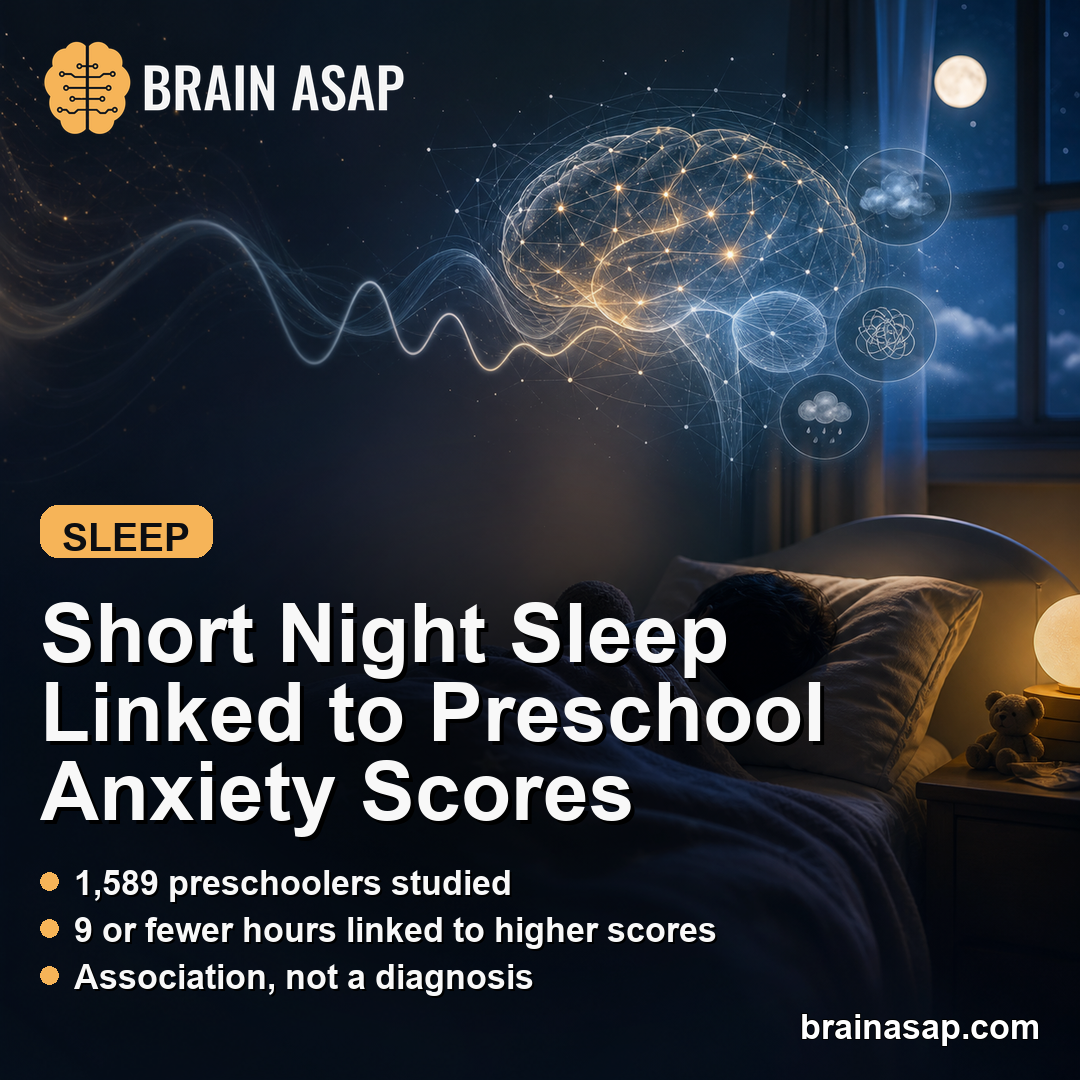
TL;DR: A 2026 cross-sectional study in Nature and Science of Sleep linked 9 hours or less of nighttime sleep with higher parent-rated anxiety scores in 1,589 preschool children in China, but the design can show association rather than prove that shorter sleep caused the symptoms.
Key Findings
- 1,589 preschoolers: Researchers analyzed parent questionnaires from two public kindergartens, with a mean child age of 4.58 years.
- Short-sleep group: 423 children slept 9 hours or less at night, while 190 children slept more than 10 hours.
- Higher anxiety scores: Children sleeping 9 hours or less scored 3.13 points higher on the Preschool Anxiety Scale than the more-than-10-hour group after adjustment.
- Specific symptom domains: Physical injury fears, social phobia, obsessive-compulsive symptoms, and generalized anxiety scores were each higher in the short-sleep group.
- Association, not diagnosis: The Preschool Anxiety Scale is a screening questionnaire, and the cross-sectional design cannot show whether sleep loss caused anxiety symptoms.
Source: Nature and Science of Sleep (2026) | Zhang et al.
Night Sleep Below 9 Hours Tracked Higher Preschool Anxiety Scores
Researchers focused on habitual nighttime sleep duration rather than total daily sleep. In China, kindergarten naps can partly offset later bedtimes, so overnight sleep may tell a different story than 24-hour sleep totals.
The analysis included 1,589 children from two public kindergartens. Parents reported sleep using the Children’s Sleep Habits Questionnaire and anxiety symptoms using the Preschool Anxiety Scale (PAS), a 28-item parent-report measure that captures symptom severity but does not diagnose an anxiety disorder.
The sample was divided into three nighttime sleep groups:
- 9 hours or less: 423 children, with an average nighttime sleep duration of 8.71 hours.
- More than 9 to 10 hours: 976 children, with an average nighttime sleep duration of 9.47 hours.
- More than 10 hours: 190 children, with an average nighttime sleep duration of 10.35 hours.
The clearest contrast was between the shortest and longest sleep groups. After adjustment for age, sex, only-child status, and main caregiver, children sleeping 9 hours or less had higher PAS total scores than children sleeping more than 10 hours.
The Main Difference Was Modest but Consistent Across Several Symptoms
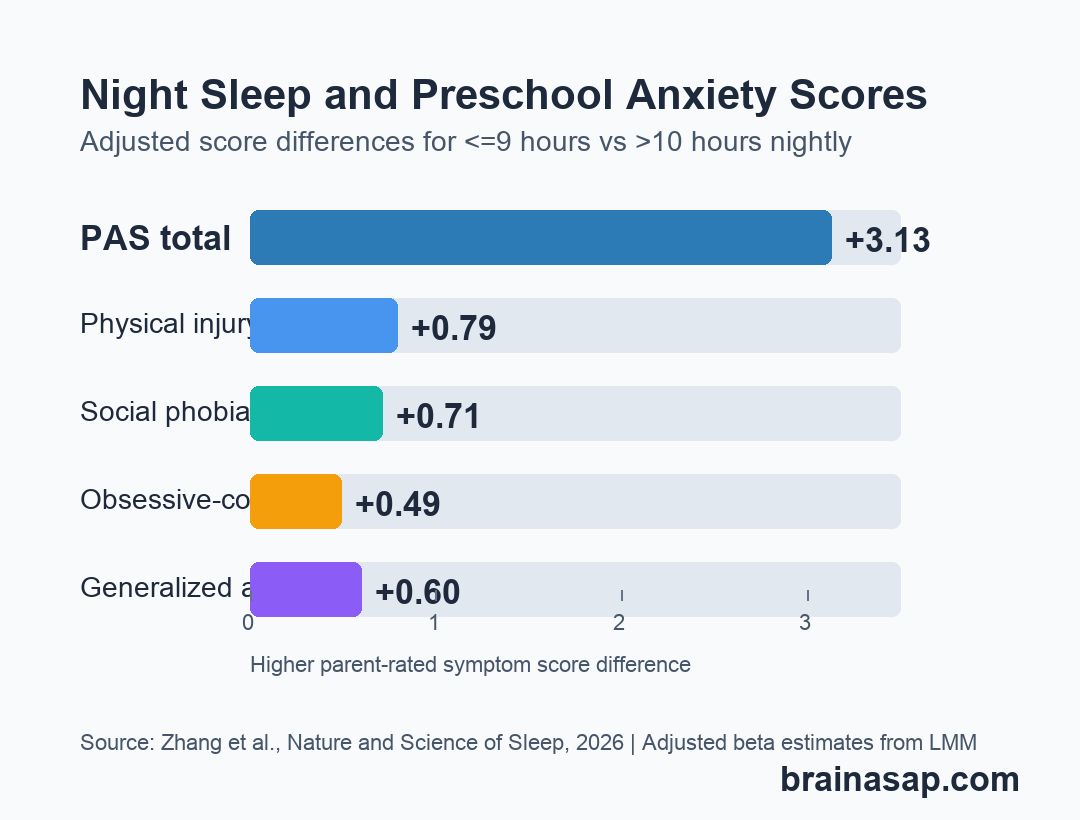
The adjusted PAS total-score difference was 3.13 points for the 9-hours-or-less group compared with the more-than-10-hours group.
The confidence interval was 1.01 to 5.25 points, and the reported P value was 0.004.
Several symptom subscales moved in the same direction. Compared with the longer-sleep group, the short-sleep group had higher scores for physical injury fears, social phobia, obsessive-compulsive symptoms, and generalized anxiety.
- Physical injury fears: Scores were 0.79 points higher, with a 95% confidence interval from 0.12 to 1.46.
- Social phobia: Scores were 0.71 points higher, with a 95% confidence interval from 0.09 to 1.33.
- Obsessive-compulsive symptoms: Scores were 0.49 points higher, with a 95% confidence interval from 0.14 to 0.84.
- Generalized anxiety: Scores were 0.60 points higher, though the overall generalized-anxiety model was borderline rather than clearly significant.
The effect sizes were small. The reported Cohen’s d values clustered around 0.19 to 0.25, which means the sleep/anxiety difference was not large for any single child but was still detectable across the group.
Parent Questionnaires Made This a Screening Study, Not a Diagnosis Study
The anxiety measure used here was the Preschool Anxiety Scale. Higher scores mean more symptoms reported by parents, but the study did not conduct clinician interviews or assign formal anxiety diagnoses.
Only 2.14% of children screened positive for significant anxiety symptoms.
The finding is better read as a population-level association between shorter nighttime sleep and higher symptom ratings, not as evidence that most short-sleeping preschoolers had an anxiety disorder.
The sleep measure also came from parents. Parent-reported sleep can be useful in large school-based studies, but it is less precise than actigraphy or another objective sleep-tracking method.
The researchers acknowledged that questionnaire-based sleep estimates may overestimate actual sleep duration.
The 9-Hour Cutoff Held Up Better Than Nearby Alternatives
The researchers tested the primary cutoff of 9 hours and then checked nearby thresholds. Alternative cutoffs at 8.5 hours and 9.5 hours did not show the same significant association with mental health outcomes.
A weekday-only analysis also supported the main pattern. Weekend sleep can blur weekday routines, especially in families where school nights and weekend nights have different bedtimes.
- Primary cutoff: 9 hours or less was associated with higher PAS total scores.
- Alternative cutoffs: 8.5-hour and 9.5-hour thresholds were not significant in the reported sensitivity checks.
- Weekday check: Weekday nighttime sleep showed a similar short-sleep association.
The study should not be read as a claim that every preschool child needs the same exact bedtime. In this sample, falling at or below 9 hours of night sleep marked a higher-symptom group.
Short Sleep Could Be a Marker, a Contributor, or Both
Biologically, the sleep/anxiety link is plausible. The researchers pointed to prior work connecting insufficient sleep with amygdala reactivity, hypothalamic-pituitary-adrenal axis activity, and prefrontal development.
Those systems help regulate fear, stress, and emotional control.
Still, this study cannot identify direction. Shorter nighttime sleep could contribute to anxiety symptoms, anxious children could sleep less, or family routines and unmeasured stressors could influence both sleep and symptoms.
A narrower takeaway is more useful: preschool sleep duration is worth asking about when parents report anxiety-like symptoms, and mental health screening is worth considering when a child is consistently sleeping very short nights.
Citation: DOI: 10.2147/NSS.S593442. Zhang et al. The Relationship Between Night Sleep Duration and Anxiety Among Preschool Children: A Cross-Sectional Study in China. Nature and Science of Sleep. 2026;18.
Study Design: Cross-sectional questionnaire study in two public kindergartens in China.
Sample Size: 1,589 preschool children, mean age 4.58 years.
Key Statistic: Children sleeping 9 hours or less had PAS total scores 3.13 points higher than children sleeping more than 10 hours after adjustment.
Caveat: Parent-reported sleep and cross-sectional data cannot prove that shorter sleep caused anxiety symptoms.