TL;DR: A 2026 medRxiv preprint linked post-stroke depressive symptoms to stroke damage in serotonin-transporter and acetylcholine-transporter weighted brain networks, suggesting depression risk after stroke may depend partly on which neurochemical circuits a lesion disrupts.
Key Findings
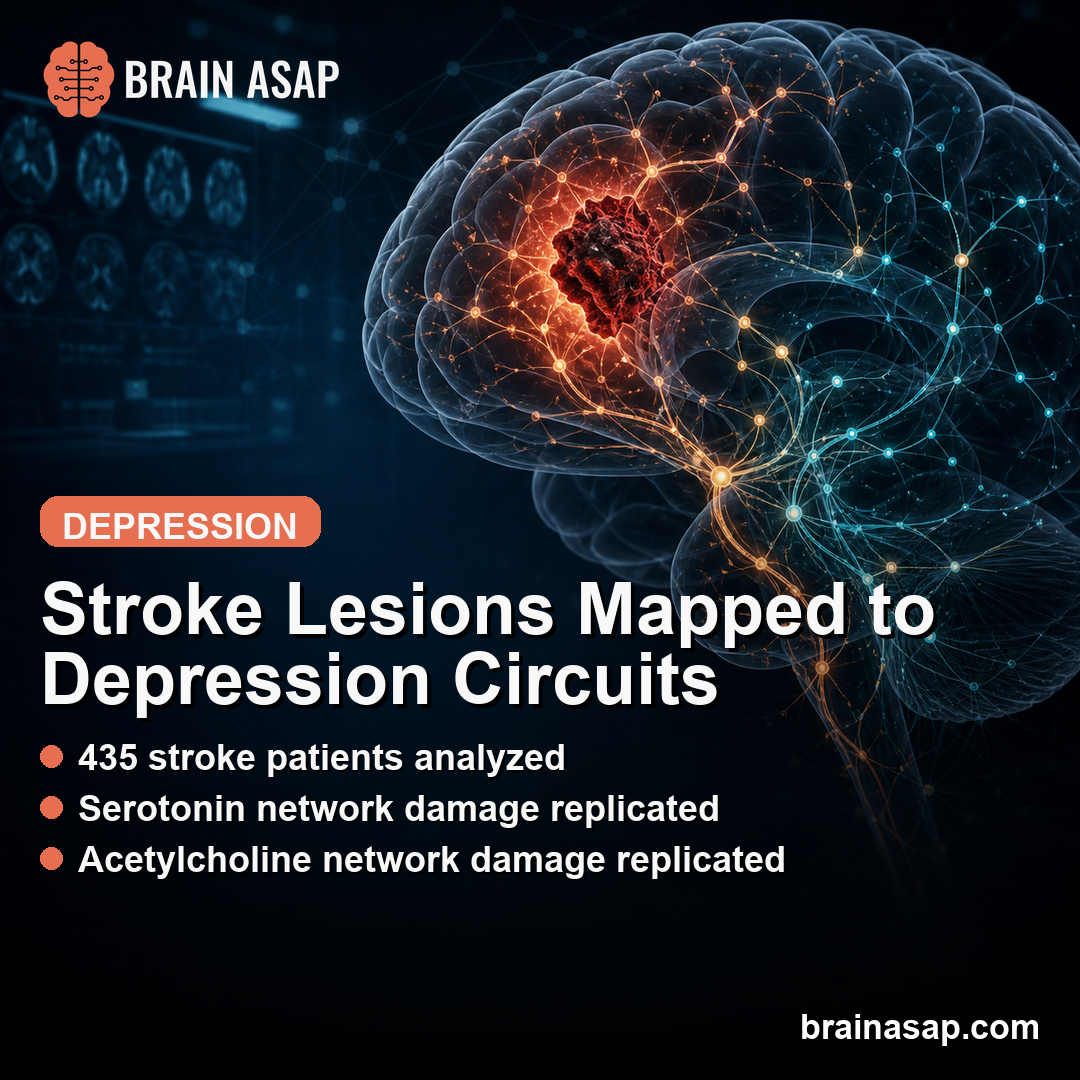
- 435 stroke patients analyzed: Researchers combined two independent cohorts, Leipzig and Oxford, after exclusions for missing clinical variables and lesion features.
- Depression cutoff was defined: Post-stroke depressive symptoms meant a Hospital Anxiety and Depression Scale depression subscale score above 7 at follow-up.
- Serotonin result replicated: More serotonin transporter (5-HTT) weighted network damage was linked to higher odds of depressive symptoms in Leipzig (OR 2.40) and Oxford (OR 2.05).
- Cholinergic result replicated: Vesicular acetylcholine transporter (VAChT) weighted network damage was also associated with depressive symptoms in Leipzig (OR 3.14) and Oxford (OR 4.18).
- Dopamine was less stable: D1 receptor weighted damage was significant in Leipzig but not Oxford, making it a cohort-specific finding rather than the main replicated result.
Source: medRxiv (2026) | Frey et al.
Post-stroke depressive symptoms are common after stroke, but lesion location alone has not reliably explained who develops them. This study asked a more specific question: whether a stroke lesion becomes more relevant for depression when it intersects white-matter connections embedded in particular neurotransmitter systems.
Stroke Lesions Were Mapped Onto 19 Neurotransmitter-Weighted Networks
Researchers reanalyzed lesion and follow-up symptom data from 435 stroke patients: 267 from Leipzig and 168 from Oxford. Depression status was based on the Hospital Anxiety and Depression Scale depression subscale (HADS-D), where scores above 7 indicated post-stroke depressive symptoms.
The analysis did not simply ask whether a lesion touched one brain region. Each lesion mask was projected into a normative structural connectome and then weighted by positron emission tomography (PET) maps for 19 neurotransmitter receptors and transporters.
- Structural damage: The model estimated how much white-matter connectivity each stroke lesion disrupted.
- Neurochemical weighting: The same disrupted pathways were weighted by receptor or transporter maps, including serotonin, dopamine, acetylcholine, GABA, glutamate, norepinephrine, opioid, cannabinoid, and histamine systems.
- Clinical adjustment: Logistic models adjusted for age, sex, lesion volume, neurological deficit on the NIH Stroke Scale, and Barthel Index functional status.
That approach let researchers test whether depressive symptoms tracked with damage to particular neurotransmitter-embedded networks, not just with larger lesions or worse stroke severity.
Serotonin Transporter Network Damage Was Linked to Depressive Symptoms
The most consistent association involved the serotonin transporter (5-HTT). For each 10% increase in 5-HTT weighted network damage, the adjusted odds of post-stroke depressive symptoms were higher in both cohorts.
In Leipzig, the 5-HTT odds ratio was 2.40 with a 95% confidence interval of 1.15 to 5.02. In Oxford, the odds ratio was 2.05 with a 95% confidence interval of 1.03 to 4.09.
Serotonin transporter damage is not a diagnostic test. Lesions intersecting serotonin-rich network architecture explained more depression-related variation than lesion volume and clinical impairment alone.
The result fits a broad clinical background: serotonin signaling is already central to depression biology and to selective serotonin reuptake inhibitors. The study adds location and connectivity detail by asking where stroke damage falls relative to serotonin-transporter weighted pathways.
Acetylcholine Transporter Damage Also Replicated Across Cohorts
The second replicated result involved the vesicular acetylcholine transporter (VAChT), a marker related to acetylcholine packaging and release. VAChT weighted network damage was associated with depressive symptoms in both datasets.
In Leipzig, VAChT weighted damage had an adjusted odds ratio of 3.14. In Oxford, the odds ratio was 4.18, with the model-fit improvement larger than the threshold the researchers used for a meaningful gain.
Acetylcholine is often discussed in memory and attention, but cholinergic signaling also interacts with mood, motivation, and neuroimmune pathways. After stroke, depression, cognitive slowing, apathy, and functional impairment can overlap clinically.
- Serotonergic pathway: The replicated 5-HTT result points toward mood-regulating network architecture.
- Cholinergic pathway: The replicated VAChT result points toward acetylcholine-linked networks that may connect mood with cognition and post-stroke slowing.
- Network context: Both findings depend on where the lesion sits in the brain’s connected architecture, not just on the lesion’s raw size.
Dopamine D1 Damage Was a Cohort-Specific Signal
Dopamine D1 receptor weighted damage looked important in Leipzig, where the adjusted odds ratio was 3.63. The same association did not replicate in Oxford, where the odds ratio was 1.74 and the association was not statistically significant.
The split is still biologically plausible. Dopamine D1 signaling is tied to motivation, reward learning, psychomotor speed, and goal-directed behavior, all of which can shape depressive syndromes after stroke.
For this dataset, though, dopamine should not be treated as the central cross-cohort result. A cleaner reading is that D1-weighted network damage may matter in some clinical mixes, while serotonin and acetylcholine transporter-weighted damage were the more reproducible markers.
Network Chemistry May Explain Why Lesion Location Alone Falls Short
Older attempts to localize post-stroke depression to a single lesion site, such as left frontal injury, have produced inconsistent results. Network approaches improved the problem by showing that different lesion sites can disrupt shared circuits.
This preprint adds another layer. Two strokes can damage different visible regions and still affect similar serotonin- or acetylcholine-weighted pathways; another lesion of similar size may spare those pathways.
- Clinical burden still mattered: Patients with depressive symptoms tended to have greater neurological symptom burden and functional impairment.
- Global disconnection was not enough: Unbiased structural disconnection did not pass the same multivariate selection threshold in either cohort.
- Chemical architecture refined the map: Neurotransmitter-weighted connectomics helped identify which disrupted networks were most relevant to depressive symptoms.
The finding does not support immediate treatment selection. It gives researchers a more detailed model for why some stroke survivors develop depressive symptoms when lesion size, stroke severity, and broad lesion location do not fully explain the outcome.
Normative PET Maps Limit Patient-Level Prediction
The main limitation is that the neurotransmitter maps came from normative PET atlases, not from each patient’s own molecular imaging. The structural connectomes were also population-averaged rather than patient-specific.
Depressive symptoms were measured at one follow-up time point, so the analysis cannot show whether these network-damage patterns caused later depression trajectories. Antidepressant treatment details were also unavailable, which limits interpretation of medication effects.
- Not causal: The models identify adjusted associations, not proof that serotonin or acetylcholine network damage directly caused depression.
- Not predictive yet: The study did not perform external out-of-sample prediction for individual patients.
- Not peer reviewed: The source is a preprint, so the findings should be treated as preliminary until reviewed and independently tested.
The strongest next test would combine longitudinal symptom follow-up with patient-specific connectivity, molecular imaging, inflammatory markers, and medication data. For now, the result gives post-stroke depression research a more specific neurochemical map to test.
Citation: DOI: 10.64898/2026.04.24.26351561. Frey et al. Linking Network Damage to Post-Stroke Depression: A Neurotransmitter-Informed Connectome Analysis. medRxiv. 2026.
Study Design: Secondary connectome analysis of two independent stroke cohorts using lesion masks, normative structural connectomes, PET-derived neurotransmitter maps, and adjusted logistic models.
Sample Size: 435 stroke patients with follow-up post-stroke depressive symptom data.
Key Statistic: 5-HTT weighted damage was associated with post-stroke depressive symptoms in Leipzig (OR 2.40) and Oxford (OR 2.05); VAChT weighted damage also replicated in Leipzig (OR 3.14) and Oxford (OR 4.18).
Caveat: The preprint uses normative molecular/connectome maps and reports associations, not patient-level prediction or causal proof.