TL;DR: Among Hispanic and Latino adults in the U.S., people with one particular DNA pattern around the APOE gene were more likely to show steep thinking decline over about 7 years. The well-known APOE4 risk version had a weaker link in the same group. Key Find…
Read article ↗
TL;DR: A 2026 retrospective analysis posted to medRxiv linked diclofenac and naproxen use in the NACC cohort to lower dementia and Alzheimer disease prevalence, while diclofenac use was also associated with slower Montreal Cognitive Assessment (MoCA) cognitive…
Read article ↗
TL;DR: A 2026 mouse and cell study in Signal Transduction and Targeted Therapy linked ATP11B, a phospholipid-flipping transport protein, to hippocampal iron handling, mitochondrial failure, ferroptosis, and age-related cognitive decline. Key Findings ATP11B fe…
Read article ↗
TL;DR: A 2026 medRxiv preprint used total-body tau PET in Alzheimer’s disease and found stronger brain-organ network synchrony, a pattern that tracked cognitive impairment through cortical tau burden and MRI markers of glymphatic dysfunction. Key Findings Smal…
Read article ↗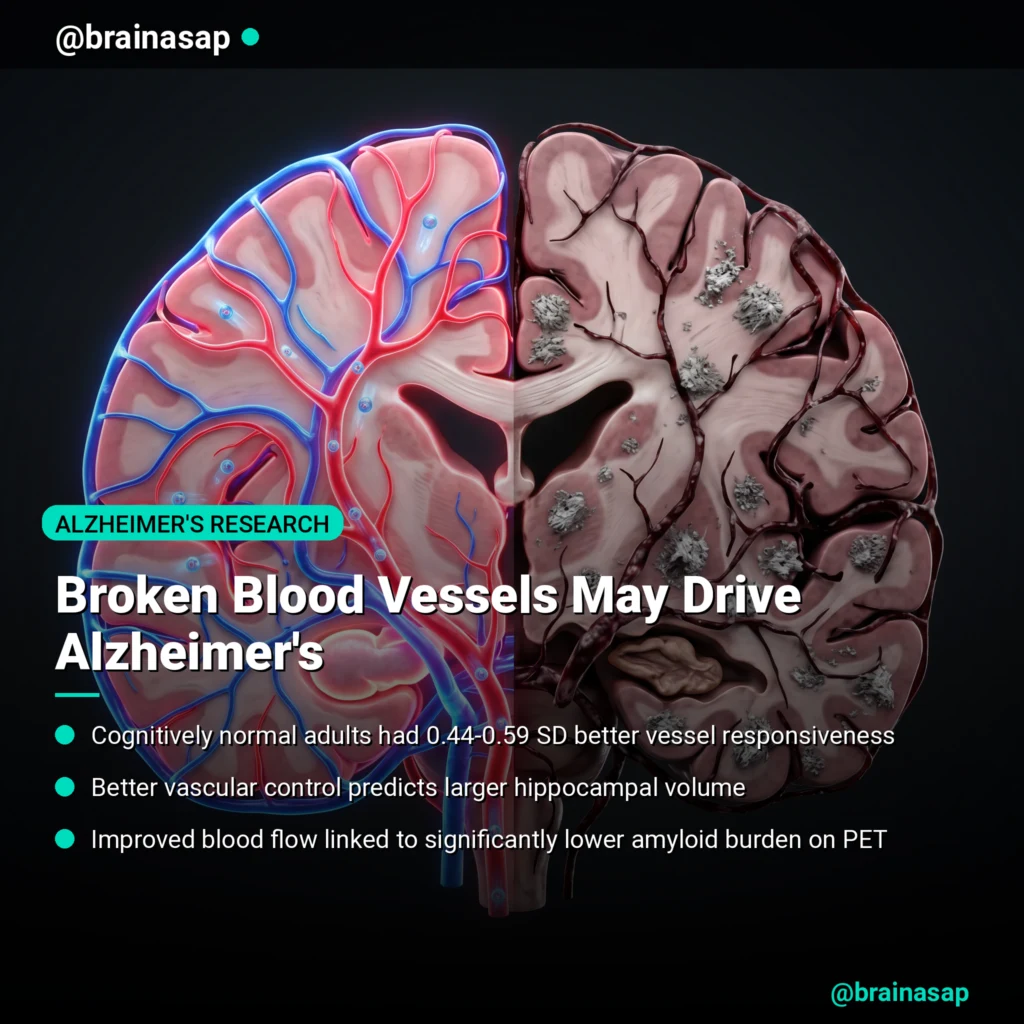
Broken Blood Vessels May Drive Alzheimer’s Decline TL;DR: A new study reveals that impaired cerebrovascular function—the brain’s ability to regulate blood flow—correlates strongly with Alzheimer’s symptoms, offering a potential non-invasive way to detect early…
Read article ↗
Omega-3 supplements and Souvenaid® show potential in slowing cognitive decline in Alzheimer’s patients, though the evidence remains inconclusive. Highlights: Cognitive Decline Reduction: The CDR scale showed a significant reduction in cognitive decline progres…
Read article ↗
ACOT7 shows promise as a non-invasive serum biomarker for Alzheimer’s disease (AD) with high diagnostic accuracy. Highlights: Increased Expression: ACOT7 levels were significantly elevated in AD patients and animal models compared to controls. Correlation with…
Read article ↗
Elevated blood urea nitrogen and creatinine ratio (BUNCr) is associated with decreased cognitive function and increased depressive symptoms, with depressive symptoms mediating part of the relationship between BUNCr and cognitive decline. Highlights: BUNCr has…
Read article ↗
Women experiencing midlife stress-related exhaustion have a higher risk of developing dementia at a younger age and exhibit long-term cognitive impairments. Highlights: Higher Dementia Risk: Women with midlife stress-related exhaustion had a nearly threefold i…
Read article ↗
Extended intra-nasal insulin (INI) treatment in an insulin-resistant early Mild Cognitive Impairment (MCI) patient improved grey matter volume, reduced beta-amyloid levels, and enhanced cognitive and pragmatic capacities, suggesting potential to slow neurodege…
Read article ↗