How Often Trauma-Exposed Kids Develop PTSD Now
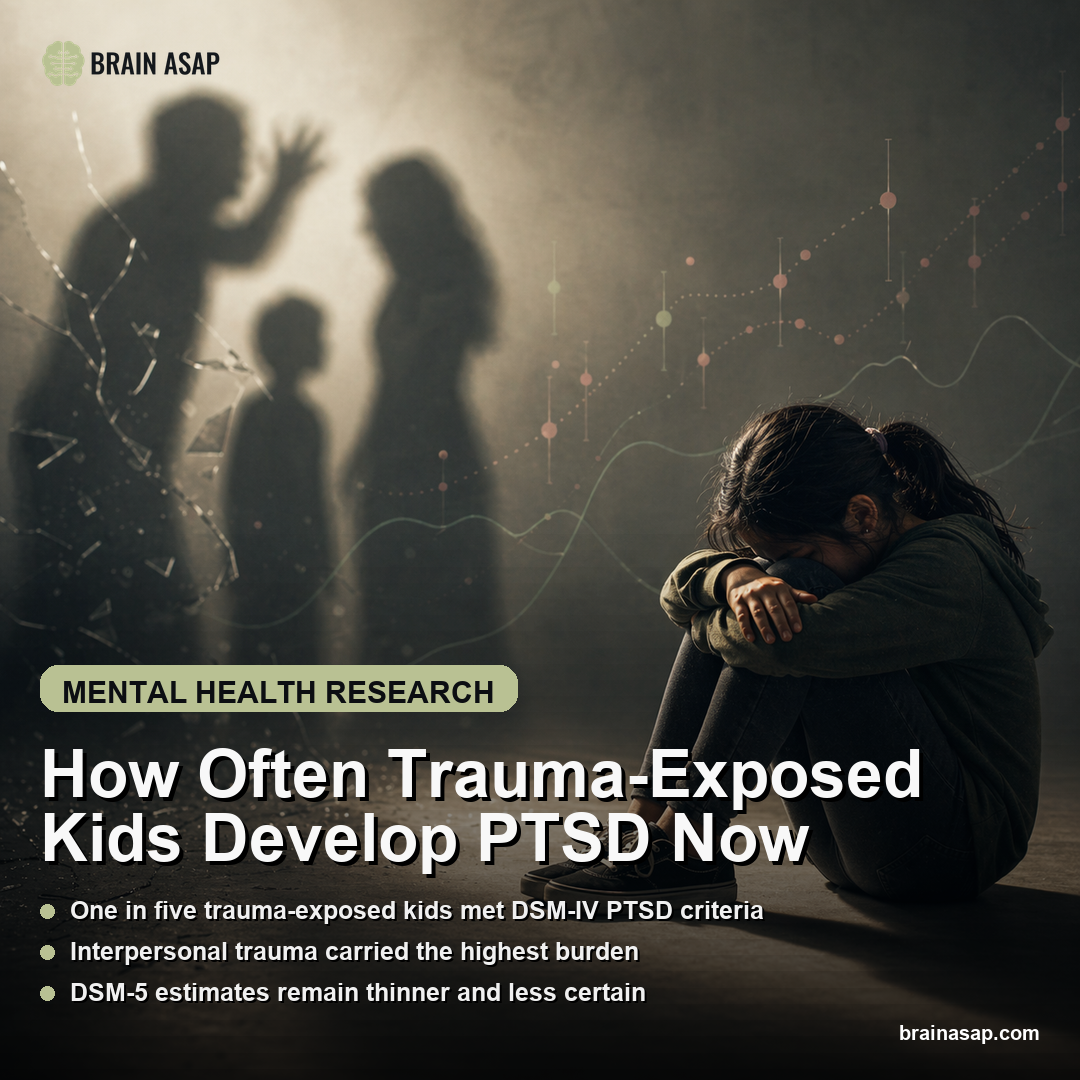
TL;DR: An updated meta-analysis of 95 studies found that about 1 in 5 trauma-exposed children met DSM-IV PTSD criteria and about 1 in 8 met DSM-5 criteria, with the highest rates in girls and in youth exposed to interpersonal trauma.
Key Findings
- 95 studies over 30 years: The review pooled 64 independent samples, including 6,745 youth in the DSM-IV analysis and 12,644 in the DSM-5 analysis.
- 20.3% under DSM-IV: Across 56 samples, the pooled PTSD prevalence was 20.3% (95% CI 14.9-26.2).
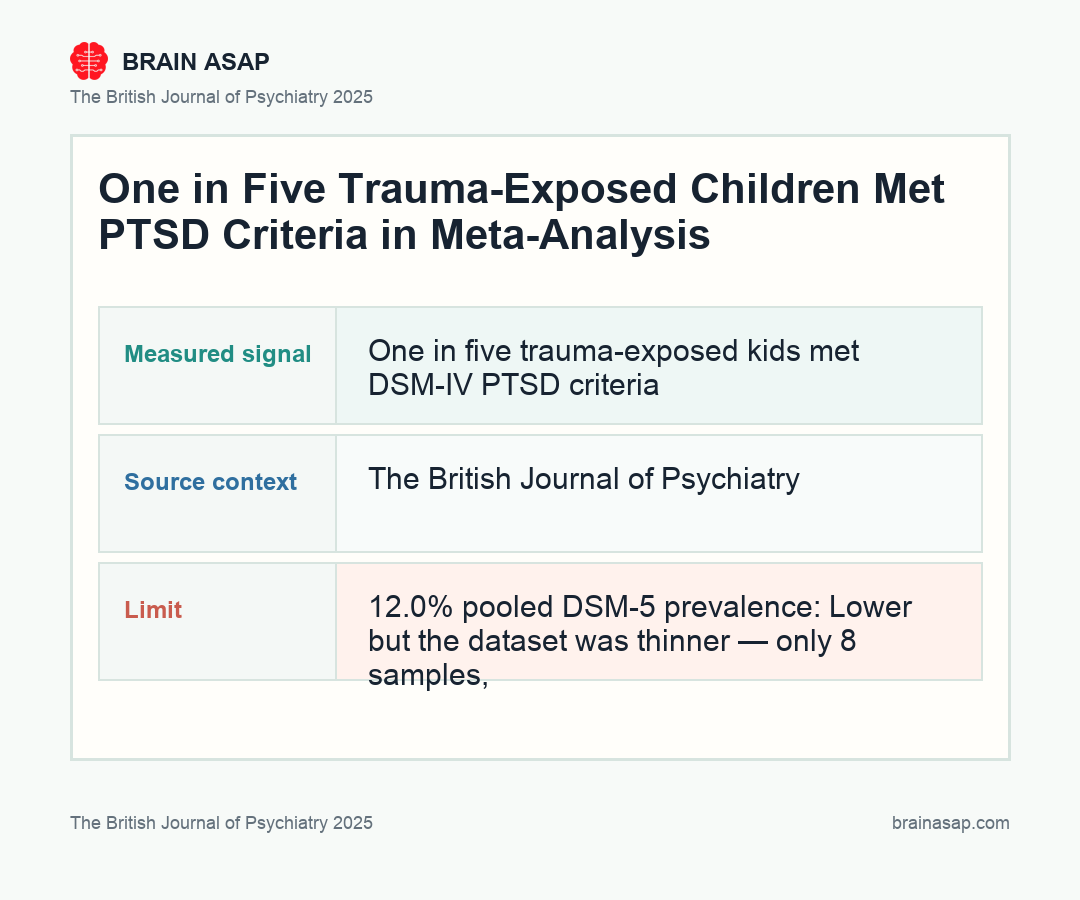
- 12.0% under DSM-5: Across the smaller 8-sample DSM-5 dataset, prevalence was 12.0% (95% CI 3.7-24.2), though the confidence interval stayed wide.
- Interpersonal trauma carried the heaviest load: DSM-IV prevalence reached 32.1% after interpersonal trauma versus 11.8% after non-interpersonal trauma.
- Girls were at higher risk: Samples with a lower percentage of boys showed higher PTSD prevalence, and gender significantly moderated the pooled estimate.
- Interview choice changed the number: In the DSM-IV set, prevalence varied substantially by diagnostic interview, from 8.8% with DICA to 62.3% with CPTSDI.
Source: The British Journal of Psychiatry (2025) | Visser et al.
The most important number in trauma care is not how many children experience something terrible. It is how many still meet full PTSD criteria after the immediate chaos has passed. This paper updates that estimate with three-level meta-analysis and, just as importantly, shows how much the answer shifts depending on the trauma and the diagnostic instrument.
One in Five Trauma-Exposed Children Met DSM-IV PTSD Criteria
Traumatic exposure is common in childhood, but PTSD is not automatic. That distinction can hide the clinical burden: even when most exposed children recover, this meta-analysis suggests the affected minority is large enough to demand routine follow-up.
The authors updated the field’s last major prevalence estimate with a much broader evidence base and a more modern statistical approach. Instead of collapsing each study to one number and pretending all variance is the same, they used a three-level random-effects model that can better account for dependence within studies. The prevalence estimate is sturdier than a simple pooled average.
The topline result is stark. Under DSM-IV criteria, the pooled prevalence was 20.3%.
That means roughly one in five trauma-exposed children or adolescents went on to meet full PTSD criteria. Under DSM-5, the pooled estimate fell to 12.0%, but the evidence base there was much thinner and the confidence interval was wide enough to leave real uncertainty.
What 95 Studies Say About Trauma Type and Risk
The paper’s clearest moderator was trauma type. In the DSM-IV analysis, children exposed to interpersonal trauma, such as assault, abuse, or other human-caused violations, had a pooled PTSD prevalence of 32.1%. Children exposed to non-interpersonal trauma, such as accidents or disasters, came in at 11.8%.
That gap is too large to shrug off as statistical noise. It suggests that the meaning and context of the trauma, not just the presence of fear, changes the psychiatric aftermath.
Interpersonal trauma often carries betrayal, ongoing threat, shame, secrecy, or disruption inside the home. Those ingredients can make recovery much harder than recovery from a frightening but more bounded event.
The main risk pattern was easier to read when the moderators were separated:
- Interpersonal trauma: PTSD prevalence was higher after assault, abuse, and other human-caused trauma than after accidents or disasters.
- Gender mix: samples with fewer boys tended to show higher PTSD prevalence, consistent with greater risk among girls.
- Time since trauma: prevalence did not significantly differ between children assessed within 3 months and those assessed later in the DSM-IV set.
That timing result does not show timing is irrelevant clinically. It means the study-level prevalence signal was not cleanly explained by that split.
DSM-IV and DSM-5 Told Different PTSD Stories
It is tempting to read the 20.3% versus 12.0% gap as proof that DSM-5 PTSD is simply less common. The safer interpretation is narrower.
DSM-5 changed the symptom structure, added developmental nuance, and dropped some older criteria, so the diagnostic frame is not identical. On top of that, the DSM-5 estimate came from only eight samples, which means each study carries much more weight.
So the lower DSM-5 number is interesting, but it should not be mistaken for settled epidemiology. The paper is explicit that there were not enough DSM-5 samples to run the same moderator analyses. That is an important caution, because the questions clinicians actually care about, who is at highest risk, after which trauma, and under which measurement conditions, were answerable mainly in the DSM-IV dataset.
In other words, DSM-5 may eventually reshape the field’s estimate, but this paper is not the final word on that point. It is a strong interim update.
How Much the Interview Tool Changed the Result
One of the most underappreciated findings is the spread across diagnostic interviews. In the DSM-IV analysis, prevalence ranged from 8.8% with DICA to 62.3% with CPTSDI, with other interviews such as CAPS-CA and K-SADS landing in between.
That does not necessarily mean one interview is wrong and another is right. It means prevalence is partly a measurement problem.
Different interviews emphasize different thresholds, symptom wording, informants, and developmental interpretations. If a school district, pediatric trauma clinic, or emergency follow-up program wants to compare its PTSD rates to the literature, the diagnostic tool matters much more than most reports acknowledge.
This is also why prevalence studies can feel frustrating to families. A child does not become less symptomatic because one instrument is stricter. But from a service-planning point of view, those instrument effects determine how many children qualify for specialized follow-up and how many are counted as “subthreshold” despite real impairment.
What the Meta-Analysis Means for Screening After Childhood Trauma
Clinical systems should stop assuming the base rate is trivial. If one in five trauma-exposed youth met DSM-IV PTSD criteria across the pooled literature, the burden is large enough that passive watch-and-wait approaches will miss a lot of children.
Screening also has to be staged intelligently. Immediate distress after trauma is expected, but persistent intrusive memories, avoidance, hyperarousal, negative mood, or functional impairment need follow-up rather than reassurance alone.
The meta-analysis supports a tiered approach: universal early check-ins after serious trauma, closer monitoring after interpersonal trauma, and diagnostic interviews when symptoms persist or impair school, sleep, family life, or safety.
The paper especially strengthens the case for targeted follow-up after interpersonal trauma and for a lower threshold to screen girls and adolescents who remain impaired even when the event is no longer immediate. It also argues for more transparency in how PTSD is assessed. A prevalence number without the interview method attached is less informative than it looks.
There are limits. The DSM-5 evidence base is still sparse, the studies vary by trauma context and country, and prevalence is not the same as chronicity or functional impact.
But the update still changes the center of gravity. The right starting assumption is no longer “PTSD in kids is relatively rare after trauma.” The better assumption is: many children recover, but the minority who do not is large enough to demand systematic screening and better measurement.
Paper: Post-traumatic stress disorder rates in trauma-exposed children and adolescents: updated three-level meta-analysis. The British Journal of Psychiatry. 2025.. DOI: 10.1192/bjp.2025.30
Authors: Visser et al.
Study Design: Updated three-level meta-analysis
Sample Size: 95 studies over 30 years: The review pooled 64 independent samples, including 6,745 youth in the DSM-IV analysis and 12,644 in the DSM-5 analysis.
Key Statistic: 20.3% under DSM-IV: Across 56 samples, the pooled PTSD prevalence was 20.3% (95% CI 14.9-26.2).