Meat Intake Linked to Lower Dementia Risk in APOE4 Carriers
TL;DR: In APOE4 carriers, higher total meat intake tracked with lower observed dementia risk over 15 years, while a higher processed-to-total meat ratio moved in the unfavorable direction.
Key Findings
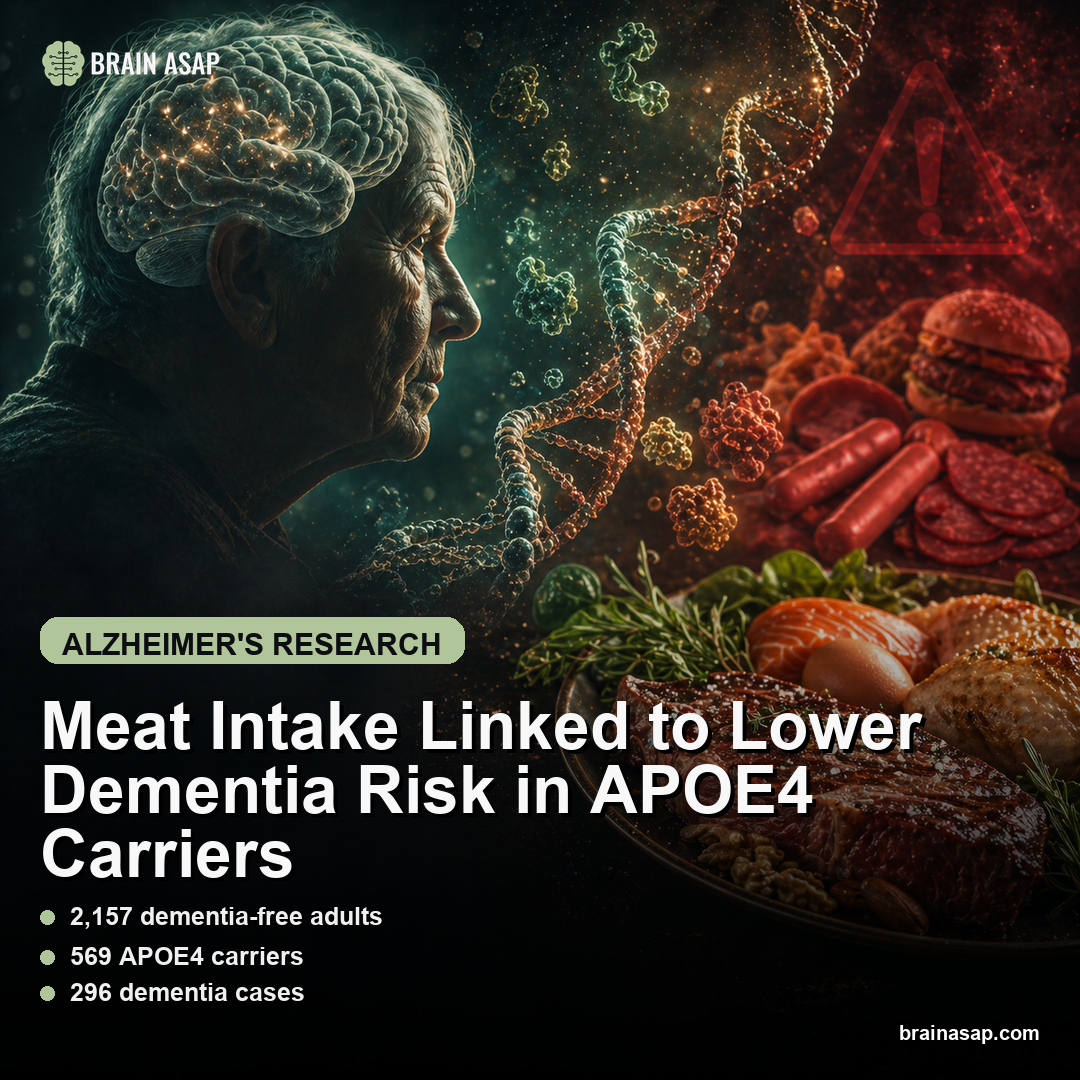
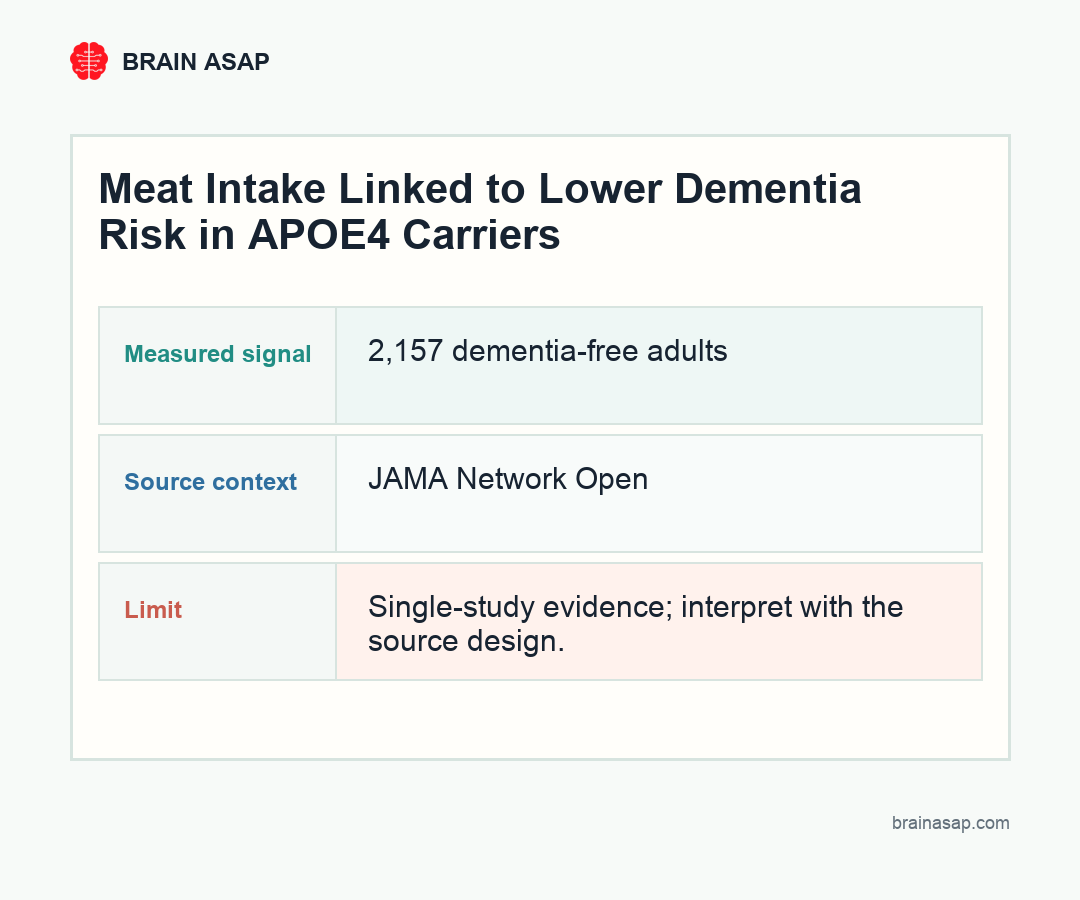
- 2,157 dementia-free adults: The study used the Swedish National Study on Aging and Care-Kungsholmen cohort with up to 15 years of follow-up.
- 569 APOE4 carriers: About 26.4% of participants had APOE3/4 or APOE4/4 genotypes.
- 296 dementia cases: Incident dementia was analyzed while treating nondementia death as a competing risk.
- Lower risk in APOE4 carriers: Top versus bottom quintile of meat intake was linked to lower dementia risk in APOE4 carriers (sHR, 0.45; 95% CI, 0.21 to 0.95; P=.04).
- Processed ratio looked worse: A higher processed-to-total meat ratio was unfavorably associated with dementia risk (sHR, 1.14; 95% CI, 1.01 to 1.29; P=.04).
Source: JAMA Network Open (2026) | Norgren et al.
APOE4 is one of the strongest common genetic risk factors for Alzheimer’s disease, which makes any diet-by-genotype finding instantly attention-grabbing and easy to overstate. This JAMA Network Open paper is interesting precisely because it is both provocative and constrained.
The Result Was Genotype-Specific
The paper did not find a broad “meat prevents dementia” result. It found that the association differed by APOE genotype. Among participants with APOE3/4 or APOE4/4 genotypes, higher total meat intake was linked with better cognitive trajectory and lower dementia risk.
Among participants without those APOE4-containing genotypes, the same association was not found. That contrast is the whole point. It suggests dietary risk and benefit may differ across genetic backgrounds.
The dementia-risk estimate in APOE4 carriers was striking: top versus bottom meat-intake quintile carried an sHR of 0.45. In plain terms, that is a substantially lower observed risk in the high-intake group, though the confidence interval was wide and residual diet, survival, and cardiometabolic confounding remain possible.
Fifteen Years of SNAC-K Data Gave the Study Weight
The cohort came from SNAC-K, a well-known Swedish aging study. Participants were at least 60 years old, dementia-free at baseline, and followed for up to 15 years.
The analysis included 2,157 people, with 1,680 contributing longitudinal cognitive data. During follow-up, 296 participants developed dementia and 690 died without dementia. The last number is important because death can hide dementia risk in older cohorts if not handled carefully.
The researchers used Fine and Gray models to account for nondementia death as a competing risk. They also analyzed cognitive trajectory, not just a binary dementia endpoint, which makes the paper more informative than a simple food-frequency association.
Processed Meat Complicated the Simple Headline
The processed-to-total meat ratio moved in the unfavorable direction. Higher processed proportion was associated with increased dementia risk, with an sHR of 1.14.
- Total meat: the protective-looking association appeared in APOE4 carriers.
- Processed share: a higher processed-to-total ratio moved in the unfavorable direction.
- Interpretive boundary: the finding is a genotype-specific signal, not a universal high-meat recommendation.
The reason is “meat” is not one exposure. Fresh red meat, poultry, processed meats, dietary pattern, sodium, nitrates, socioeconomic factors, and overall food quality can all travel under the same casual label.
The study did not find a substantial difference between unprocessed red meat and poultry in the scanned abstract. But it did suggest that the processed share of meat intake deserves separate attention.
The Evolutionary Hypothesis Is Interesting, Not Settled
The press material highlights an evolutionary idea: APOE4 is an older variant that can have arisen in an ancestral dietary environment with more animal-based foods. That hypothesis is plausible enough to investigate, but it should not be treated as proof.
Modern older adults do not live in Paleolithic conditions. Meat intake today can come bundled with different cooking methods, processed products, cardiometabolic risks, fiber displacement, and health behaviors. A genotype-specific observational result cannot resolve all of that.
What the paper does support is more targeted nutrition research. If APOE genotype changes the relationship between diet and cognitive aging, one-size-fits-all dementia-prevention advice may miss important biology.
This Is Not a Reason to Self-Prescribe a High-Meat Diet
The obvious danger is that the headline becomes dietary permission. That would be too fast. The study is observational, based on food-frequency questionnaires, and conducted in a specific Swedish cohort.
It also does not override cardiovascular risk, kidney disease, colorectal cancer concerns, environmental considerations, or individual medical context. Dementia prevention advice has to live inside the whole body, not only inside an APOE model.
The careful takeaway is narrower: APOE4 carriers in this cohort did not show the expected cognitive disadvantage at high meat intake, while processed-meat proportion looked unfavorable overall. That is a strong reason for replication, not a final menu.
APOE4 May Change the Nutrition Question
APOE is involved in lipid transport and brain metabolism, so a diet interaction is biologically plausible. APOE4 carriers differ in Alzheimer’s risk, lipid handling, inflammation, vascular risk, and possibly how the brain responds to energy stress. A genotype-specific diet signal therefore should not be dismissed just because the exposure sounds culturally loaded.
But plausible is not proven. Meat intake may be standing in for protein adequacy, iron, B vitamins, lower carbohydrate intake, broader dietary pattern, socioeconomic factors, or survival effects. The authors used methods aligned with causal-inference principles, but no observational diet paper can fully escape measurement error and residual confounding.
The study is strongest as a hypothesis generator for precision nutrition. It says APOE genotype may matter enough that future dementia diet trials should stratify by it rather than averaging everyone together.
The Processed-Meat Ratio Is the Caution Flag
The processed-to-total meat finding keeps the result from becoming a simplistic pro-meat interpretation. A higher processed proportion was associated with higher dementia risk, and that signal did not depend meaningfully on APOE interaction in the scanned abstract.
Processed meats can differ from unprocessed meat in sodium, preservatives, cooking byproducts, fat profile, and the broader dietary pattern they travel with. That does not show processed meat was proven causal here, but it does mean the practical conversation should separate total protein sources from heavily processed food patterns.
The public-facing version should be careful: the interesting finding is genotype-specific total meat association in one cohort, not a universal recommendation to eat more processed meat. The study itself points in almost the opposite direction on that second question.
Protein Adequacy May Be One Plausible Bridge
One plausible interpretation is not meat itself as a single decisive exposure, but adequate protein and nutrient density in older adults at genetic risk. Aging often brings reduced appetite, muscle loss, frailty, and changing metabolism, all of which can interact with brain health.
That possibility still needs direct testing. Future work would need to compare meat with other protein sources, measure total diet quality, and examine whether the APOE4 signal reflects animal protein, micronutrients, lower processed-food displacement, or something else entirely.
It would also need to ask what participants ate instead of meat. Replacing meat with legumes, fish, yogurt, ultra-processed snacks, or refined starches would create very different biological comparisons, even if the food-frequency table labeled each person as lower-meat.
That substitution question is where the next study should start.
Otherwise the result will remain interesting but hard to turn into advice.
Paper: Meat Consumption and Cognitive Health by APOE Genotype. JAMA Network Open. 2026. DOI: 10.1001/jamanetworkopen.2026.6489
Authors: Norgren et al.
Study Design: Population-based longitudinal cohort study with genotype-stratified dietary analyses.
Sample Size: 2,157 dementia-free older adults, including 569 APOE3/4 or APOE4/4 carriers.
Key Statistic: In APOE4 carriers, top versus bottom quintile of total meat intake was associated with lower dementia risk (sHR, 0.45; 95% CI, 0.21 to 0.95; P=.04).