Fish Oil Supplements Aren’t the Villain
TL;DR: A comprehensive review of the UK Biobank found that fish oil supplements show favorable associations with health outcomes—not harmful ones—contradicting recent alarming headlines about atrial fibrillation risk.
When a major study claims fish oil supplements increase heart arrhythmia risk, the headlines scream. But what happens when researchers dig deeper into the same dataset and find the opposite? This is exactly what happened with fish oil in the UK Biobank, where a wave of negative publicity around atrial fibrillation masked a much more nuanced reality hidden in the data.
Key Findings
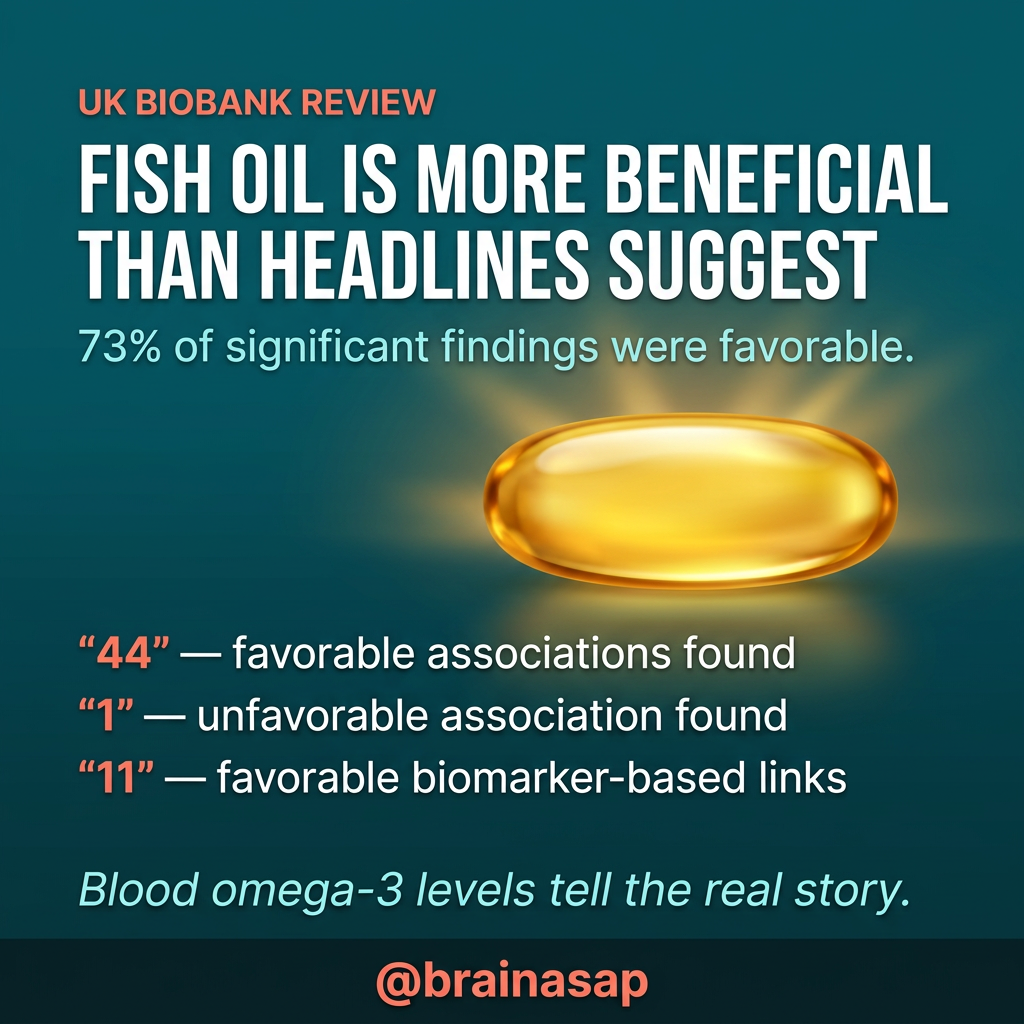
- 44 favorable associations: Among 60 UK Biobank studies examining fish oil supplement use and disease outcomes, 44 showed statistically significant favorable associations—accounting for 73% of all significant findings.
- One unfavorable finding: Only one study reported an unfavorable association, which involved osteoarthritis, while another found no association at all.
- Meta-analyses support benefits: Six published meta-analyses using circulating omega-3 blood biomarkers reported 11 statistically significant favorable relationships with major disease outcomes and zero unfavorable associations.
- Omega-3 status matters most: Studies measuring actual omega-3 levels in blood provide more objective evidence than self-reported supplement use questionnaires.
- Healthy user bias unlikely: The consistency of favorable outcomes across biomarker-based analyses suggests omega-3 fatty acids themselves drive the benefits, not merely the behavior of taking supplements.
- Neutral finding on stroke: One investigation found no unfavorable association between fish oil and hemorrhagic stroke, adding to the evidence of relative safety.
Source: Prostaglandins Leukot Essent Fatty Acids (2025) | Abuknesha et al.
The Atrial Fibrillation Scare That Started It All
In 2024, a study from the UK Biobank made waves claiming that fish oil supplement users had elevated atrial fibrillation risk in the general population. Media outlets ran with it, and supplement sales likely dropped accordingly. But this conclusion—repeated endlessly across health news cycles—raised a critical question: what about all the other health outcomes in that same massive dataset?
This review by Abuknesha and colleagues set out to answer it comprehensively. Instead of focusing on one dramatic finding, they surveyed the entire medical literature for papers examining fish oil supplement use in the UK Biobank population across a range of diseases and conditions.
The Broader Picture: 60 Studies, One Clear Pattern
What emerged was striking. The researchers identified 32 UK Biobank studies examining the links between reported fish oil use and various diseases. Collectively, these studies reported 60 fish-versus-disease-outcome associations—and the majority favored fish oil.
44 associations were significantly favorable, meaning they showed protective or beneficial effects. One was unfavorable (osteoarthritis). The remaining associations were neutral. When the data is presented this way—not cherry-picked headlines, but the full picture—the story shifts entirely.
The researchers didn’t stop there. They also examined six published meta-analyses that took a different approach: instead of relying on people’s self-reports about taking fish oil, these studies measured actual omega-3 blood levels. This matters because self-reported supplement use is inherently unreliable. Someone who says they take fish oil regularly might take it sporadically, or not at all.
These biomarker-based meta-analyses found 11 statistically significant favorable relationships with major disease outcomes—and crucially, zero unfavorable associations. No increased stroke risk. No spike in arrhythmias. Just consistent, measurable benefits.
Why Measured Omega-3 Is More Trustworthy Than Surveys
The divide between questionnaire-based studies and biomarker-based studies reveals a fundamental problem in nutritional epidemiology: people are terrible at remembering what they ate or whether they took supplements. A woman who took fish oil for three months five years ago might not recall it at all. A man who takes it sporadically might report it as habitual.
Circulating blood levels of omega-3 fatty acids—docosahexaenoic acid (DHA) and eicosapentaenoic acid (EPA)—don’t have this problem. They reflect actual tissue exposure regardless of how the omega-3 got there: supplements, fish, seaweed, or fortified foods.
The consistency of favorable findings in these biomarker studies is important for another reason: it challenges a common criticism of observational research called “healthy user bias.” The argument goes like this: people who take fish oil supplements are generally more health-conscious, exercise more, eat better, and have healthier lifestyles overall. So any benefits we see might not come from the omega-3 itself, but from the fact that supplement-takers are already healthier people.
If that were the case, we’d expect the strongest benefits to appear in self-reported supplement users (the “healthy” group) and weaker benefits in objective biomarker studies. Instead, the opposite is true. The biomarker studies show consistent, significant favorable associations. This suggests that higher omega-3 status itself drives the benefits.
What the Evidence Points To
The authors conclude that the totality of UK Biobank evidence—both from the 60 disease associations in survey-based studies and from the six meta-analyses using blood biomarkers—supports a straightforward hypothesis: higher omega-3 status is generally beneficial for health, regardless of how it’s achieved. The protective effects appear across cardiovascular health, metabolic function, and likely other domains.
This doesn’t mean every fish oil supplement user will live to 100, or that fish oil is a cure-all. It means that at the population level, when you look at the data honestly—all of it, not just the alarming studies—omega-3 fatty acids show up as a protective factor for most major health problems.
[Insert image: bar chart showing favorable (44) versus neutral versus unfavorable (1) health associations for fish oil in UK Biobank studies]
The Bottom Line: Data Beats Headlines
One study claiming harm gets amplified across media. A comprehensive review showing broad benefits gets published in a peer-reviewed journal and mostly ignored. This is why it matters to look at the full evidence base instead of reacting to individual studies, especially when they’re based on the same large dataset that contradicts them elsewhere.
For anyone considering fish oil supplements, this review suggests the risk-benefit calculation skews toward benefit at the population level. For researchers, it’s a reminder that one alarming finding doesn’t overturn decades of evidence unless subsequent investigations corroborate it. In this case, they mostly don’t.
Citation: Abuknesha RA, O’Keefe JH, Harris WS. A review of the relationships between reported fish oil supplement use and health outcomes in the UK Biobank. Prostaglandins Leukot Essent Fatty Acids. 2025 Dec;207:102711. DOI: 10.1016/j.plefa.2025.102711
Authors’ affiliations: Nada R. Abuknesha, Saint Luke’s Mid America Heart Institute, Kansas City, MO; James H. O’Keefe, Saint Luke’s Mid America Heart Institute, Kansas City, MO; William S. Harris, University of South Dakota School of Medicine, Sioux Falls, SD.