Cell-Type Gene Networks Reveal Hidden Causes of Alzheimer’s
TL;DR: Researchers mapped how genes are regulated differently across six brain cell types in Alzheimer’s disease, discovering that excitatory neurons drive the most extensive regulatory disruptions—and identifying key hub genes like RPS27A that could become therapeutic targets.
Alzheimer’s disease is a disease of broken communication. The brain doesn’t just lose cells—it loses control, as genes that once coordinated healthy aging suddenly misfire in ways that vary wildly depending on which type of cell you’re looking at. But traditional genetic studies miss this critical detail, treating the brain as one undifferentiated lump. A new study flips that assumption upside down.
Key Findings
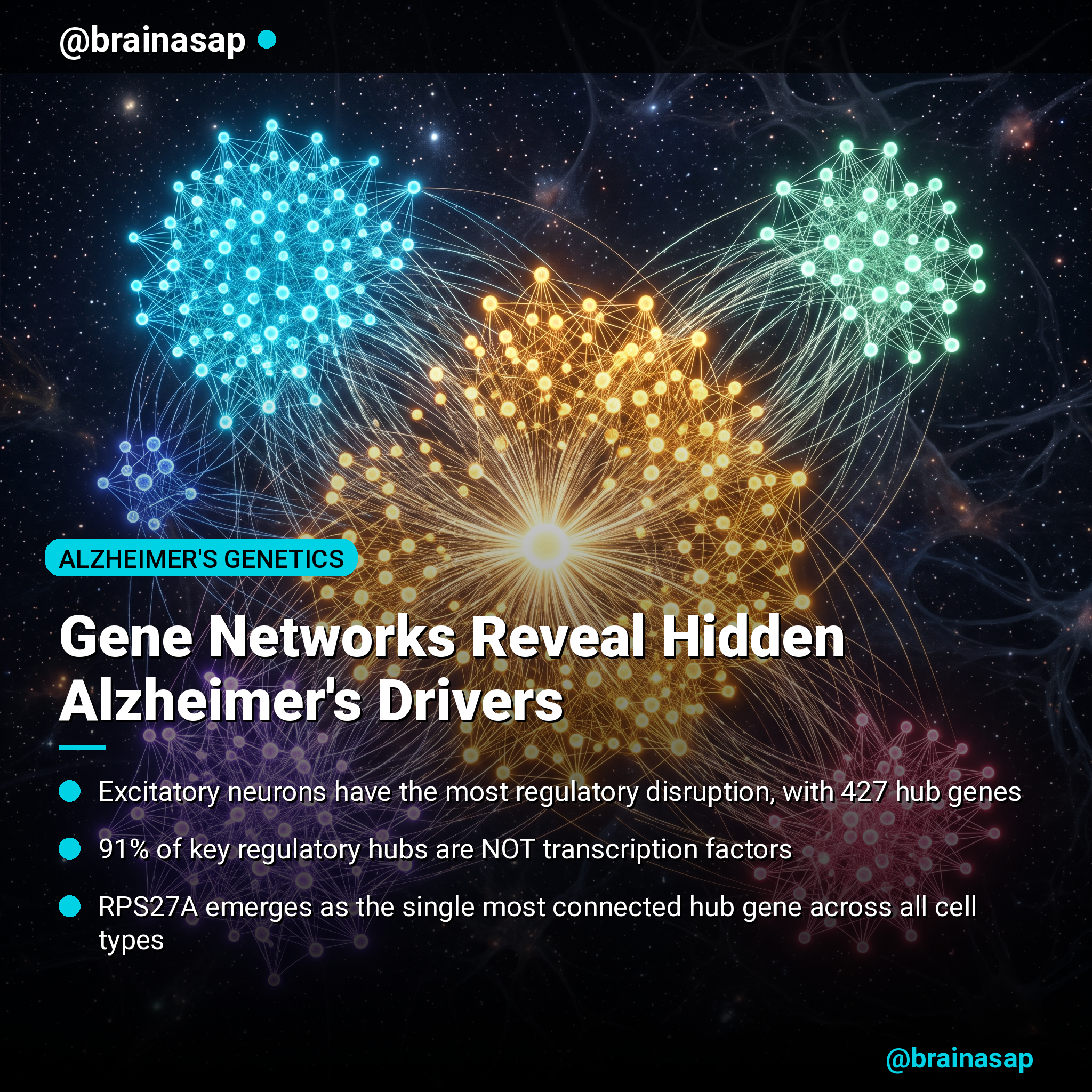
- Excitatory neuron dominance: Excitatory neurons exhibited the most extensive regulatory networks with 2,428 regulations, far exceeding astrocytes (2,446) and other glial cells, with the strongest regulatory effects concentrated in this cell type.
- 427 hub genes in excitatory neurons: Excitatory neurons possessed 11.66% of all hub genes—427 regulatory hubs that orchestrate downstream gene expression, with genes like ETV5, EGR1, and NRAA1 at the top regulatory tier.
- APP and MAP2 directional causation: The study identified bidirectional causal regulation between APP (amyloid precursor protein) and MAP2 in inhibitory neurons, with a correlation of 0.78, revealing protein-protein interaction networks previously hidden by correlation-only analysis.
- RPS27A as critical hub: RPS27A emerged as the single hub gene with the highest regulatory degree across all cell types, controlling ribosomal function and protein degradation pathways central to neurodegeneration.
- Non-TF regulation underappreciated: Only 8.67% of regulatory hubs were transcription factors; 91.33% were non-TF genes, demonstrating that classical TF-centric models miss 9 out of 10 regulatory relationships.
- 272 AD patients, cell-type resolution: The study analyzed 947,268 nuclei from 272 Alzheimer’s disease patients across six major brain cell types using single-nucleus RNA sequencing and whole-genome sequencing, enabling unprecedented cellular precision.
Source: Alzheimer’s & Dementia (2026) | Liu, Jiang, Kim, Tukker et al.
Why Correlation Isn’t Causation in the Alzheimer’s Brain
For decades, researchers studying Alzheimer’s disease have relied on a shortcut: find genes that are turned on or off together, and assume one is controlling the other. But the brain is far more wired than that assumption allows.
When you look at 272 Alzheimer’s disease patients at the level of individual cells—not tissue averages—the picture transforms. Genes that appear linked in bulk data might be controlled by entirely different regulators in, say, excitatory neurons versus microglia. The Liu team decided to build cell-type-specific causal gene regulatory networks (GRNs): maps that show not just which genes move together, but which genes are actually pulling the strings.
Building the Regulatory Map Cell by Cell
The researchers combined single-nucleus RNA sequencing (capturing which genes are active in individual cell types) with whole-genome sequencing (identifying genetic variants that act as “instruments” for causal inference). This two-pronged approach allowed them to apply a computational method called SIGNET—essentially asking: “If this genetic variant changes, does gene A consistently shift before gene B?”
They then grouped 947,268 individual nuclei from frozen brain tissue into six major cell types: excitatory neurons, inhibitory neurons, astrocytes, oligodendrocytes, microglia, and oligodendrocyte progenitor cells (OPCs). Each cell type got its own regulatory network built independently—crucial, because a gene might act as a hub regulator in one cell type but remain silent in another.
Excitatory Neurons: The Regulatory Powerhouses of AD
The biggest surprise came when comparing regulation counts across cell types. Excitatory neurons dominated with 2,428 total regulations and 427 hub genes—far more than any other cell type. These hub genes showed the strongest regulatory effects in both directions: turning up genes tied to neurodegeneration and turning down protective genes.
The top regulatory hubs in excitatory neurons included ETV5, EGR1, NR4A1, and ZBT87A. Notably, ETV5 and EGR1 weren’t transcription factors in the classical sense—they were genes whose protein products act as regulatory intermediaries, a finding that would have been invisible in traditional TF-centric models.
RPS27A emerged as perhaps the most striking discovery. This single hub gene, expressed broadly across all cell types, controls ribosomal function and protein quality control. RPS27A’s high regulatory degree in both incoming and outgoing directions suggests it’s not just a target of disease pathways—it’s a central node that, if dysregulated, cascades through multiple other genes.
The APP Puzzle: Unmasking Hidden Causal Relationships
Amyloid precursor protein (APP) is the villainous favorite in Alzheimer’s research—the gene from which toxic amyloid-beta is cleaved. But its actual role in cell-type-specific regulation had remained fuzzy.
In the GRN analysis, APP showed complex bidirectional causal regulation with MAP2 in inhibitory neurons (correlation of 0.78), and strong causal links through intermediate proteins like SNCA and GRB2. This reveals a fundamental problem with older studies: correlation-based networks reported only indirect connections between APP and other genes, missing the direct causal architecture that matters for drug targeting.
Four key Alzheimer’s risk genes—APP, PICALM, PICD2, and PSEN1—were mapped across the networks, showing that they don’t act as isolated risk factors. Instead, they’re embedded in regulatory circuits with distinct roles depending on cell type, explaining why blocking APP alone has failed as a treatment strategy.
The Non-TF Revolution
One of the study’s most important findings flips textbook assumptions. In the excitatory neuron networks, only 8.67% of hub genes were transcription factors (TFs). The remaining 91% were non-TF genes whose protein products orchestrate regulation through other mechanisms: post-translational modifications, protein-protein interactions, and metabolic rewiring.
Genes like MAPRE2 (which stabilizes microtubules) and SPIN1 (involved in synaptic function) emerged as powerful regulatory hubs despite not binding DNA. This suggests that therapies focusing exclusively on transcription factor targets will miss the majority of disease-relevant regulation.
Limitations and the Path Forward
The study was limited to frozen brain tissue from the Religious Orders Study and the Rush Memory and Aging Project—both predominantly White cohorts. Future work should validate findings across diverse populations and living tissue to confirm whether the regulatory patterns persist in vivo.
The researchers also note that constructing GRNs requires massive sample sizes and computational power. The method isn’t easily applied to smaller studies or tissues, though the framework is now available for other neurodegenerative diseases.
[Insert image: network diagram showing APP-MAP2 bidirectional regulation in excitatory neurons with RPS27A as central hub gene]
Why This Matters for Treatment
Classical approaches to Alzheimer’s have targeted single proteins—amyloid-beta, tau, inflammation. But the GRN reveals why single-target drugs keep failing: Alzheimer’s is fundamentally a disease of broken regulatory networks, not broken individual proteins.
RPS27A, the top hub gene across cell types, now becomes a candidate for deeper investigation. So do the interconnected modules around APP and MAP2 in inhibitory neurons. Most importantly, the cell-type specificity means future drugs could be designed to rescue regulatory function in excitatory neurons specifically, where the dysregulation is most severe.
This study doesn’t provide immediate answers about which genes to target. But it provides something more valuable: a comprehensive regulatory map of Alzheimer’s at the cellular level, and a methodology for building similar maps in other neurodegenerative diseases. In a field that’s spent decades chasing single genetic bullets, the recognition that Alzheimer’s is a disease of network dysfunction is itself a breakthrough.
Citation: Liu D, Jiang Z, Kim H, Tukker AM, Dalvi A, Xie J, Li Y, Yuan C, Bowman AB, Zhang D, Zhang M. From correlation to causation: cell-type-specific gene regulatory networks in Alzheimer’s disease. Alzheimer’s & Dementia. 2026;22:e71053. DOI: 10.1002/alz.71053
Authors’ affiliations: Department of Epidemiology and Biostatistics, University of California, Irvine; Department of Statistics, Purdue University; School of Health Sciences, Purdue University; Center for Complex Biological Systems, University of California, Irvine; Division of Biomedical Engineering, Purdue University, West Lafayette, Indiana.