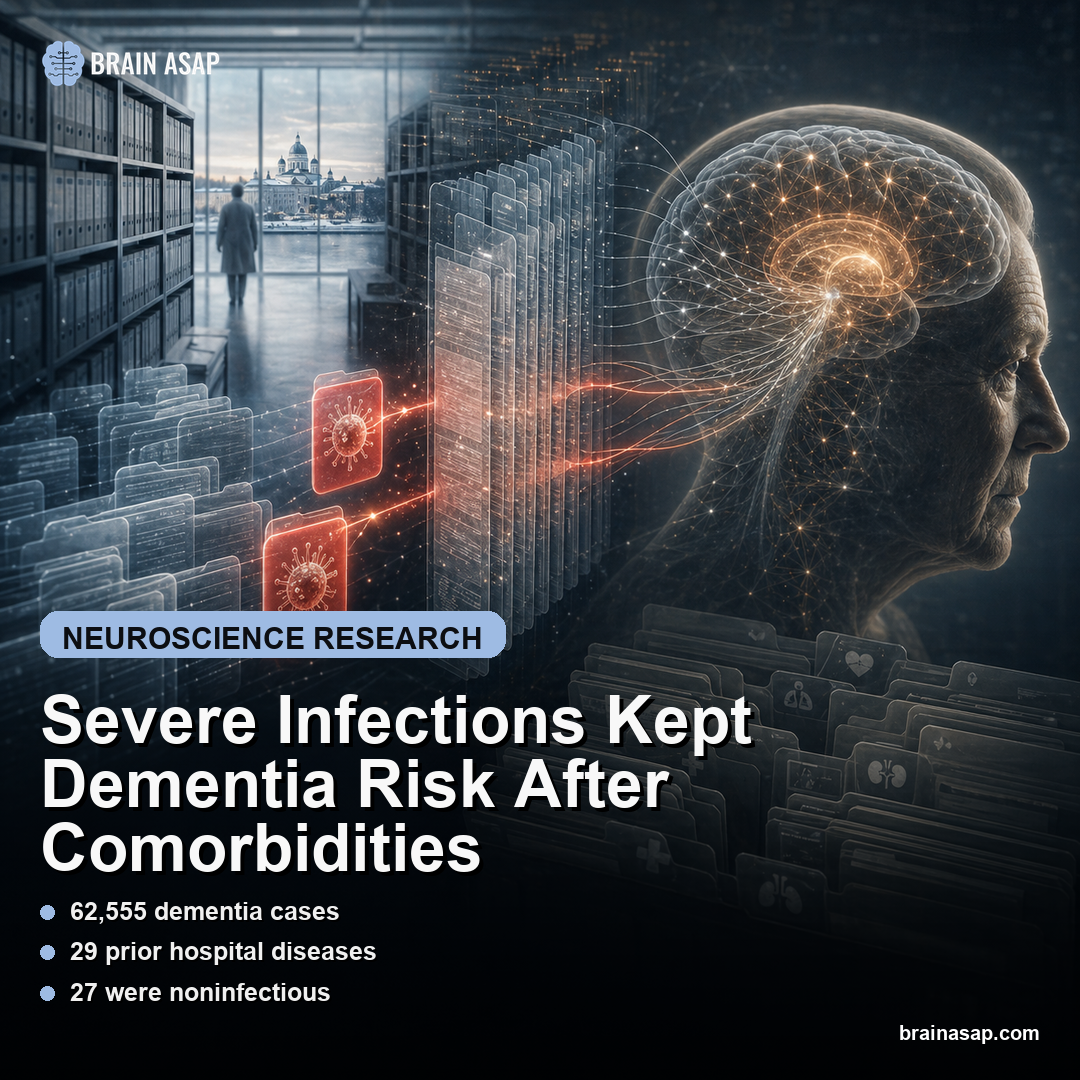
TL;DR: A 2026 study in PLOS Medicine found that severe infections stayed linked to later dementia in Finland even after researchers accounted for a broad set of noninfectious comorbid diseases.
Key Findings
- 62,555 dementia cases: The analysis matched Finnish adults diagnosed with late-onset dementia from 2017 to 2020 against 312,772 dementia-free controls.
- 29 prior hospital diseases: A 1- to 21-year lookback identified 29 hospital-treated diseases robustly associated with dementia risk.
- 27 were noninfectious: The comorbidity map included mental, behavioral, digestive, endocrine, cardiometabolic, neurological, eye, and injury diagnoses.
- 47% had one flagged disease: Before dementia, 29,376 cases had at least one of the 29 dementia-linked hospital diagnoses.
- Infection risk persisted: Cystitis and unspecified bacterial infection both remained associated after adjustment, with post-adjustment rate ratios of 1.19.
Source: PLOS Medicine (2026) | Sipilä et al.
In this Finnish registry study, researchers tested a straightforward alternative explanation: people hospitalized with serious infections may also have diabetes, vascular disease, psychiatric illness, or other diagnoses that raise dementia risk. The analysis asked whether cystitis and unspecified bacterial infection remained associated with later dementia after those noninfectious diseases were included in the model.
Frailty and Comorbidity Were the Main Alternative Explanation
Severe infections are already associated with higher dementia risk, but association is not mechanism. People hospitalized with serious infections often carry other diagnoses that also predict dementia.
The Finnish data let researchers test that problem at scale. Instead of adjusting for a short checklist of chronic disease, they searched hospital records for diseases that appeared years before dementia and were themselves linked to later diagnosis.
The approach targets a real interpretive problem: infection can look risky for several reasons at once. A hospital-treated infection may reflect acute inflammation, underlying frailty, urinary problems, diabetes, vascular disease, medication burden, or early cognitive decline that has already started to change daily life.
Researchers built the analysis around that ambiguity. They first mapped the noninfectious hospital diagnoses that predicted dementia, then asked whether the infection association remained after those comorbidities entered the model.
This is a stricter test than simply adding age, sex, and a few chronic conditions to a model. The analysis treated prior illness as a large registry pattern that had to be measured before the infection association could be interpreted.
Cystitis and Bacterial Infection Survived the 27-Disease Filter
Two infectious diagnoses passed the study’s robust association threshold: cystitis and bacterial infection of an unspecified site. The key question was whether those associations were explained by the 27 noninfectious diseases.
Cystitis moved from a rate ratio of 1.22 to 1.19 after comorbidity adjustment, while unspecified bacterial infection moved from 1.21 to 1.19. The estimates were modest, but the broad adjustment changed them only slightly.
- Cystitis: the dementia-linked rate ratio moved only slightly after the 27 noninfectious diseases were included.
- Unspecified bacterial infection: the adjusted association also remained at 1.19.
- Other hospital diagnoses: most of the comorbidity landscape was noninfectious, including cardiometabolic, neurological, psychiatric, digestive, eye, and injury categories.
The adjusted numbers are small enough to avoid alarmist interpretation, but they are still informative. If a broad comorbidity adjustment barely changes the estimate, the remaining association is less consistent with a simple hospital-record artifact.
The finding is also clinically plausible because urinary and bacterial infections can trigger delirium, hospitalization, inflammatory stress, and functional decline in older adults. The registry cannot prove that those episodes damage the brain, but it gives researchers a reason to test those pathways directly.
The 1.19 rate ratios also need scale. They do not mean one infection determines dementia, but a modest association can still matter when severe infections are common in older populations and often cluster with hospitalization, immobility, delirium, and incomplete recovery.
A One-Year Lag Helped Avoid Early Dementia Confusion
Researchers used a 1-year lag between prior hospital diagnoses and dementia follow-up. The reason is early cognitive decline can itself lead to infections, falls, missed medications, and hospital visits.
No lag can remove every reverse-causation problem, but the 1-year lag makes the result less consistent with dementia already changing behavior right before diagnosis. The exposure window reached as far back as 21 years.
The long lookback is useful because dementia develops over many years. A diagnosis recorded 10 or 15 years before dementia is harder to explain as a last-minute consequence of memory loss than a diagnosis recorded in the months before clinical recognition.
At the same time, hospital data capture the severe end of illness. Mild infections treated at home, outpatient antibiotic use, immune markers, and symptom duration were outside the registry signal analyzed here.
The one-year lag also leaves room for a conservative reading. If infections in the final year before diagnosis were excluded, the remaining association is less likely to be driven only by families seeking care because dementia symptoms had already become obvious.
Nearly Half of Dementia Cases Had Prior Comorbid Disease
The study should not be read as infection replacing vascular, metabolic, psychiatric, or neurological risk. Nearly half of dementia cases had at least one flagged prior disease.
The result supports an additive interpretation: infection may contribute information beyond the measured comorbid diseases. Dementia risk can reflect vascular injury, metabolic disease, psychiatric burden, sensory loss, injuries, and infection-related stress at the same time.
That combined risk profile should change how the finding is used. Infection prevention, vaccination, prompt treatment, urinary-health management, and delirium prevention may belong beside cardiovascular and metabolic care rather than in a separate dementia-prevention category.
Registry Data Can Separate Diagnoses, Not Biology
The authors could not directly measure inflammation, frailty, social isolation, sleep, exercise, smoking, or immune changes that never became registry codes. Those missing variables are not small details.
Still, the scale and matching make the conclusion useful. Infections did not vanish when the measured hospital-record comorbidities entered the model, so severe infection remains worth studying as a potential dementia-risk marker.
The biological possibilities remain broad. Severe infection can trigger systemic inflammation, delirium, blood-brain barrier stress, vascular strain, and prolonged functional decline, any of which could interact with an aging brain already accumulating pathology.
The registry cannot choose among those mechanisms. It does show that cystitis and bacterial infection warrant mechanistic follow-up rather than being treated only as markers of generally sicker patients.
For prevention, the result points toward ordinary clinical systems rather than exotic interventions. Infection control in older adults includes several practical targets:
- Prevention: vaccination, urinary-tract care, catheter stewardship, and hydration.
- Acute care: early treatment and careful delirium monitoring during hospitalization.
- Recovery: rehabilitation after hospitalization and follow-up for incomplete functional recovery.
None of those steps is dementia-specific by itself. The Finnish data suggest they may still belong in the same long-term brain-health conversation as blood pressure, diabetes, hearing, exercise, and depression care.
The next layer should be biological measurement. Studies that pair infection timing with inflammatory markers, delirium episodes, neuroimaging, and cognitive trajectories could test whether the registry signal reflects immune injury, vascular stress, frailty, or several pathways at once.
The paper also keeps the outcome clinically grounded. These were late-onset dementia diagnoses in national records, not a screening score or a single cognitive test, so the association points to a serious endpoint even though the mechanism remains unresolved.
Citation: DOI: 10.1371/journal.pmed.1004688. Sipilä et al. The role of noninfectious comorbidities in the association between severe infections and risk of dementia in Finland: A nationwide registry study. PLOS Medicine. 2026;23(3):e1004688.
Study Design: Nationwide matched Finnish registry study with a 1-year lag and hospital-diagnosis lookback.
Sample Size: 62,555 adults aged 65 or older with late-onset dementia and 312,772 matched dementia-free controls.
Key Statistic: After adjustment for 27 noninfectious dementia-related comorbidities, cystitis and unspecified bacterial infection each retained a rate ratio of 1.19 for dementia.
Caveat: Registry associations cannot prove infection causality or capture all frailty and preclinical dementia pathways.