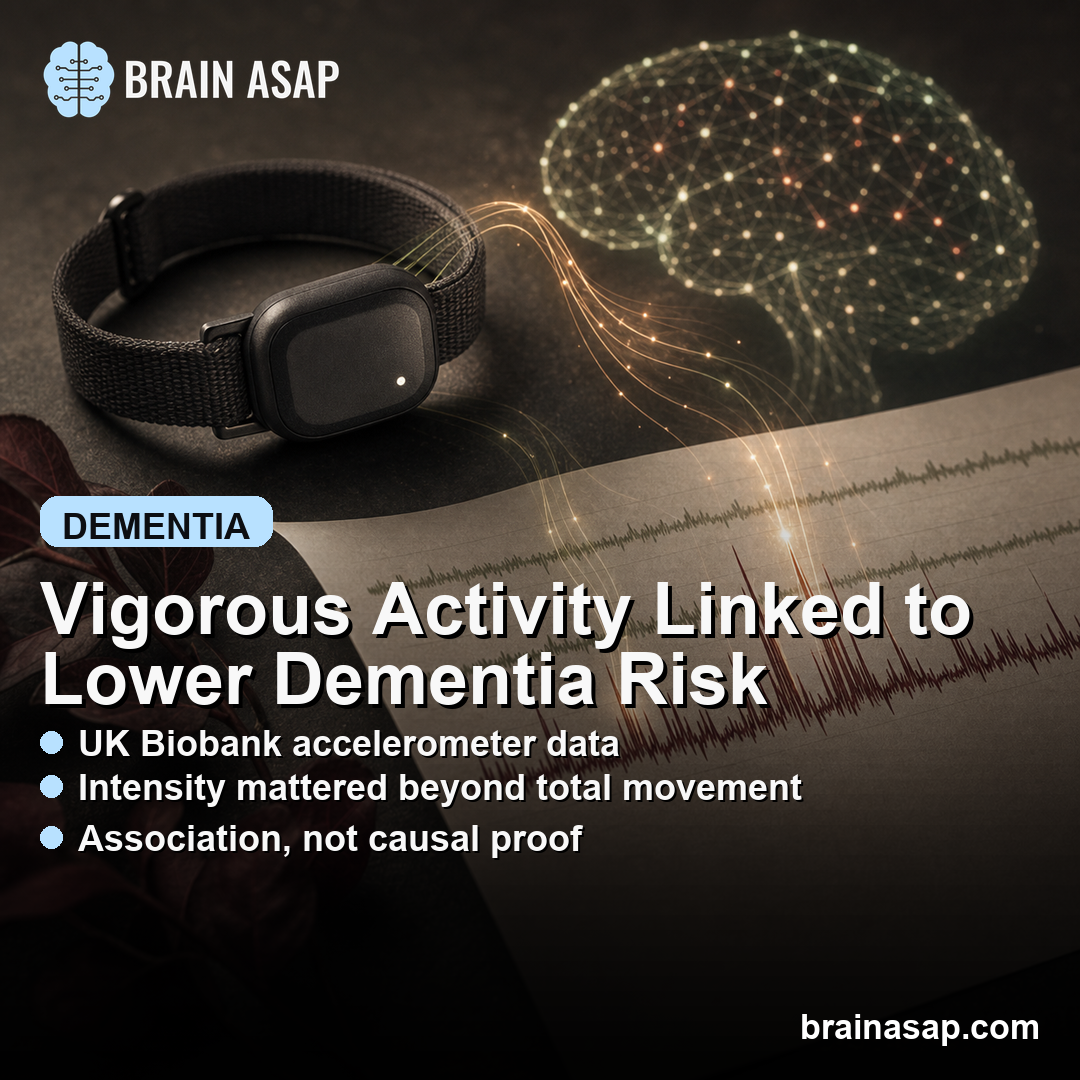
Vigorous Activity Linked to Lower Dementia Risk in UK Biobank
TL;DR: In UK Biobank accelerometer data, the vigorous share of daily movement accounted for 32% of dementia’s population-attributable fraction versus just 8% for total activity volume — suggesting brief breathless bursts carry brain-health information that step counts miss.
Key Findings
- Dementia favored intensity over volume: Population-attributable analysis estimated 32.3% contribution for vigorous intensity versus 8.1% for total activity volume — dementia was uniquely intensity-dependent among the eight chronic diseases tested.
- >4% vigorous activity linked to 29–61% lower risk across eight diseases: Compared to 0% vigorous physical activity (VPA), participants with more than 4% VPA had substantially lower adjusted risks for MACE, type 2 diabetes, AFib, dementia, and others.
- Intensity effect held after controlling for total volume: The vigorous-activity advantage appeared in analyses that already accounted for total movement — intensity carried independent risk information.
- Accelerometers captured what self-report misses: Device-measured wrist data detected short vigorous bursts — brief stair climbs, fast uphills, carrying loads — that questionnaires typically miss.
- UK Biobank scale: 96,408 device-measured + 375,730 self-reported participants: Eight chronic disease outcomes plus all-cause mortality tested across both datasets.
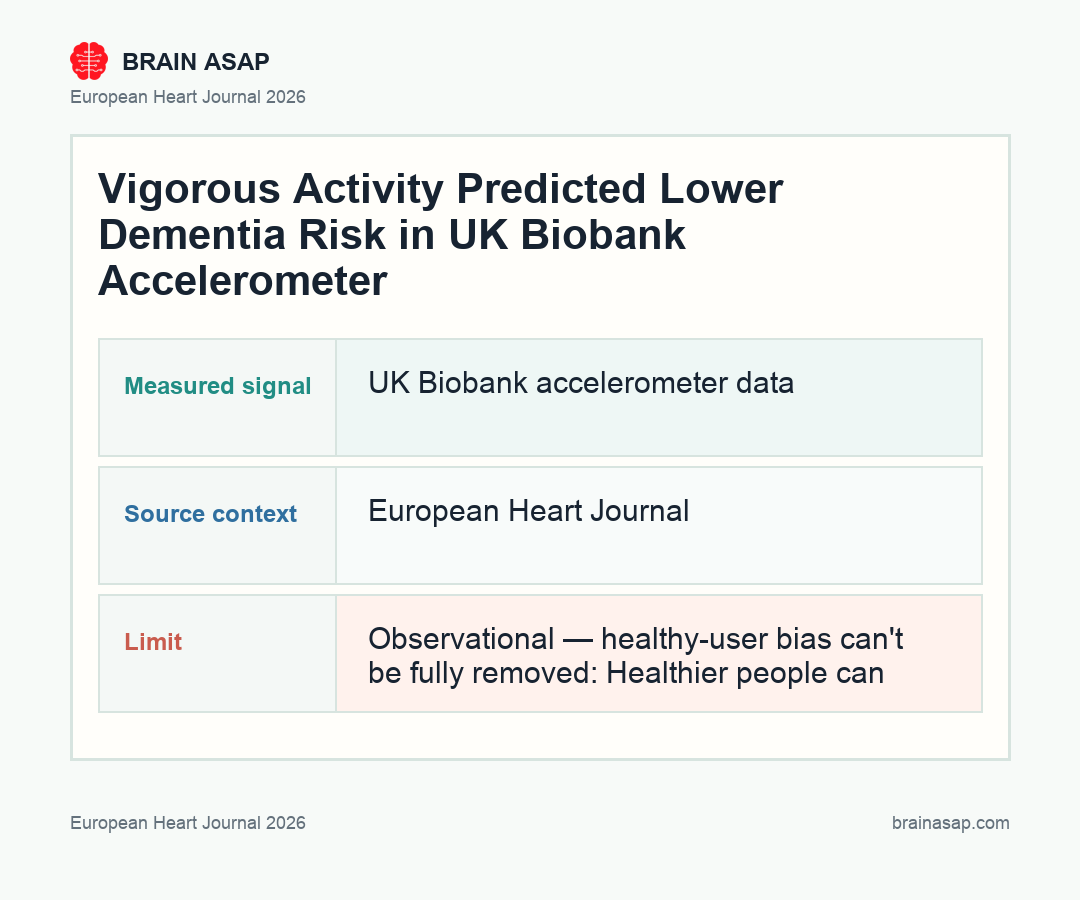
- Observational — healthy-user bias can’t be fully removed: Healthier people can perform more vigorous exercise, so residual confounding remains even with adjustment.
Source: European Heart Journal (2026) | Wei et al.
Physical activity advice tends to sound like a volume prescription: move more, sit less, hit your step count. This large UK Biobank analysis asks a sharper question — is the vigorous share of your daily movement doing something that the total amount of movement can’t fully explain? For dementia specifically, the answer appears to be yes.
Accelerometers Changed the Question
Self-reported exercise has a known problem: people recall formal workouts better than embedded physical activity, and they reliably misjudge intensity. A person who calls themselves “moderately active” may include everything from a gentle stroll to a breathless hill climb without distinguishing them.
Wrist accelerometers fixed this. They captured movement continuously, including the short, intense bursts that often don’t get logged — hurrying upstairs, carrying groceries quickly, walking fast to catch a bus. The device data let the authors separate total physical activity from the percentage of that activity classified as vigorous, then ask whether that vigorous fraction predicted disease risk independently of total volume.
The answer, across 96,408 participants with device data, was yes. Even after accounting for total activity, the vigorous share still predicted outcomes. Two people with the same step count could carry meaningfully different chronic-disease risk if one of them regularly included brief hard efforts and the other didn’t.
Dementia Stood Out Among Eight Chronic Diseases
The study tested eight chronic disease categories plus all-cause mortality: major cardiovascular events, atrial fibrillation, type 2 diabetes, inflammatory disease, metabolic liver disease, respiratory disease, kidney disease, and dementia.
Vigorous activity mattered for all of them, but the dementia result was the most intensity-dependent. Population-attributable analysis estimated that 32.3% of dementia’s burden could be attributed to the vigorous-intensity fraction of movement — versus just 8.1% for total activity volume. For every other disease in the study, the volume-intensity balance looked different.
That asymmetry points to something biology-specific about the brain’s relationship with intensity rather than just duration of movement. It might reflect vascular reserve — harder effort places stronger demands on blood-flow regulation, and cerebrovascular health is central to dementia risk. Or it might reflect metabolic flexibility, inflammatory control, neurotrophic signaling, or some combination of pathways that intensity challenges more powerfully than sustained gentle movement does.
The 4% Threshold Shows the Bar Is Low
The headline comparison — participants with more than 4% vigorous physical activity versus those with 0% — showed 29–61% lower risks across disease categories. That 4% threshold sounds abstract, but it isn’t. In an average waking day’s movement, 4% vigorous means perhaps a few minutes of genuine breathlessness: a fast uphill, a heavy carry, a stair sprint.
This doesn’t require an hour at the gym. It requires some moments of real effort embedded in daily life. The study doesn’t prove that adding those bursts is what causes the lower risk — it’s observational, and healthier people are more capable of vigorous effort. But the finding that even modest vigorous fractions separated risk groups is a clinically useful signal for public-health framing.
Why the Brain Needs More Than Just Steps
The dementia-intensity pattern fits what’s known about the mechanisms linking exercise to brain aging. Vascular health is one of the strongest modifiable determinants of dementia risk — and vigorous exercise challenges the cardiovascular system in ways that low-intensity sustained movement does less effectively.
Dementia also shares risk architecture with metabolic and inflammatory disease. Insulin resistance, blood pressure variability, chronic inflammation, and cardiorespiratory fitness all shape the brain’s long-term environment. Vigorous exercise may address several of these simultaneously: improving endothelial function, reducing arterial stiffness, enhancing insulin sensitivity, and driving anti-inflammatory adaptations that moderate-intensity activity produces less efficiently.
There may also be a neurotrophic component. BDNF — brain-derived neurotrophic factor, a protein that supports neuron survival and plasticity — has been shown to rise more robustly with higher-intensity exercise in several studies. Whether that acute effect translates into long-term dementia protection is unresolved, but it’s a plausible pathway.
This Isn’t a Command to Sprint Through Middle Age
The observational design leaves the conclusion appropriately conditional. Healthier people exercise harder, and no statistical model fully removes that reverse-causality problem. Some of the dementia-vigorous-exercise association may reflect brain health enabling vigorous movement, not vigorous movement protecting the brain.
There’s also the question of who this advice applies to. For people with cardiovascular disease, musculoskeletal problems, or unstable chronic illness, “add some vigorous bursts” needs to be medically supervised and individually calibrated. This study doesn’t override that context.
What it does provide is a better target for exercise research and public-health messaging. The current default — move more, sit less, aim for 150 minutes of moderate activity per week — is correct but incomplete. For dementia specifically, the intensity of movement appears to carry independent weight that can’t be accumulated through gentle strolling alone.
The cleanest next test would be a randomized trial that holds total activity volume constant while varying the vigorous fraction — tracking cognition, cerebrovascular markers, metabolic health, and inflammatory biomarkers as outcomes. Until then, the UK Biobank finding gives the field a well-powered, device-measured signal that intensity deserves its own line in exercise prescriptions for brain aging.
Citation: Wei et al. Volume vs intensity of physical activity and risk of cardiovascular and non-cardiovascular chronic diseases. European Heart Journal. 2026. DOI: 10.1093/eurheartj/ehag168
Study Design: Prospective UK Biobank cohort; wrist accelerometer data (n=96,408) and IPAQ self-reported activity (n=375,730).
Sample Size: 96,408 (device-measured); 375,730 (self-reported).
Key Statistic: Dementia population-attributable fraction: 32.3% for vigorous intensity vs 8.1% for total activity volume. >4% VPA linked to 29–61% lower adjusted risks across eight chronic diseases vs 0% VPA.