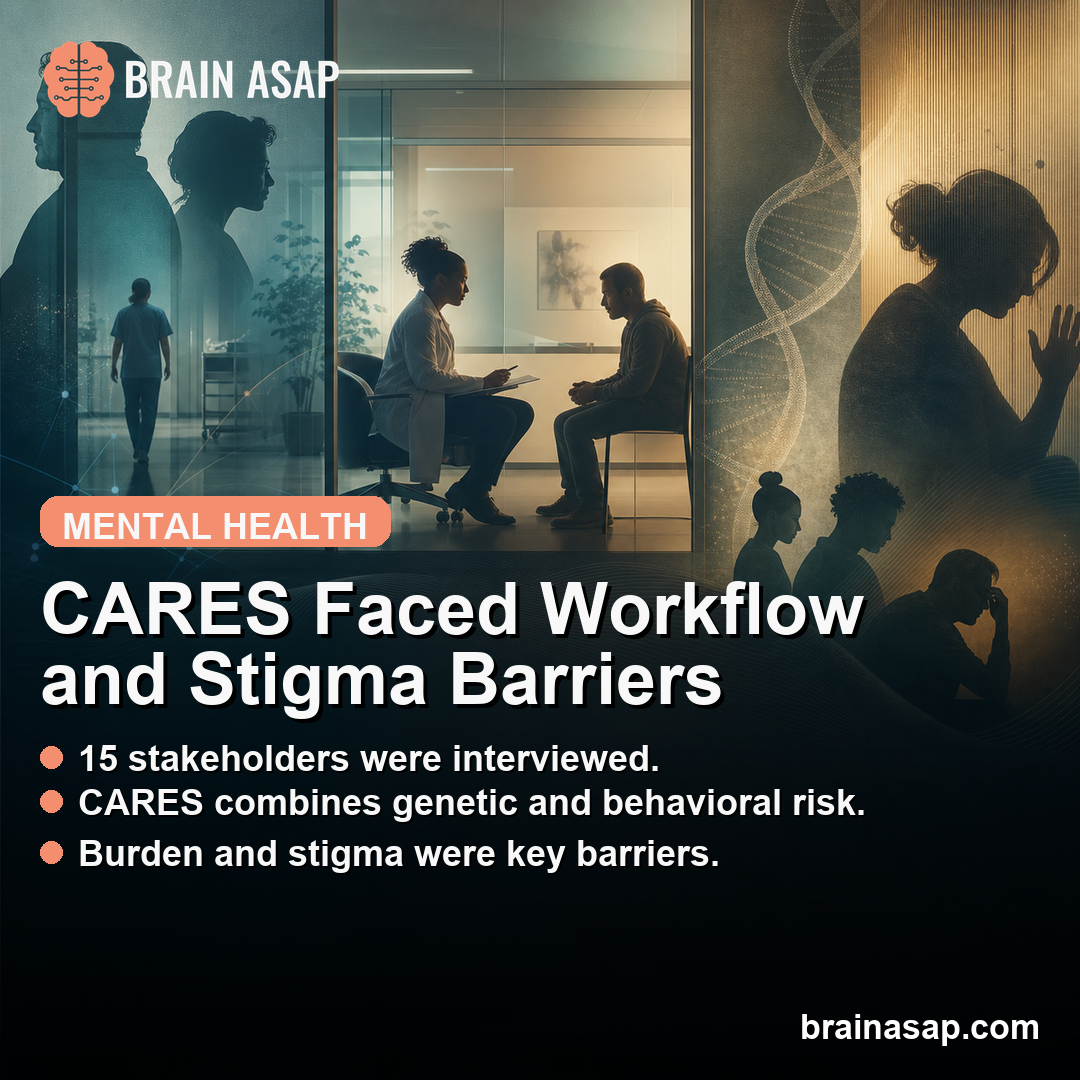
TL;DR: A 2026 medRxiv preprint found that hospital stakeholders saw a need for CARES, a Comprehensive Addiction Risk Evaluation System combining genetic and behavioral/environmental risk information, but warned that provider burden, substance-use stigma, and workflow integration could limit adoption.
Key Findings
- 15 stakeholder interviews: Researchers conducted semi-structured interviews using the Consolidated Framework for Implementation Research.
- Prevention-focused tool: CARES was designed to provide personalized substance-use-disorder risk information before current use becomes the only trigger for screening.
- General openness: Interviewees described a need for new screening tools and were generally open to new clinical approaches.
- Implementation barriers: Provider burden, limited substance-use-disorder knowledge, discomfort, and stigma were expected to slow uptake.
- Clinical integration issue: Participants discussed medical-record integration, adolescent use, patient response, and changes needed for implementation.
Source: medRxiv (2026) | Dash et al.
Substance-use screening usually asks whether a patient is already using alcohol, cannabis, opioids, stimulants, or other substances in a risky way. That approach can identify current problems, but it is less suited to prevention before a disorder develops.
The Dash preprint studied whether a prevention-focused tool could fit into health care. CARES gives personalized information about genetic and behavioral/environmental risk for substance use disorder and links people to resources based on risk profile.
CARES Was Designed for Addiction Risk Before Problems Escalate
Primary care guidelines often encourage screening for problematic substance use during checkups. In practice, screening is uneven, often brief, and adds work to already crowded visits.
CARES tries to shift the timing. Instead of waiting until current use or consequences are obvious, the platform aims to communicate risk earlier, when prevention resources may still change a person’s trajectory.
The system is also broader than a single questionnaire. It combines genetic risk with behavioral and environmental information, then provides personalized feedback and resource connections.
That design raises a real implementation challenge. A tool can be scientifically appealing and still fail if clinicians do not have time, patients distrust the information, or the workflow does not fit the electronic health record.
Prevention tools also need a clear action path. If a patient receives elevated risk feedback, the clinic needs a practical next step, such as brief counseling, digital resources, follow-up screening, family guidance, or referral to behavioral-health support.
Without that action path, risk feedback can become information without care. The implementation problem is therefore not only whether CARES can calculate risk, but whether the clinic can respond in a way that helps patients.
Stakeholders Saw a Need for Lower-Burden SUD Screening
Researchers interviewed 15 stakeholders and analyzed transcripts using rapid qualitative analysis. The interview guide was built around the Consolidated Framework for Implementation Research, a common structure for studying whether interventions can fit real clinical settings.
Several themes supported the basic need for CARES. Interviewees described current substance-use screening as important but limited by provider time, inconsistent procedures, and discomfort around substance-use conversations.
- Current screening gap: Existing tools often focus on current substance use rather than future risk and prevention.
- Provider workload: Clinicians can resist a tool that adds tasks without reducing burden elsewhere.
- Organizational fit: Stakeholders considered whether CARES aligned with clinical goals and priorities.
Those responses suggest the implementation problem is not indifference. Stakeholders appeared to recognize the clinical need, but they also expected practical friction.
That combination is common in behavioral-health implementation. A clinic can agree that substance-use prevention is important while still lacking staff time, reimbursement structure, training, or privacy language to support a new process.
The study’s stakeholder approach has practical value because these barriers often appear before effectiveness is tested. Identifying them early can prevent a pilot from failing for predictable workflow reasons rather than because the prevention concept is weak.
Genetic Risk Feedback Raised Workflow and Stigma Concerns
CARES includes genetic risk information, which can make prevention more personalized. It can also make the conversation more sensitive.
Patients may worry that genetic-risk feedback labels them, predicts their future too strongly, or enters the medical record in ways they cannot control. Clinicians may also need training to explain probabilistic risk without making deterministic claims.
Substance-use stigma adds another layer. If patients expect judgment, punishment, or insurance consequences, they may avoid honest disclosure or decline a prevention tool even when the intent is supportive.
These concerns do not argue against risk screening. They show why implementation needs careful language, privacy planning, and clinician support before a genetic-plus-behavioral tool is placed in routine care.
Clinician training would need to cover both the science and the conversation. A high-risk result should be explained as a reason to strengthen prevention, not as a diagnosis or a fixed prediction.
That distinction is central for genetic information. Genetic risk can raise or lower probability, but substance-use outcomes still depend on environment, access to substances, stress, peer context, mental health, and protective supports.
Adolescent Use Requires Extra Care Around Consent and Interpretation
Stakeholders also discussed adolescent populations. That context is important because prevention may be most valuable before patterns of substance use become entrenched.
At the same time, adolescent risk feedback involves parents, developing autonomy, privacy, and the possibility that a young person is treated differently because of a risk label. The tool would need clear consent procedures and age-appropriate communication.
- Risk is probabilistic: Genetic and behavioral risk information should not be presented as destiny.
- Resources matter: Screening without realistic prevention options can leave patients and families with concern but no next step.
- Privacy matters: Medical-record integration should be designed around who can see risk information and how it is used.
That adolescent layer makes CARES more than a software implementation. It becomes a communication and ethics problem as well as a clinical workflow problem.
CARES Needs Pilot Testing Before Effectiveness Claims
The study does not show that CARES prevents substance use disorder. It also does not show that patients will use the tool, change behavior, or experience better outcomes after receiving risk feedback.
What the study provides is a pre-implementation map. Stakeholders identified why the tool could fit a health system and which barriers could block adoption before a pilot begins.
The next evidence step should test clinical uptake. That means measuring completion rates, patient understanding, clinician burden, documentation flow, referral uptake, and whether high-risk patients actually receive helpful prevention resources.
Pilot testing should also watch for unintended effects. If risk feedback increases shame, reduces trust, or creates confusion about genetics, implementation would need revision before expansion.
Strong pilot outcomes would include patient willingness to receive feedback, comprehension of probabilistic risk, clinician time burden, referral completion, and whether the tool changes prevention conversations during ordinary clinical care.
The qualitative result is practical: health systems may be open to prevention-oriented substance-use risk screening, but CARES will need low-burden workflow design, stigma-aware communication, and medical-record planning to work outside a research setting.
Future pilots should also define success before launch. A tool that identifies risk but fails to connect patients with prevention resources would not solve the clinical problem that motivated CARES.
Implementation should therefore be judged by both adoption and follow-through. The key test is whether risk feedback leads to understandable guidance, lower clinician burden, and reachable support for patients who want help reducing substance-use risk early in routine care settings.
Citation: DOI: 10.64898/2026.04.14.26350880. Dash et al. Stakeholder views on implementing a novel addiction screening and prevention tool in a hospital setting: A qualitative study. medRxiv. 2026
Study Design: Qualitative stakeholder interview study guided by implementation-science framework domains.
Sample Size: 15 interviewees.
Key Statistic: Stakeholders saw need and feasibility for CARES but identified provider burden, stigma, knowledge gaps, and workflow integration as barriers.
Caveat: Preprint qualitative findings do not show CARES adoption rates, patient outcomes, or substance-use prevention effects.