TL;DR: A 2026 study in The Journal of Neuroscience found that listening to consonant chord progressions while looking at a live partner increased functional near-infrared spectroscopy (fNIRS), a scalp blood-flow measure, in social brain systems.
Key Findings
- Dyadic design: The study tested 20 participant pairs while both partners were recorded at the same time.
- Two music conditions: Participants heard structured chord progressions or unstructured compositions made from the same notes.
- Live gaze condition: Brain activity was compared during live face-to-face gaze and during no-gaze conditions.
- Social-system activation: Right angular gyrus, right somatosensory association cortex, and bilateral dorsolateral prefrontal cortex increased during live gaze plus structured chords.
- Connectedness link: Subjective connectedness ratings were associated with temporal-gyrus activity during face gaze and right angular-gyrus activity during chord progressions.
Source: The Journal of Neuroscience (2026) | Watts et al.
Music and Eye Contact Were Tested in the Same Social Task
Consonant chord progressions are predictable sequences of harmonious notes. Researchers tested whether that musical structure changes social-brain activity when two people are physically present and looking at each other.
The team used fNIRS, a noninvasive method that estimates cortical activity from changes in oxygenated blood near the scalp. Both people in each pair were recorded at the same time, a setup often called hyperscanning.
The design separated two ingredients that often travel together in real life: sound structure and live social attention. Participants listened to music with or without face gaze, and the music either had a structured chord progression or a scrambled arrangement of the same notes.
This design is stricter than asking whether people like music. The same dyad heard controlled sound conditions while the social context changed, so the analysis could look for a brain response tied to the combination.
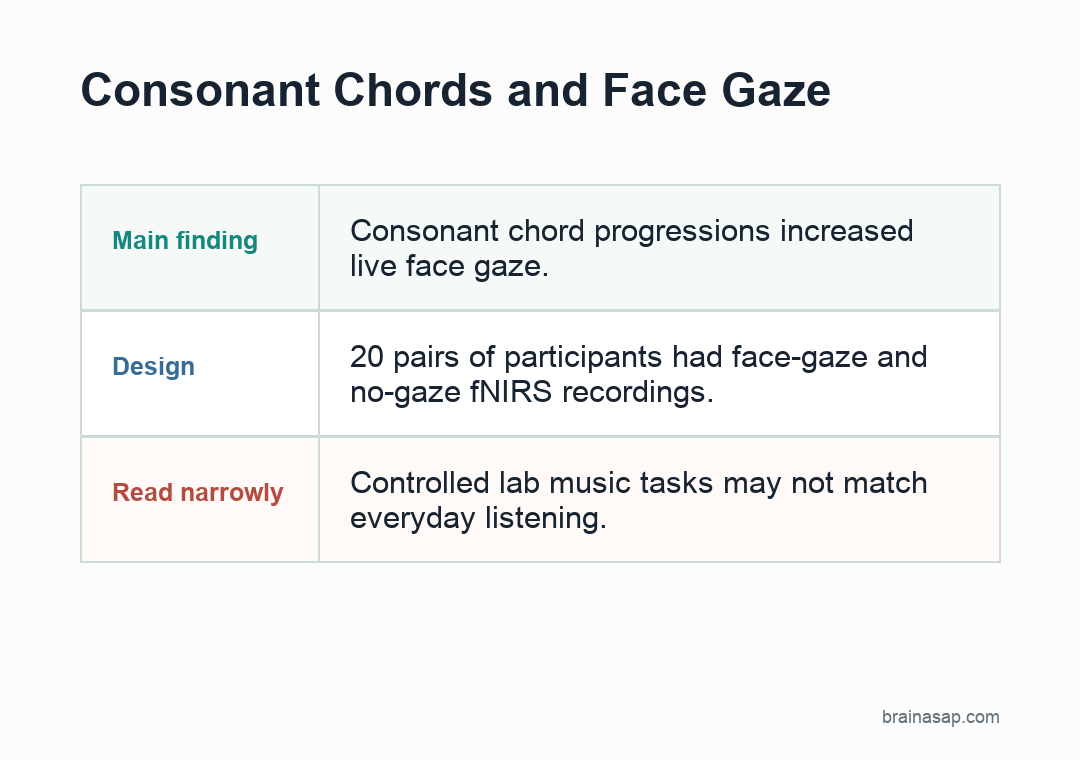
Twenty Pairs Heard Structured Chords and Scrambled Notes
The sample included 20 dyads with equal numbers of male and female participants. Each pair experienced musical conditions built from the same notes, which reduced the chance that a simple note-content difference explained the brain activity.
Structured chord progressions created predictable acoustic relationships. The comparison condition used unstructured and unpredictable note order, giving researchers a way to ask whether musical organization itself contributed to social-brain responses.
Pleasing sound and social meaning are easy to confuse in music neuroscience. A scrambled-note control keeps the study closer to a specific claim about harmonic predictability.
- Participants: Twenty pairs completed the dyadic listening task.
- Measurement: fNIRS recorded cortical blood-flow signals from both partners.
- Comparison: The strongest contrast combined live gaze with consonant chord progression.
Right Angular Gyrus Activity Increased During Chords and Gaze
The brain regions highlighted in the abstract are not random auditory areas alone. The right angular gyrus, right somatosensory association cortex, and bilateral dorsolateral prefrontal cortex all fit broader social-cognition and prediction networks.
Activation increased when participants listened to the structured chord progression while gazing at a live partner. The combined condition is the point: music structure and social attention together produced the clearest neural difference.
Subjective connectedness ratings also tracked brain activity. Ratings were associated with right superior and middle temporal gyri during face gaze and with right angular gyrus activity during chord progressions.
- Neural readout: Right angular gyrus activity was the clearest chord-progression signal.
- Behavioral readout: Connectedness ratings gave the brain contrast social context.
- Boundary: The experiment measured acute dyadic responses, not therapy outcomes.
The connectedness finding gives the neural contrast behavioral context. Participants were not only hearing an arranged sound sequence; they were also reporting how socially connected they felt during the experiment.
Predictable Musical Structure May Support Social Alignment
The researchers framed chord progressions as a form of temporal and spectral alignment. Predictable note relationships can help listeners anticipate what comes next, and shared anticipation may support social coordination.
That interpretation fits the fNIRS result because the highlighted regions are involved in integrating sensory information, attention, prediction, and social context. A chord sequence did more than make the sound pleasant; it changed activity during a live interpersonal condition.
The result also helps explain why music can support social coordination without requiring lyrics. A person can share timing, prediction, and attention with another listener even when the music carries no explicit verbal message.
The mechanism is also compatible with everyday group music. Singing, clapping, dancing, or listening together all create shared timing, and shared timing can make social coordination easier to maintain.
Music-Therapy Claims Still Need Clinical Testing
The study was not a treatment trial. It did not test loneliness, autism, depression, dementia, or social anxiety outcomes. It tested neural activity and connectedness ratings in healthy dyads during controlled listening.
Even so, the data give clinical researchers a cleaner target. Future music-therapy studies can ask whether structured harmonic prediction plus live social engagement produces stronger effects than passive listening alone.
For now, the result supports a specific mechanism: predictable chord progressions paired with face gaze engaged social-brain systems and related to perceived connectedness. That mechanism is narrower and more testable than a general claim that music bonds people.
Clinical translation would need symptom outcomes, repeated sessions, comparison groups, and follow-up. The present experiment is best treated as a mechanism study for how musical structure can interact with live social attention.
One next experiment could compare live gaze, video gaze, and no-gaze listening across the same chord conditions. Another could test whether people with loneliness or social anxiety show the same connectedness-brain relationship during repeated sessions.
Those additions would move the work from acute neural response toward durable social functioning in daily interpersonal settings outside the laboratory.
Citation: DOI: 10.1523/jneurosci.1116-25.2026. Watts et al. Listening to a consonant chord progression during live face-to-face gaze enhances neural activity in social systems. The Journal of Neuroscience. 2026;46:e1116252026.
Study Design: Dyadic fNIRS hyperscanning experiment comparing structured chord progressions with unstructured note sequences during live gaze and no-gaze conditions.
Sample Size: 20 participant pairs with equal numbers of male and female participants.
Key Statistic: Live gaze plus structured chords increased activity in right angular gyrus, right somatosensory association cortex, and bilateral dorsolateral prefrontal cortex.
Caveat: The study measured neural activity and connectedness ratings, not clinical outcomes.