TL;DR: A 2026 mouse study in Nature found that small-molecule glucagon-like peptide 1 receptor agonists (GLP-1RAs), obesity and diabetes drugs built around a glucose-linked hormone pathway, suppressed palatable-food intake through central amygdala neurons that lowered nucleus accumbens dopamine.
Key Findings
- Humanized mouse model: Researchers engineered mice so small-molecule GLP-1 receptor agonists could be studied despite species differences in receptor binding.
- Two feeding pathways: The drugs affected both homeostatic feeding circuits and hedonic feeding circuits for palatable food.
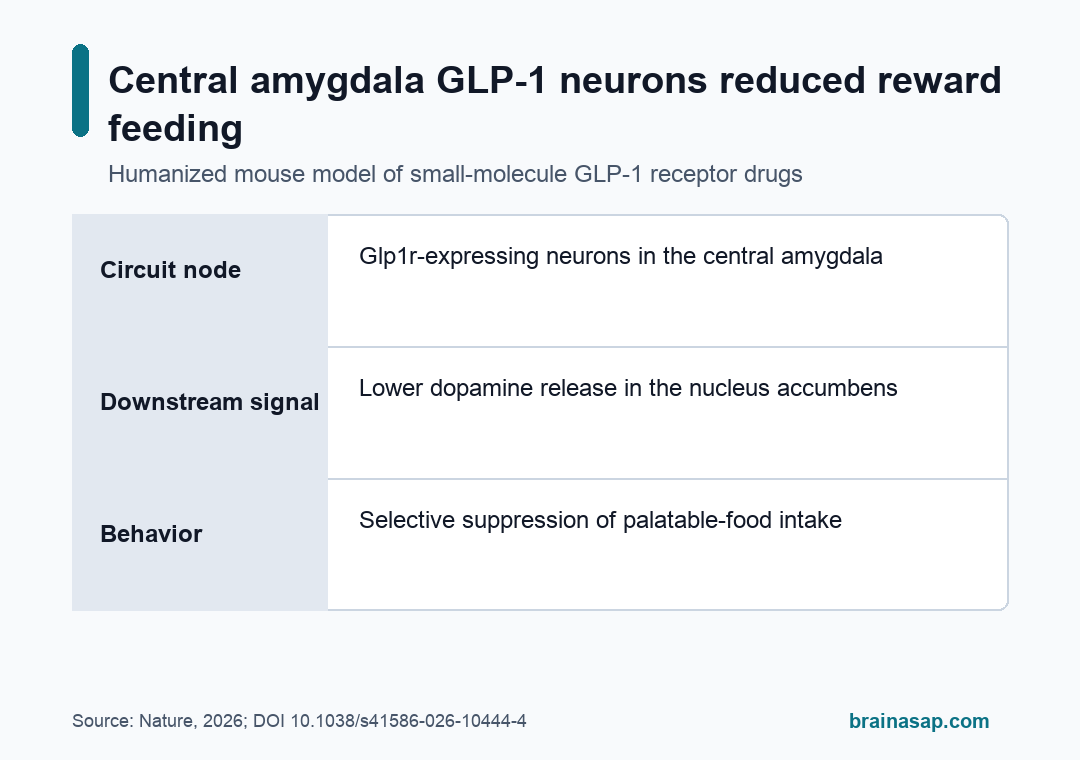
- Central amygdala cells: A discrete population of Glp1r-expressing neurons in the central amygdala selectively suppressed palatable-food consumption.
- Dopamine mechanism: The pathway reduced dopamine release in the nucleus accumbens, a reward region involved in motivated intake.
- Causal tests: Stimulating the central amygdala neurons curtailed hedonic feeding, while deleting the receptor in those cells weakened drug efficacy for reward-driven intake.
Source: Nature (2026) | Godschall et al.
Humanized GLP1R Mice Let Researchers Test Small-Molecule Drugs
GLP-1 receptor agonists are widely used for obesity and diabetes, but many established therapies are peptide injections. Small-molecule versions could be easier to manufacture and take orally.
Mechanistic testing has been difficult because some small molecules bind selectively to human versus rodent GLP-1 receptors. Researchers solved that problem by developing humanized mouse models that retained normal metabolic function while responding to candidate compounds.
With that model, the study could ask where the drugs act in the brain. The answer extended beyond hypothalamic and hindbrain systems that regulate hunger and energy balance.
The model also let researchers test oral-candidate compounds in animals without pretending standard mice have the same receptor pharmacology as humans. That species problem has limited earlier work on small-molecule GLP-1 drugs.
Central Amygdala Neurons Targeted Palatable-Food Intake
Researchers identified Glp1r-expressing central amygdala neurons as a pathway for hedonic feeding. Hedonic feeding means intake driven by reward value, palatability, or craving-like motivation rather than simple energy need.
Those neurons selectively suppressed palatable-food consumption. The drug pathway therefore separated reward-driven intake from homeostatic feeding, which is controlled more heavily by hypothalamic and hindbrain circuits.
That separation is relevant for obesity biology because people often eat in response to reward cues when energy need is low. A reward-specific pathway could help explain why these drugs change more than meal size.
- Homeostatic feeding: Intake linked to energy balance and metabolic need.
- Hedonic feeding: Intake linked to reward value and palatable food.
- Reward output: Dopamine release in the nucleus accumbens decreased along the central amygdala route.
Nucleus Accumbens Dopamine Fell Along the Reward Route
The nucleus accumbens is a reward and motivation region where dopamine helps shape pursuit of valued stimuli. Lower dopamine release there gives the circuit a plausible route for reducing palatable-food seeking.
The researchers did not rely only on mapping. Stimulating the central amygdala neurons curtailed hedonic feeding, while targeted deletion of the receptor in that cell population reduced the anorectic efficacy of GLP-1 receptor agonists for reward-driven intake.
Those causal tests make the circuit evidence stronger than a correlation between drug treatment and brain activity. The circuit was manipulated in both directions: activate the cells and reward feeding falls; remove the receptor and the drug effect weakens.
The dopamine measure completes the pathway. Central amygdala GLP-1 receptor neurons provided an upstream control point, and the nucleus accumbens supplied the reward-output readout.
- Cell target: Glp1r-expressing central amygdala neurons shaped palatable-food intake.
- Reward output: Nucleus accumbens dopamine supplied the downstream readout.
- Translation gap: Human craving and cue-reactivity studies still have to test the same pathway.
Reward Feeding Links Obesity Drugs to Binge Eating and Addiction Questions
GLP-1 drugs are already being investigated beyond weight loss and diabetes. Their effects on alcohol use, substance craving, and binge eating are under active study because all involve reward learning and motivated intake.
The central amygdala pathway gives those clinical questions a circuit target. If the same pathway or a homologous human circuit influences reward-driven intake, GLP-1 drugs may affect craving through more than nausea, fullness, or slowed gastric emptying.
That possibility needs human testing. Mouse dopamine data cannot prove benefit for binge eating disorder or substance-use disorder, but it does identify a biological pathway worth measuring in clinical trials.
Clinical trials could test craving ratings, cue-reactivity tasks, food-choice behavior, and substance-use outcomes alongside weight and glucose measures. Without those outcomes, reward-circuit speculation will stay indirect.
Small-Molecule GLP-1 Drugs Still Need Human Circuit Evidence
The study’s strongest claim is mechanistic: humanized mice showed that small-molecule GLP-1 receptor agonists can recruit a central amygdala reward circuit. The source does not establish the same circuit effect in patients.
Human studies will need brain imaging, behavioral craving tasks, and careful separation of reward-specific effects from general appetite suppression. Dosing, side effects, and individual differences may also determine whether reward-circuit changes are clinically meaningful.
For now, the data sharpen the biology of next-generation obesity drugs. GLP-1 receptor signaling can reach beyond energy-balance circuits into a defined reward-feeding pathway that lowers nucleus accumbens dopamine in mice.
The translational question is whether that mouse pathway maps onto human craving, binge eating, or substance reward. The study gives researchers a circuit hypothesis that can now be tested directly.
A human version of the same claim would need to show changed reward response before or alongside changed intake. Imaging alone would not be enough unless it connects to behavior.
For patients, the distinction could affect expectations. A medication that reduces reward-driven intake may change craving and cue response rather than only increasing fullness, slowing digestion, or changing blood sugar.
The mouse data make that patient-facing question biologically plausible, while leaving the clinical answer open for controlled human trials with behavioral endpoints and longer follow-up periods.
Citation: DOI: 10.1038/s41586-026-10444-4. Godschall et al. A brain reward circuit inhibited by next-generation weight-loss drugs in mice. Nature. 2026.
Study Design: Mouse mechanistic study using humanized GLP1R models, pharmacology, circuit stimulation, dopamine measurement, and targeted receptor deletion.
Sample/Model: Humanized GLP1R mice designed to respond to small-molecule GLP-1 receptor agonists.
Key Statistic: Central amygdala GLP1R neurons suppressed palatable-food intake by reducing nucleus accumbens dopamine release.
Caveat: The work is preclinical and does not prove treatment effects for human binge eating or substance-use disorders.