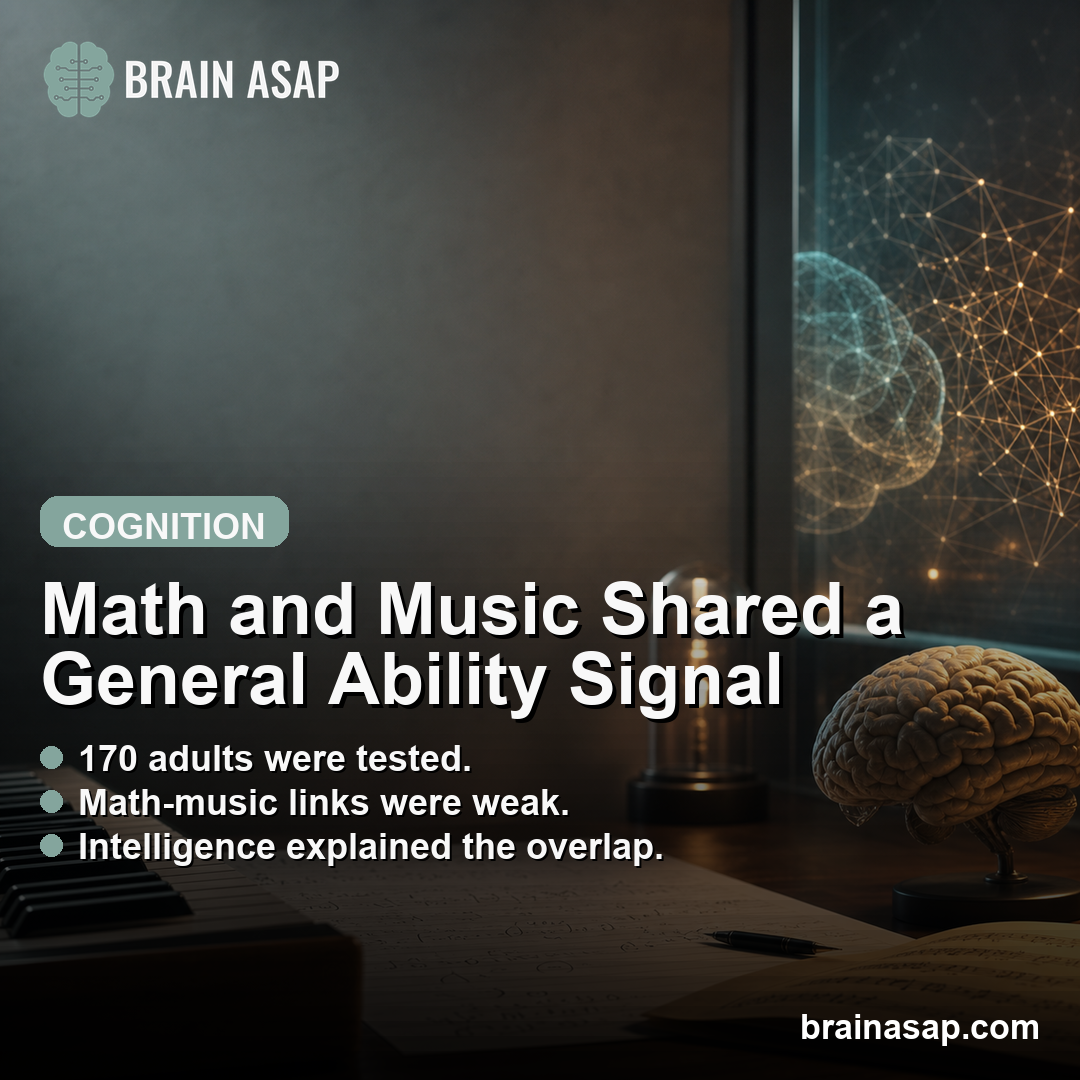
TL;DR: A 2026 Journal of Intelligence study of 170 adults found that math ability and music ability were only weakly related, and the link was reduced to almost zero after researchers accounted for general intelligence.
Key Findings
- Adult ability groups were tested: The 170-person sample included math specialists, music specialists, and controls who did not specialize in either field.
- Direct task batteries were used: Participants completed math tasks, music-perception tasks, experience questionnaires, and a standardized intelligence assessment.
- Math-music links were mostly weak: Participants who scored better on mathematical tasks tended to score somewhat better on musical tasks, but the associations were not large.
- General intelligence explained the overlap: Once intelligence was included in the models, the remaining association between math and music abilities was reduced to almost zero.
- Training effects were not settled: The cross-sectional design compared ability patterns but did not prove whether math or music training caused changes in the other domain.
The source is a DOI-backed paper in Journal of Intelligence, not the PsyPost discovery article that surfaced it.
Why Math and Music Look Related
Math and music are often treated as cousins. Both use pattern detection, timing, memory, sequence tracking, symbolic rules, and fast error checking.
That overlap makes the intuitive story appealing: someone who hears structure in rhythm may also find structure in numbers. A pianist reading notation and an engineer manipulating formulas both have to hold patterned information in mind while making decisions under rules.
The Meier study tested whether that familiar idea survives a stricter question. Are mathematical abilities and musical abilities related because they share a special math-music skill, or because both partly depend on broader general intelligence?
The distinction changes the interpretation. If a domain-specific association remains after adjustment, music training and math training might share a cognitive bridge worth testing.
If intelligence explains most of the statistical overlap, the same broad reasoning ability may help people on both kinds of tasks.
The Study Compared Math, Music, and Control Groups
Researchers recruited 170 adults with an average age of about 25 years. The sample was deliberately shaped to include people with strong math backgrounds, strong music backgrounds, and neither specialization.
The three recruitment groups gave the study a wider ability range than a generic undergraduate sample would provide:
- Math group: Students, graduates, or workers in mathematics, physics, engineering, or closely related fields.
- Music group: Students or graduates in music, music education, musicology, or related areas.
- Control group: Participants whose study or work did not center on math or music, mostly from psychology-related backgrounds.
This design does not prove what training causes. It does let researchers ask whether individual differences in math and music performance travel together when people come from different expertise backgrounds.
Researchers Used Separate Task Batteries
The measurement strategy was important because the study did not rely only on self-reported talent. Participants completed direct tasks for music perception, direct tasks for mathematical performance, questionnaires about experience, and a standardized intelligence assessment.
The music battery focused on perception rather than performance on an instrument:
- Beat Alignment Test: A rhythm task that asks whether a beat track lines up with music.
- Mistuning Perception Test: A pitch task that asks whether a note is slightly out of tune.
- Melodic Discrimination Test: A melody task that asks whether two melodic patterns differ.
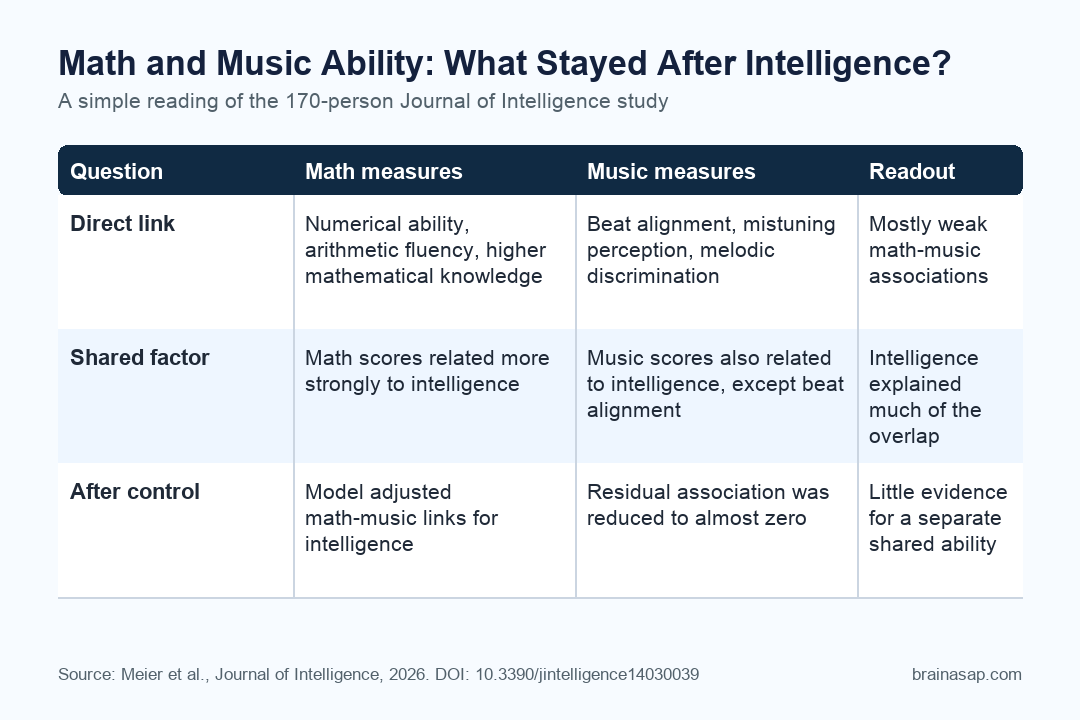
The math side included basic numerical ability, arithmetic fluency, and higher mathematical knowledge. Participants also completed questionnaires about musical sophistication and mathematical experience, plus the Intelligence Structure Test for broader cognitive ability.
The setup avoids an overly narrow test. One math task or one music questionnaire could have made the result look cleaner than it was.
Here, researchers separated several kinds of ability before asking what they had in common.
The Direct Math-Music Link Was Weak
The first result was modest. Across the task batteries, better math performance tended to travel with better music performance, but the associations were mostly weak rather than dramatic.
Both math and music measures showed positive links with intelligence. One exception was the Beat Alignment Test, which did not show the same association with intelligence.
Overall, intelligence appeared to relate somewhat more strongly to the math measures than to the music measures. The pattern fits the test content: arithmetic fluency and higher math knowledge are more obviously close to conventional reasoning tests than pitch or melody discrimination tasks are.
The result still does not make music irrelevant to cognition. It says the measured math-music correlation was not strong enough to stand apart clearly from a broad intelligence factor in this sample.
After Accounting for Intelligence, the Link Nearly Disappeared
The decisive analysis asked what remained after researchers controlled for intelligence. In that adjusted model, the association between math and music abilities was reduced to almost zero.
In practical terms, the study points to a shared-general-ability explanation rather than a separate math-music bridge. People who scored higher on intelligence tended to perform better across several cognitive tasks, and that broad tendency explained much of the apparent relationship.
The adjusted analysis supports three points:
- Math and music performance can correlate: The study did not find that the two domains are unrelated in raw form.
- The correlation was not very large: Most direct task associations were weak.
- General intelligence absorbed the overlap: Once the broader cognitive measure entered the analysis, little math-music association remained.
That result narrows a common oversimplification. Music and mathematics share some surface structure, but this study suggests the shared structure may not translate into an independent ability link once general reasoning is measured.
The Finding Does Not Settle Training Effects
The main limitation is design. This was a cross-sectional study, so it cannot show whether math training improves music skills, whether music training improves math skills, or whether people with stronger general ability are more likely to pursue both domains.
Several boundaries should stay visible:
- Ability range was intentional: Recruiting specialists helps detect ability differences, but it also means the sample is not a simple mirror of the general population.
- Music was measured as perception: Beat, pitch, and melody tasks do not capture all of musical performance, composition, improvisation, or long-term practice.
- Math was measured through selected tasks: Numerical ability, arithmetic fluency, and higher knowledge do not cover every form of mathematical thinking.
- Causality remains untested: A longitudinal or training study would be needed to test whether one domain changes the other.
The better takeaway is not that music and math have nothing to do with each other. The measurable overlap in this study was better explained as a general cognitive ability signal than as a special two-domain connection.
What the study changes for the math-music claim: The result narrows the popular claim. Saying “music and math are linked” is too broad.
In this dataset, math and music scores were somewhat related, but that relationship became small once researchers accounted for intelligence.
That still leaves room for domain-specific questions. Rhythm may matter for timing, music notation may support symbolic fluency, and long practice histories may shape attention and working memory.
The Meier study does not erase those possibilities.
It does raise the bar for future claims. A stronger study would need to show that math and music remain connected after measuring broader reasoning ability, prior training, motivation, and other shared background factors.
For now, the simplest reading is direct: general intelligence helped explain why math and music abilities appeared related in this 170-person sample.
Citation: DOI: 10.3390/jintelligence14030039. Meier et al. Are Mathematical and Musical Abilities Related Beyond Intelligence? Journal of Intelligence. 2026.
Study Design: Cross-sectional task-based study comparing math, music, and control-background adults.
Sample Size: 170 adults, including 99 women, with an average age of about 25 years.
Key Statistic: After controlling for intelligence, the association between mathematical and musical abilities was reduced to almost zero.
Caveat: The study cannot determine whether training in math or music causes later changes in the other domain.