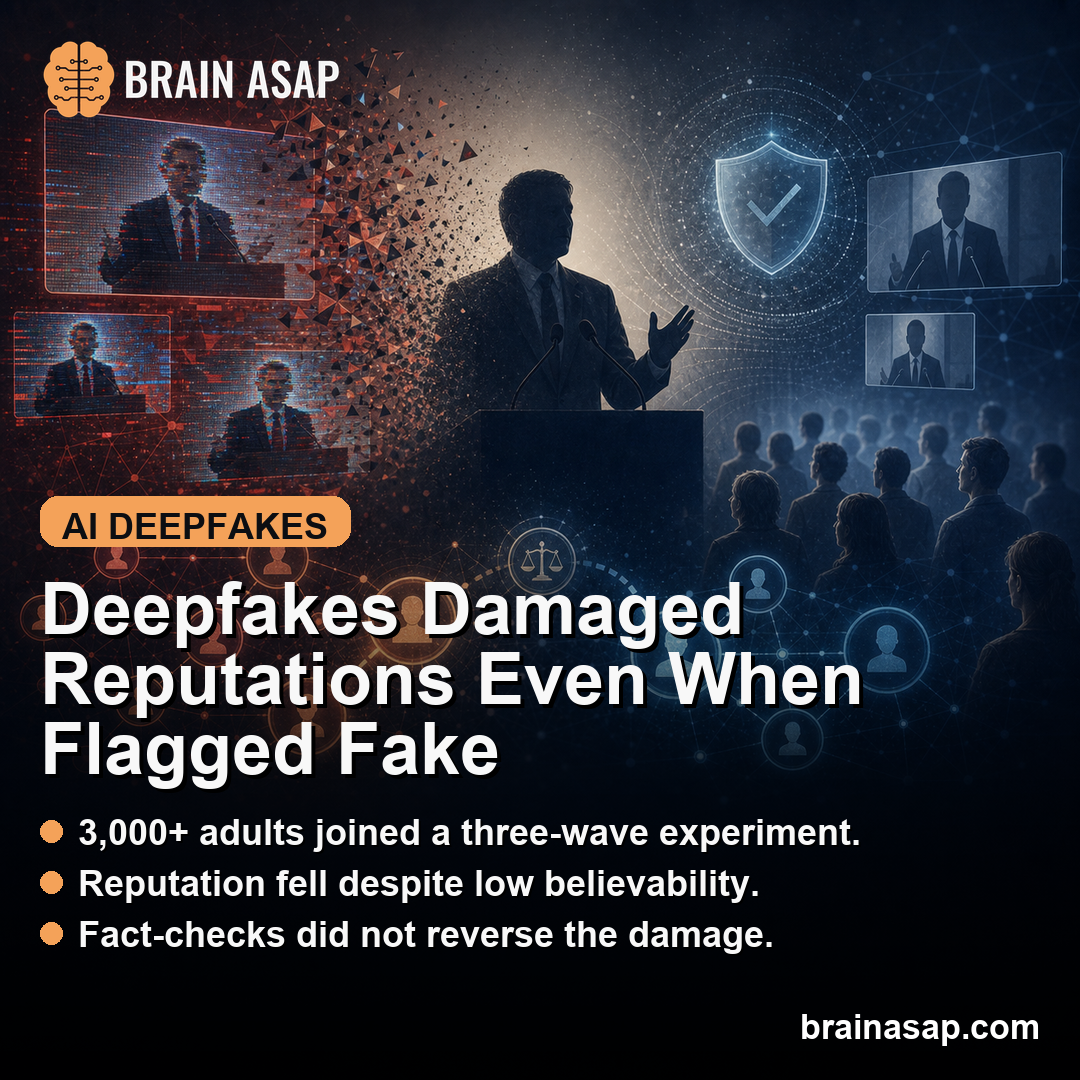
TL;DR: A 2026 three-wave experimental study in Communication Research (N=3,000+ adults across the US and the Netherlands) found that AI-generated political deepfake videos damaged the reputations of targeted politicians even when viewers correctly suspected the footage was fake — and standard fact-checks restored authenticity perception without reversing the reputational harm.
Key Findings
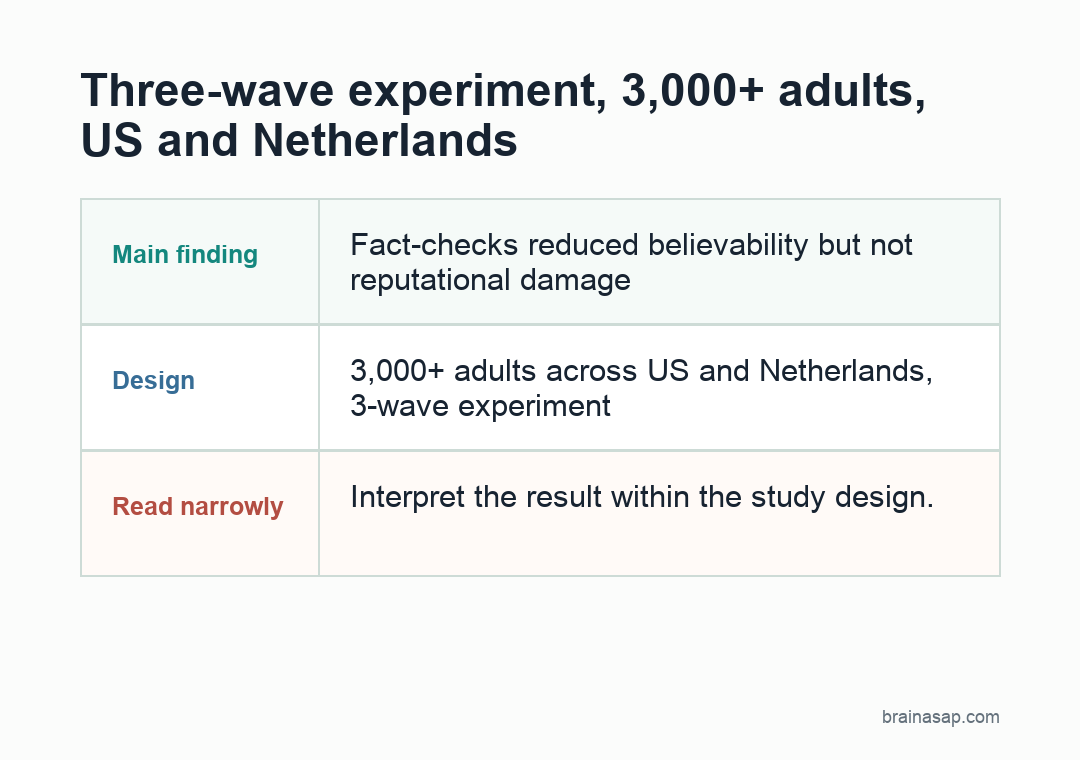
- Three-wave experiment, 3,000+ adults, US and Netherlands: Participants completed surveys at start, 2 days later, and 3 days after that, viewing either a genuine political address or an AI-manipulated version of the same politician.
- Reputation damage occurred anyway: Even when participants correctly suspected the footage was fake, their opinion of the targeted politician dropped. The deepfakes successfully degraded reputations of both Nancy Pelosi (US target) and Sybrand Buma (Netherlands target).
- Damage was largest among initial supporters: Participants who started out favoring the targeted politician took the biggest reputation hit. People who already disliked the politician barely moved, since their opinion was already negative.
- Fact-checks fixed authenticity perception but not reputation: Standard point-by-point fact-checks made viewers less likely to believe the video was real, but the same fact-checks did not reverse the reputational damage. Media-literacy warnings produced almost no measurable effect.
- Effects faded by the end of the week: Negative feelings toward the targeted politicians largely dissipated within days when participants stepped away from the false content. The window of damage was time-limited in this isolated experiment.
Source: Communication Research (2026) | Hameleers et al.
Generative AI now lets political operatives produce deceptive video clips at scale that look and sound like a target politician saying something they never said.
The central policy issue is whether such deepfakes meaningfully shift voter behavior, or whether the public catches the fakes and discounts them.
This three-wave experimental design tests both possibilities in two contrasting media environments.
Three Survey Waves in Two Contrasting Political Systems
Researchers at the University of Amsterdam designed an experiment to track voter responses to AI-generated political content over a full week.
The structure:
- 3,000+ adults recruited: Participants split between two contrasting media environments — the polarized two-party US system and the Netherlands’ multiparty consensus-driven system.
- Three measurement waves: A baseline survey at start, a follow-up 2 days later, and a final survey 3 days after that, covering a full week in 2021.
- Random assignment: Participants were randomly assigned to view either a genuine political address or an AI-manipulated deepfake of the same politician.
- US target: Representative Nancy Pelosi, with synthetic audio implying she sympathized with the January 6 Capitol rioters.
- Dutch target: Christian Democratic moderate Sybrand Buma, with manipulated footage showing him delivering an extremist anti-immigrant monologue.
The two targets were chosen because the deepfaked statements were designed to contradict each politician’s established public persona — setting up the test of whether out-of-character claims can damage reputations even when viewers detect the manipulation.
Viewers Largely Saw Through the Deception
The initial finding is partly reassuring.
In both countries, participants rated the manipulated videos as substantially less believable than the genuine versions.
The bizarre nature of the synthetic statements — Pelosi sympathizing with the Capitol breach, the moderate Dutch politician delivering an extremist nationalist monologue — tipped most viewers off that something was wrong with the footage.
Detection happened across both political systems. The polarized US system and the consensus-driven Dutch system produced similar belief patterns.
Vulnerability to AI-generated political content was not limited to either media environment.
Reputation Damage Happened Even When Viewers Suspected Fakery
The more concerning finding is the disconnect between belief and reputation.
Even though most participants correctly flagged the videos as suspect, their opinion of the targeted politician still dropped after watching.
The pattern was strongest among initial supporters:
- People who started favorable to the politician: Took the biggest reputation hit, since seeing a favored leader appear to voice extreme or contradictory views produced an immediate negative reaction.
- People who already disliked the politician: Barely moved, mostly because their opinion floor was already low.
- People in between: Showed measurable but smaller drops.
The mechanism researchers describe is processing fluency: visual content slips past the rational-skepticism filter and lands emotionally even when the viewer’s analytic system flags it as fake.
The Deepfakes Did Not Shift Broader Political Beliefs
Important boundary on the result: damage was specific to the targeted politician.
Watching the manipulated Pelosi video did not lead US participants to support the Capitol riot more broadly. Watching the manipulated Buma footage did not shift Dutch participants toward extremist anti-immigrant positions.
The deception altered judgments about the messenger, not the message.
For deepfake policy, the distinction is concrete: AI-generated political content acted as a personal-reputation weapon rather than a tool for shifting underlying ideological positions through the apparent words of a politician.
Fact-Checks Restored Authenticity Perception But Not Reputation
The trial also tested two defensive interventions, with mixed results:
- Fact-check immediately after viewing: A point-by-point refutation of the false claims, formatted like professional journalism. This made participants less likely to believe the footage was real — but did not reverse the reputational damage to the politician.
- Media-literacy warning before viewing: An introductory tip sheet on questioning sources and spotting fabricated content. This produced almost no measurable effect on either outcome.
The asymmetry is the most actionable result in the paper. Fact-checking treats the authenticity judgment: is this video real?
It leaves the trust judgment almost untouched: do I trust this politician? The two systems update on different inputs, and a fact-check only updates the authenticity judgment.
Effects Faded by the End of the Week
By the final survey wave, 3 days after the second exposure, the negative feelings directed at the targeted politicians had largely faded.
Two readings of this finding:
- Optimistic reading: A deepfake encountered once and not reinforced may not produce lasting reputational damage in isolated lab conditions.
- Pessimistic reading: A real-world political deepfake campaign would not be a single isolated exposure. Repeated, multi-source amplification across an election cycle is the relevant counterfactual, and the trial cannot estimate cumulative effects under that condition.
Repeating the video twice did deepen the reputation damage among US participants, suggesting that even modest repetition compounds the effect — which is consistent with how political disinformation actually circulates.
Pre-Publication Detection Beats Post-Hoc Fact-Checking on the Reputation Outcome
The practical takeaways are sobering for current platform countermeasures:
- Fact-checks are not enough: Standard point-by-point corrections fix the belief question but leave the reputational damage in place. Platforms relying on fact-check labels as their main response may be solving the wrong half of the problem.
- Pre-exposure media-literacy warnings did almost nothing: The intervention that platforms most often endorse as scalable produced essentially no measurable benefit on either outcome in this trial.
- Initial supporters are the most vulnerable: Targeted disinformation that depicts a favored politician acting out of character is more effective than content aimed at viewers who already disliked the target.
- Pre-publication detection and removal matters more than post-hoc correction: If exposure produces lasting reputational damage that fact-checks cannot reverse, platform interventions that prevent the deepfake from circulating in the first place have more leverage than those that label it after viewing.
- Repetition compounds the harm: Even modest repeated exposure deepens the effect, which means the relevant policy metric is cumulative campaign exposure, not single-video impact.
Citation: DOI: 10.1177/00936502261421437. Hameleers et al. Radical Right-Wing Political Deepfakes Can Successfully Delegitimize Targeted Political Actors: Evidence From Three-wave Experiments in the US and The Netherlands. Communication Research. 2026.
Study Design: Three-wave experimental design across the US and the Netherlands; random assignment to genuine vs AI-manipulated political video; tested fact-check and media-literacy warning countermeasures; 1-week follow-up.
Sample Size: 3,000+ adults across both countries, with three repeated-measure survey waves over 1 week.
Key Statistic: Deepfakes reduced reputations of both targeted politicians (Pelosi in the US, Buma in the Netherlands) even though viewers correctly identified the videos as less believable than genuine footage. Reputation damage was largest among initial supporters of each target. Fact-checks reduced perceived video authenticity but did not reverse reputation damage; media-literacy warnings produced almost no measurable effect.
Caveat: Single-exposure experimental setting underestimates real-campaign cumulative effects; effects faded by week’s end in isolation but repeated exposure compounded damage; tested only video-format deepfakes; political-belief shifts (vs personal-reputation shifts) were not observed in this study.