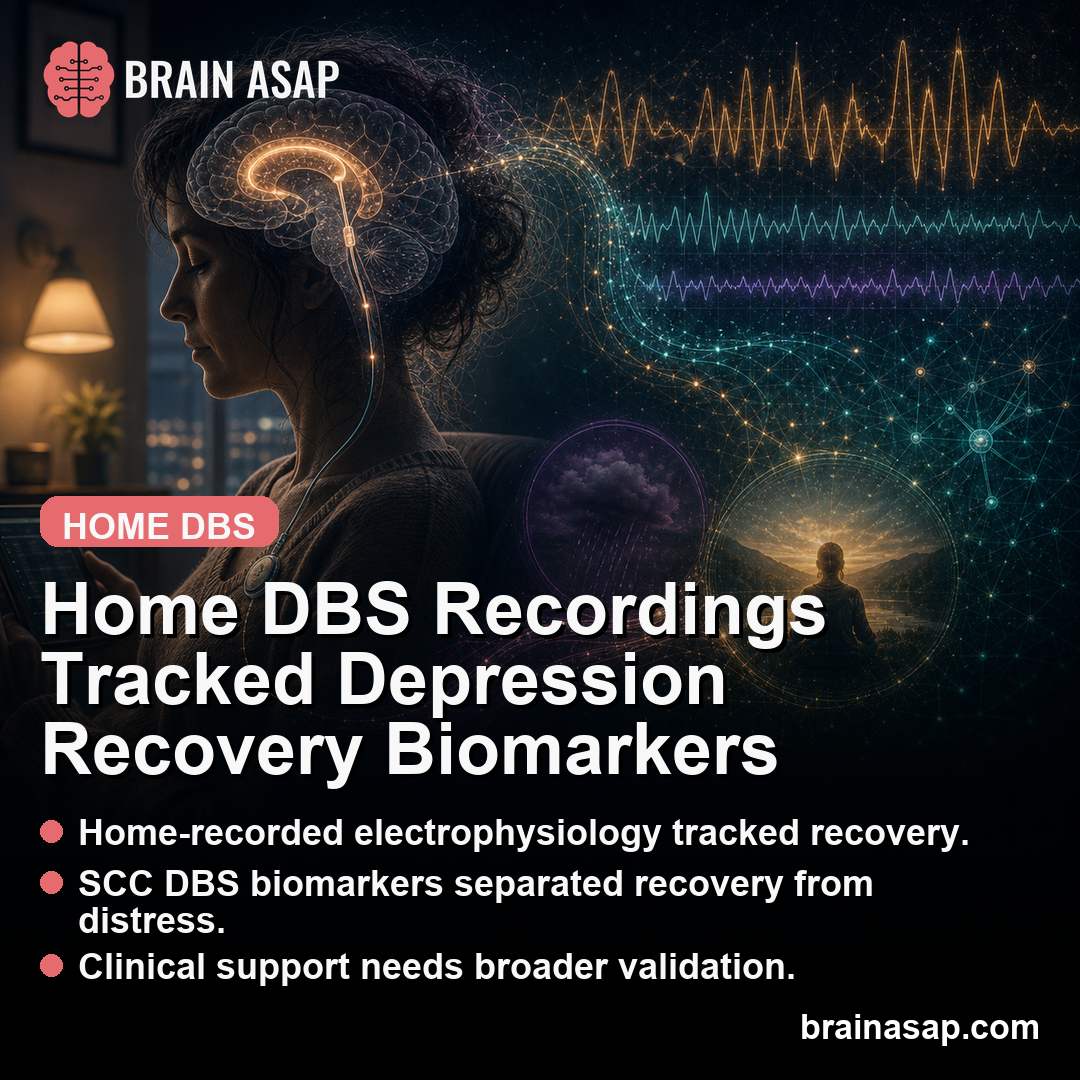
TL;DR: A 2026 preprint deep brain stimulation biomarker study in medRxiv found that home-recorded electrophysiology biomarkers tracked stable depression recovery during SCC DBS, while the biomarkers helped distinguish recovery from nonspecific symptom fluctuations and external distress.
Key Findings
- Study type: a home-recording study using bidirectional deep brain stimulation devices to monitor electrophysiology during depression recovery.
- Patient context: Treatment-resistant depression patients had subcallosal cingulate cortex DBS and chronic local field potential recordings.
- Main result: Home-recorded electrophysiology biomarkers tracked stable depression recovery during SCC DBS.
- Second result: The biomarkers helped distinguish recovery from nonspecific symptom fluctuations and external distress.
- Caution: The sample was specialized and small, so clinical decision support needs broader validation.
Source: medRxiv (2026) | Fitoz et al.
Subcallosal cingulate cortex deep brain stimulation, or DBS, can help some people with treatment-resistant depression, but symptom ratings can fluctuate for reasons unrelated to stimulation response.
This preprint used chronic local field potential recordings collected at home to track electrophysiology biomarkers during SCC DBS treatment.
Core result: this is a monitoring claim: home-recorded electrophysiology biomarkers tracked stable depression recovery during subcallosal cingulate DBS. The point is objective follow-up outside the clinic, not consumer mood tracking.
Home DBS Recordings Targeted Depression Recovery Monitoring
Design: a home-recording study using bidirectional deep brain stimulation devices to monitor electrophysiology during depression recovery. Sample: treatment-resistant depression patients with subcallosal cingulate cortex DBS and chronic local field potential recordings.
Bidirectional DBS devices can record local field potentials during everyday life. That creates a rare chance to compare neural recordings with recovery state over time.
- DBS target: The intervention focused on subcallosal cingulate cortex stimulation.
- Recording: Bidirectional devices collected local field potentials.
- Home setting: Data were gathered outside standard clinic visits.
- Goal: The biomarkers were intended to guide stimulation management.
Local Field Potentials Provided Objective Biomarker Data
The main result is that home-recorded biomarkers tracked stable recovery. The reason is depression symptoms can fluctuate with stress even when a longer recovery trajectory is stable.
The biomarkers helped separate recovery from nonspecific symptom fluctuations and external distress. That is the clinically important part of the monitoring workflow.
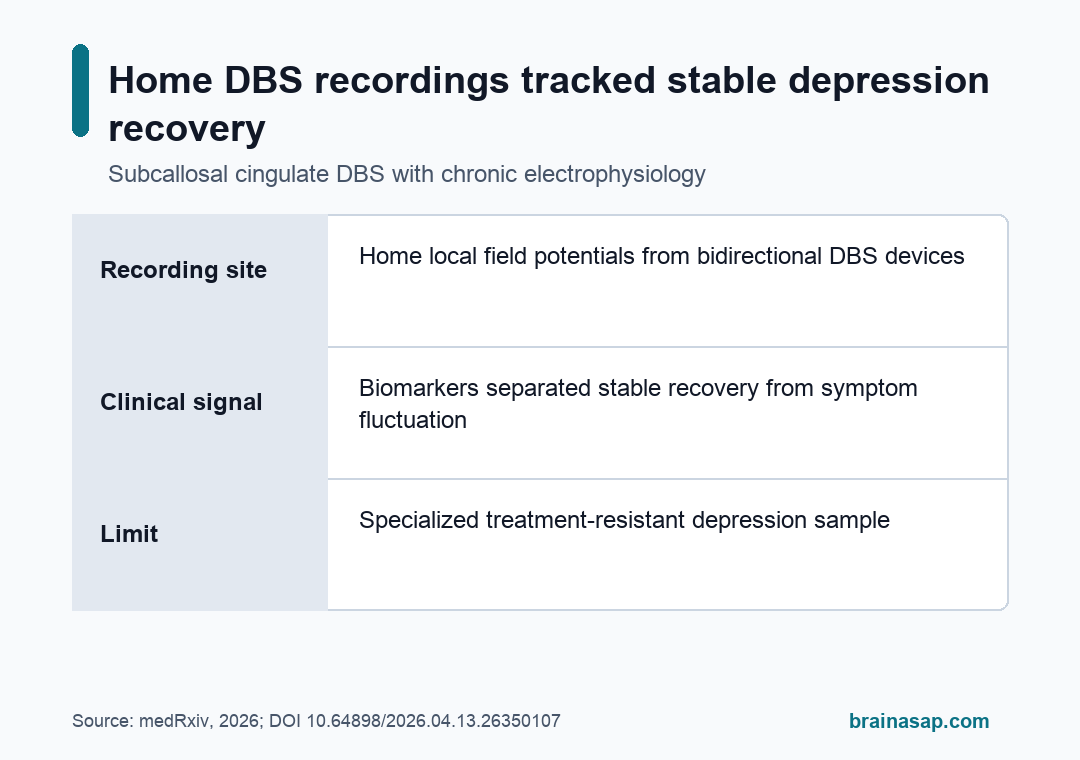
Measurement detail: Local field potentials are objective recordings from a very specific treatment context. They are not a general depression biomarker for people who do not have DBS implants.
- Patient context: Treatment-resistant depression patients had subcallosal cingulate cortex DBS and chronic local field potential recordings.
- Design: Home recordings from bidirectional DBS devices monitored electrophysiology during depression recovery.
- Primary anchor: Home-recorded electrophysiology biomarkers tracked stable depression recovery during SCC DBS.
- Second layer: The biomarkers helped distinguish recovery from nonspecific symptom fluctuations and external distress.
- Boundary: The sample was specialized and small, so clinical decision support needs broader validation.
Interpretation: DBS recordings may help monitor recovery in carefully selected treatment-resistant depression patients. Broader decision support needs more patients.
Follow-up work should validate the same electrophysiology markers in larger DBS cohorts with prespecified decision rules.
The result supports longitudinal recovery monitoring in SCC DBS, not depression diagnosis or non-DBS treatment tracking.
Electrophysiology Helped Separate Recovery From Distress Fluctuations
Local field potentials are objective recordings from a very specific treatment context. They are not a general depression biomarker for people who do not have DBS implants.
The home-recording context matters because depression ratings can move for reasons that are not stimulation failure. A stressful event, sleep disruption, illness, or medication change can temporarily worsen symptoms while the longer recovery trajectory remains intact.
An electrophysiology marker could help clinicians separate those situations, but only after validation. The marker would need to remain stable across devices, electrode placements, medication changes, and different recovery states.
That is why this study is best treated as a monitoring proof of concept. It supports objective follow-up for a highly specialized DBS population rather than a broad biomarker claim for depression.
The restrained read is that DBS recordings may help monitor recovery in carefully selected treatment-resistant depression patients. Broader decision support needs more patients.
The home setting is important because clinic-only biomarkers can miss what happens during ordinary life.
Remote recordings can also reduce reliance on single clinic visits. A patient may arrive during an unusually good or bad week, while home electrophysiology can show whether the broader recovery pattern has changed.
That time-series view is the clinical attraction of bidirectional DBS devices. They can connect symptoms, stimulation exposure, and local field potentials across weeks rather than only at scheduled visits.
Small DBS Samples Limit Immediate Clinical Decision Support
Main limitation: the sample was specialized and small, so clinical decision support needs broader validation.
- Small sample: DBS biomarker studies usually include few patients.
- Specialized care: The workflow requires implanted research-capable devices.
- Decision support: A biomarker must be validated before guiding routine adjustments.
- Symptoms: Psychosocial distress can change ratings without requiring stimulation changes.
The sample was small and specialized. A biomarker for DBS follow-up has to prove reliability across more patients, devices, and clinical states.
Depression DBS Needs Biomarkers That Work Outside the Clinic
Practical takeaway: depression DBS may need biomarkers that work between appointments.
- Best use: Use the result as evidence for longitudinal recovery monitoring in SCC DBS.
- Do not overread: Do not generalize it to depression diagnosis or non-DBS treatment monitoring.
- Next question: Validate the same electrophysiology markers in larger DBS cohorts with prespecified decision rules.
The practical promise is specific: not a mood gadget, but a possible objective layer for a highly specialized therapy.
For patients already receiving SCC DBS, that layer could help separate true recovery changes from temporary symptom noise.
That separation is central to DBS follow-up.
Citation: DOI: 10.64898/2026.04.13.26350107; Fitoz et al.; Common Electrophysiology Biomarkers Collected at Home Robustly Track Depression Recovery With Deep Brain Stimulation; medRxiv; 2026.
Study Design: A home-recording study using bidirectional deep brain stimulation devices to monitor electrophysiology during depression recovery.
Sample Size: Treatment-resistant depression patients with subcallosal cingulate cortex DBS and chronic local field potential recordings.
Key Statistic: Home-recorded electrophysiology biomarkers tracked stable depression recovery during SCC DBS.
Caveat: The biomarker applies to a small, specialized DBS population and is not a general depression diagnostic test.