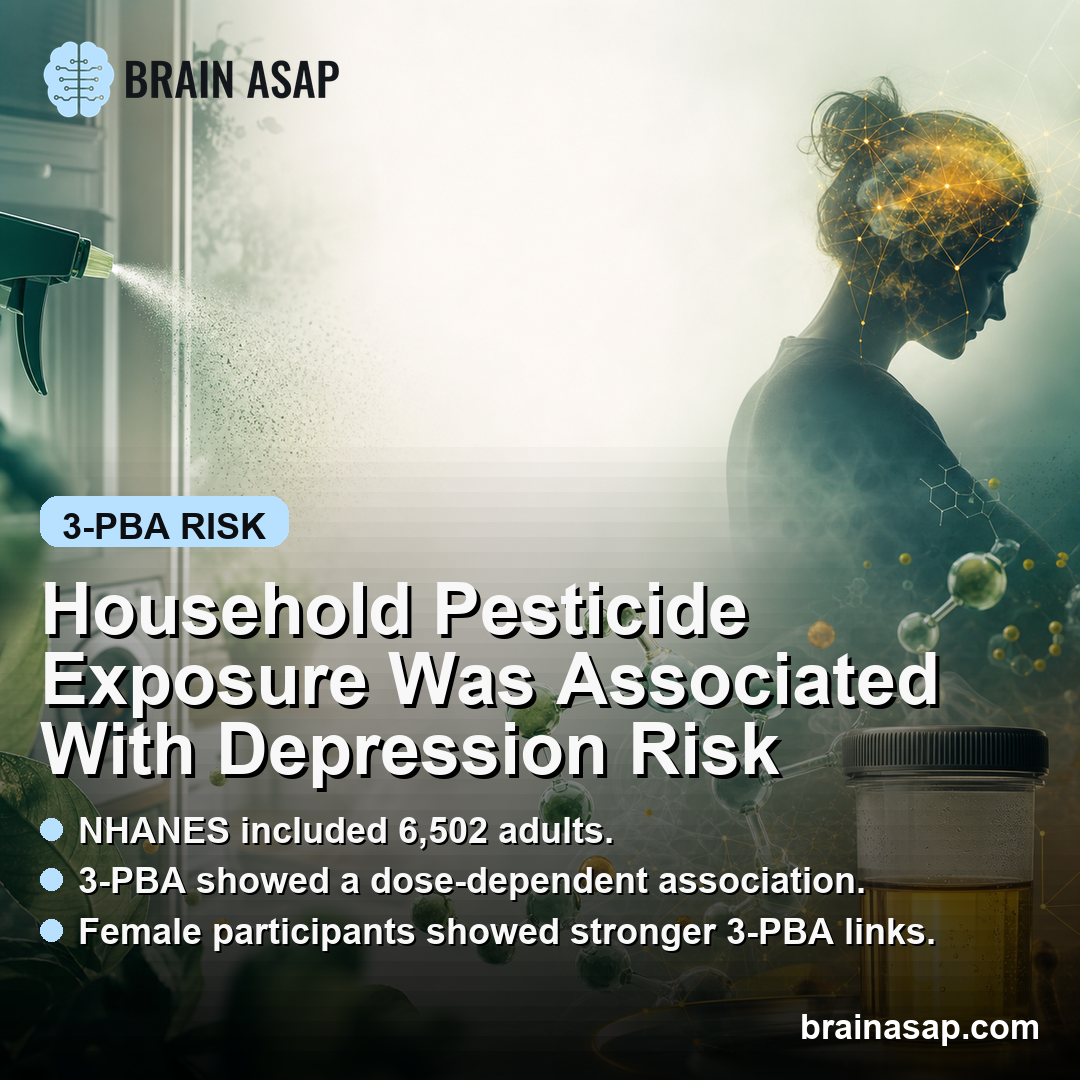
TL;DR: A 2026 cross-sectional NHANES analysis in Depression and Anxiety found that urinary pyrethroid metabolite 3-PBA showed a dose-dependent association with depression, while female participants showed stronger associations for 3-PBA and 4F-3-PBA, while males showed sensitivity to DCBA in mixture models.
Key Findings
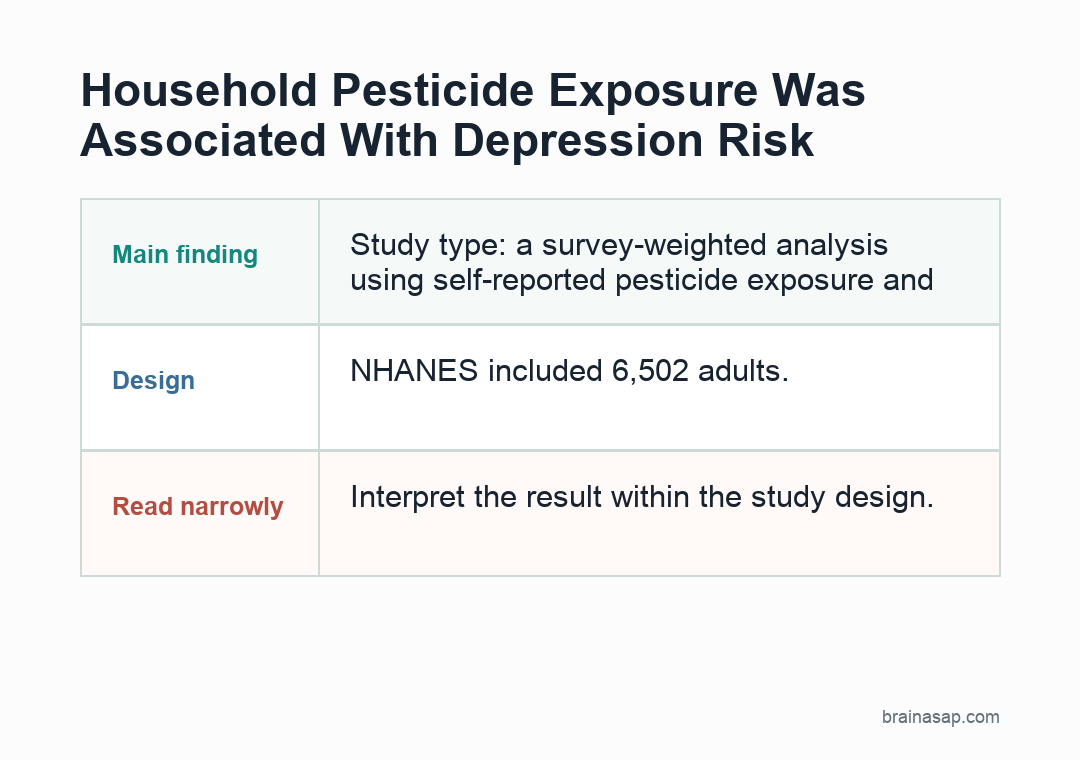
- Study type: a survey-weighted analysis using self-reported pesticide exposure and urinary pesticide metabolites.
- NHANES cohort: The analysis included 6,502 adults from NHANES 2007-2014.
- Main result: Urinary pyrethroid metabolite 3-PBA showed a dose-dependent association with depression.
- Second result: Female participants showed stronger associations for 3-PBA and 4F-3-PBA, while males showed sensitivity to DCBA in mixture models.
- Caution: Cross-sectional NHANES data cannot establish that pesticide exposure caused depression.
Source: Depression and Anxiety (2026) | Chen et al.
Household pesticide exposure is common, but mental health research usually focuses on occupational or high-dose exposure. The study asked whether residential exposure markers were associated with depression in a large US dataset.
The authors combined self-report, urinary biomarkers, and mixture modeling to examine pyrethroid and repellent-related metabolites.
Core result: urinary pyrethroid metabolite 3-PBA showed a dose-dependent association with depression. The focus is measured residential exposure markers rather than vague chemical concern.
NHANES Linked Household Pesticides With Depression Measures
Design: a survey-weighted analysis using self-reported pesticide exposure and urinary pesticide metabolites. Sample: 6,502 adults from NHANES 2007-2014.
NHANES provides self-reported exposure, urinary metabolites, and depression measures in a large US survey sample. The design is broad and informative, but cross-sectional.
- Self-report: Participants reported household pesticide exposure.
- Urinary markers: Metabolites included 3-PBA, 4F-3-PBA, DCBA, DHMB, and DEET.
- Models: The study used logistic regression, restricted cubic splines, BKMR, and WQS.
- Symptoms: Fatigue, self-blame, and appetite disturbance contributed statistically.
3-PBA Showed a Dose-Dependent Depression Association
The main result is the 3-PBA association. A dose-dependent depression link is more specific than saying household pesticides were generally related to mood.
Sex-specific patterns added detail: female participants showed stronger associations for 3-PBA and 4F-3-PBA, while males showed sensitivity to DCBA in mixture models.
Measurement detail: Urinary metabolites capture recent exposure and metabolism. They do not reveal long-term dose history, source, or whether depression changed exposure behavior.
- Population: 6,502 adults from NHANES 2007-2014.
- Design: Survey-weighted analysis using self-reported pesticide exposure and urinary pesticide metabolites.
- Primary anchor: Urinary pyrethroid metabolite 3-PBA showed a dose-dependent association with depression.
- Second layer: Female participants showed stronger associations for 3-PBA and 4F-3-PBA, while males showed sensitivity to DCBA in mixture models.
- Boundary: Cross-sectional NHANES data cannot establish that pesticide exposure caused depression.
Interpretation: The 3-PBA result is the main marker, while the sex-specific mixture findings are follow-up leads rather than final explanations.
Longitudinal studies should repeat exposure markers and depression measures over time. That design would test whether exposure comes before mood change rather than tracking the same household or health factors.
The current result is valuable because it names a specific metabolite pattern instead of making a broad claim about household chemicals.
Sex-Specific Pesticide Metabolite Patterns Differed
Urinary metabolites capture recent exposure and metabolism. They do not reveal long-term dose history, source, or whether depression changed exposure behavior.
The safe interpretation is that household pesticide markers were associated with depression in NHANES. Causality remains unproven.
The mixture-model analysis matters because people encounter multiple pesticide-related compounds, not one isolated molecule.
The exposure side also needs care. A urinary metabolite is not the same thing as a complete household-use history.
Self-reported pesticide exposure can miss product type, dose, ventilation, protective behavior, and occupational overlap. Those details could change the apparent mental-health association.
The sex-specific pattern is a reason for follow-up rather than a final explanation. Future studies would need repeated metabolite measures, more detailed exposure histories, and enough power to test whether the female and male mixture-model signals replicate.
A stronger follow-up study would also separate residential use from occupational exposure. Yard treatments, indoor insect sprays, pet products, and agricultural work can produce different exposure profiles even when the same urinary metabolite appears.
Depression measurement needs the same care. A survey score can identify depressive symptoms, but it cannot show whether symptoms preceded exposure, followed exposure, or shared another cause such as housing quality, chronic illness, or socioeconomic stress.
Biology also remains open. Pyrethroid metabolites can mark exposure to compounds that affect sodium channels and neuroimmune pathways, but a urinary association does not identify the mechanism in humans.
Future work would need repeated biospecimens, product-level exposure records, and inflammatory or neurologic measures before making a stronger brain-health claim.
Cross-Sectional Pesticide Data Cannot Prove Causality
Main limitation: cross-sectional NHANES data cannot establish that pesticide exposure caused depression.
- Timing: Exposure and depression were measured in the same survey window.
- Biomarkers: Urinary metabolites can reflect recent exposure.
- Residual confounding: Housing, occupation, illness, and lifestyle can affect associations.
- Effect size: Some estimates were marginal or small.
Cross-sectional survey data cannot settle direction of effect. Longitudinal exposure tracking would be needed for a stronger mental-health claim.
Residential Chemical Exposure Needs Longitudinal Mental Health Study
Practical takeaway: residential pesticide exposure deserves better longitudinal mental-health study.
- Best use: Use 3-PBA as the clearest measured association in this analysis.
- Do not overread: Do not claim the study proves household pesticides caused depression.
- Next question: Follow exposure markers and depressive symptoms over time, with attention to sex-specific patterns.
That keeps the analysis restrained: a specific NHANES association, not a causal verdict.
For now, the best public-health use is prioritization. The result says residential pesticide exposure deserves better mental-health tracking, especially when biomarker data and self-reported use point in the same direction.
It also argues for cleaner exposure histories in future surveys, including product type, indoor versus outdoor use, and recent occupational contact.
Those details would make the depression association easier to interpret.
Citation: DOI: 10.1155/da/4872833; Chen et al.; Joint Association of Household Pesticide Exposure With Depression in Adults; Depression and Anxiety; 2026.
Study Design: A survey-weighted analysis using self-reported pesticide exposure and urinary pesticide metabolites.
Sample Size: 6,502 adults from NHANES 2007-2014.
Key Statistic: Urinary pyrethroid metabolite 3-PBA showed a dose-dependent association with depression.
Caveat: Cross-sectional survey data cannot show whether pesticide exposure preceded depression or whether shared factors explain the association.