TL;DR: A 2026 cross-sectional metabolomics study in Brain, Behavior, & Immunity – Health found that serum and cerebrospinal fluid (CSF) metabolite signatures differed in knee osteoarthritis and related to pain, fatigue, sleep, and pressure sensitivity, while CSF histamine and 3-hydroxyphenylacetic acid were associated with pain intensity and sleep disturbance.
Key Findings
- Study type: a targeted metabolomics study of serum and cerebrospinal fluid, or CSF, in knee osteoarthritis.
- People studied: 36 knee osteoarthritis patients, 38 healthy serum controls, and 39 cerebrospinal fluid controls with non-inflammatory neurological symptoms.
- Main result: Serum and CSF metabolite signatures differed in knee osteoarthritis and related to pain, fatigue, sleep, and pressure sensitivity.
- Second result: CSF histamine and 3-hydroxyphenylacetic acid were associated with pain intensity and sleep disturbance.
- Caution: The study is cross-sectional and cannot show that the metabolites caused symptoms.
Source: Brain, Behavior, & Immunity – Health (2026) | Bjerkhaug et al.
Knee osteoarthritis pain is not only a joint-structure problem. Peripheral inflammation, central sensitization, fatigue, sleep disruption, anxiety, and depression can all shape the symptom burden.
The study measured metabolites in serum and cerebrospinal fluid, or CSF, to look for systemic and central biochemical signatures linked to pain and fatigue.
The metabolomics finding is that knee osteoarthritis showed both blood and central-fluid chemistry signals: serum and cerebrospinal fluid metabolite signatures differed and related to pain, fatigue, sleep, and pressure sensitivity.
Serum and CSF Were Both Profiled in Knee Osteoarthritis
Design: a targeted metabolomics study of serum and cerebrospinal fluid, or CSF, in knee osteoarthritis. People studied: 36 knee osteoarthritis patients, 38 healthy serum controls, and 39 cerebrospinal fluid controls with non-inflammatory neurological symptoms.
Measuring serum and cerebrospinal fluid, or CSF, lets researchers look beyond the knee joint itself. That is why the finding belongs in pain biology rather than simple joint wear-and-tear.
- Serum: Blood-based metabolites captured systemic differences.
- CSF: Cerebrospinal fluid provided a central nervous system window.
- Symptoms: Pain, fatigue, sleep, anxiety, depression, and disability were measured.
- Controls: Serum and CSF comparisons used different control groups.
Bile Acids and Amino Acids Differed in Serum
The main result was a two-compartment metabolite pattern: serum and CSF signatures differed in knee osteoarthritis. That suggests systemic and central biology may both relate to symptoms.
CSF histamine and 3-hydroxyphenylacetic acid were associated with pain intensity and sleep disturbance. Those links are symptom associations, not proof of a pain cause.
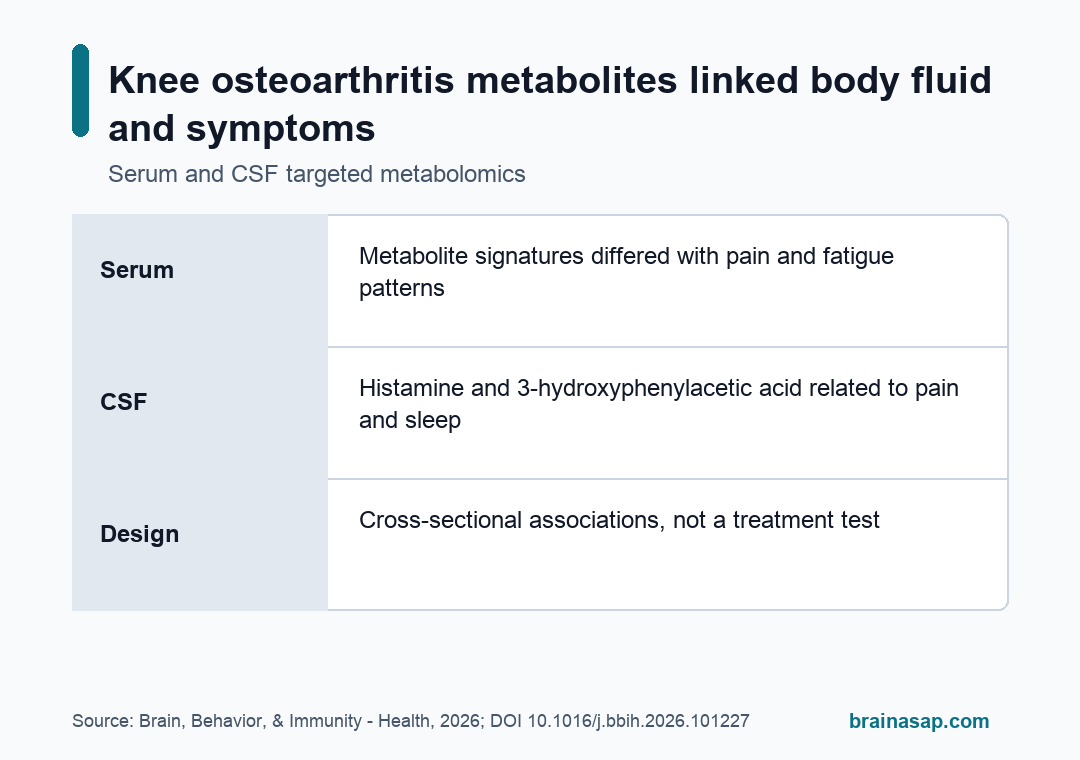
The serum and CSF findings are easiest to interpret alongside the small sample, targeted-metabolomics design, symptom measures, and lack of causal evidence.
- Population or model: 36 knee osteoarthritis patients, 38 healthy serum controls, and 39 cerebrospinal fluid controls with non-inflammatory neurological symptoms.
- Design: a targeted metabolomics study of serum and cerebrospinal fluid, or CSF, in knee osteoarthritis.
- Primary anchor: Serum and CSF metabolite signatures differed in knee osteoarthritis and related to pain, fatigue, sleep, and pressure sensitivity.
- Second layer: CSF histamine and 3-hydroxyphenylacetic acid were associated with pain intensity and sleep disturbance.
- Boundary: The study is cross-sectional and cannot show that the metabolites caused symptoms.
Measurement detail: CSF is informative because it is closer to the central nervous system, but it is also harder to collect. Serum is easier to measure but less specific to nervous-system processes.
Best reading: osteoarthritis pain and fatigue may involve biochemical changes beyond the joint. Causal testing is still needed.
Follow-up: Test whether metabolite profiles predict pain progression or change after treatment. This would show whether the finding holds when the sample, method, or setting changes.
Interpretation: The serum-CSF contrast is the main comparison.
Knee osteoarthritis had biochemical associations in both systemic and central compartments, not only in joint structure.
Symptom context: Pain, fatigue, sleep disturbance, anxiety, depression, and pressure sensitivity can travel together in osteoarthritis. Measuring both serum and CSF helps separate local joint disease from broader pain-system biology.
Terms like knee osteoarthritis, CSF, cerebrospinal fluid get fuzzy when separated from the evidence. Here, they stay tied to the reported sample, the measurement strategy, and the specific outcome being described.
The cross-sectional design prevents causal interpretation. Metabolite profiles can precede symptoms, follow symptoms, or reflect another disease-severity process.
Use the serum-CSF contrast to understand why osteoarthritis pain can extend beyond joint structure. Future work should test whether metabolite profiles predict pain progression or treatment response.
CSF Metabolites Related to Pain and Sleep Symptoms
CSF is informative because it is closer to the central nervous system, but it is also harder to collect. Serum is easier to measure but less specific to nervous-system processes.
The restrained interpretation is that osteoarthritis pain and fatigue may involve biochemical changes beyond the joint. Causal testing is still needed.
The pressure-sensitivity and sleep findings are important because osteoarthritis burden often includes central sensitization-like symptoms, not only cartilage damage.
Metabolite Associations Do Not Prove Pain Causality
Main limitation: the study is cross-sectional and cannot show that the metabolites caused symptoms.
- Cross-sectional: Timing prevents causal interpretation.
- Sample size: The groups were modest.
- Control mix: CSF controls were not healthy volunteers.
- Mechanism: Metabolites may reflect, contribute to, or respond to symptoms.
The cross-sectional design cannot show whether metabolites caused symptoms, followed symptoms, or reflected another process related to disease severity.
Osteoarthritis Pain Biology Extends Beyond the Knee
Practical takeaway: knee osteoarthritis symptoms may have systemic and central biochemical layers.
- Best use: Use the serum-CSF contrast to understand why pain biology can extend beyond joint structure.
- Do not overread: Do not treat metabolite associations as proven causes or ready diagnostic tests.
- Next test: Test whether metabolite profiles predict pain progression or change after treatment.
This keeps the result clinically relevant without overselling metabolomics as a finished diagnostic tool.
Citation: DOI: 10.1016/j.bbih.2026.101227. Bjerkhaug et al. Distinct serum and cerebrospinal fluid metabolic signatures associate with pain and fatigue in knee osteoarthritis. Brain, Behavior, & Immunity – Health. 2026.
Study Design: A targeted metabolomics study of serum and cerebrospinal fluid, or CSF, in knee osteoarthritis.
Sample Size: 36 knee osteoarthritis patients, 38 healthy serum controls, and 39 cerebrospinal fluid controls with non-inflammatory neurological symptoms.
Key Statistic: Serum and CSF metabolite signatures differed in knee osteoarthritis and related to pain, fatigue, sleep, and pressure sensitivity.
Caveat: Cross-sectional metabolomics cannot show that the measured metabolites caused pain, fatigue, or sleep symptoms.