TL;DR: A 2026 Psychological Medicine meta-analysis of 109 studies linked parental severe mental illness, especially schizophrenia and bipolar disorder, to lower cognitive performance in offspring across IQ, language, memory, executive function, and general cognition.
Key Findings
- Scale: The review included 109 studies and 1,586,339 participants.
- Schizophrenia: Offspring of parents with schizophrenia had lower scores across several domains, including general cognition, language, and IQ.
- Bipolar disorder: Parental bipolar disorder was associated with lower general cognition, memory, executive function, IQ, and language scores.
- Major depression: Parental major depressive disorder showed weaker but statistically significant associations in selected cognitive domains.
- Caution: The estimates combine heterogeneous studies and do not mean every child of a parent with severe mental illness will have cognitive impairment.
Source: Psychological Medicine (2026) | Adane et al.
Children of parents with severe mental illness can face a mix of genetic, prenatal, family, social, and healthcare risks. Cognitive development is one part of that picture, but previous reviews often focused on one diagnosis, one age range, or a smaller slice of cognition.
Researchers combined evidence across parental schizophrenia, bipolar disorder, and major depressive disorder. The review covered cognitive and academic outcomes including IQ, attention, memory, language, executive function, processing speed, social cognition, and school performance.
The broad finding was consistent: offspring of parents with severe mental illness tended to score lower than comparison offspring, with parental schizophrenia showing the largest cognitive differences and parental major depressive disorder showing weaker associations.
A 109-Study Meta-Analysis Compared Cognition in Offspring of Parents With SMI
SMI stands for severe mental illness. In this review, it included schizophrenia, bipolar disorder, and major depressive disorder.
The researchers searched MEDLINE, EMBASE, PsycINFO, and CINAHL from database inception through December 2025.
The final meta-analysis included 109 studies with 1,586,339 participants. The review calculated standardized mean differences, which allow results from different cognitive tests to be compared on a common scale.
That common scale is important because the included studies did not all use the same cognitive tests. Standardizing the estimates allowed the review to compare IQ, memory, language, executive function, and broader cognitive scores across a diverse literature.
The review also used random-effects meta-analysis with robust variance estimation. That approach is intended for evidence bases where studies differ from one another and where a single study may contribute more than one related estimate.
A negative standardized mean difference means offspring of parents with the diagnosis scored lower than controls. The size of the estimate helps indicate whether the difference was small, moderate, or large across the pooled literature.
Parental Schizophrenia Had the Largest Cognitive Effect Sizes
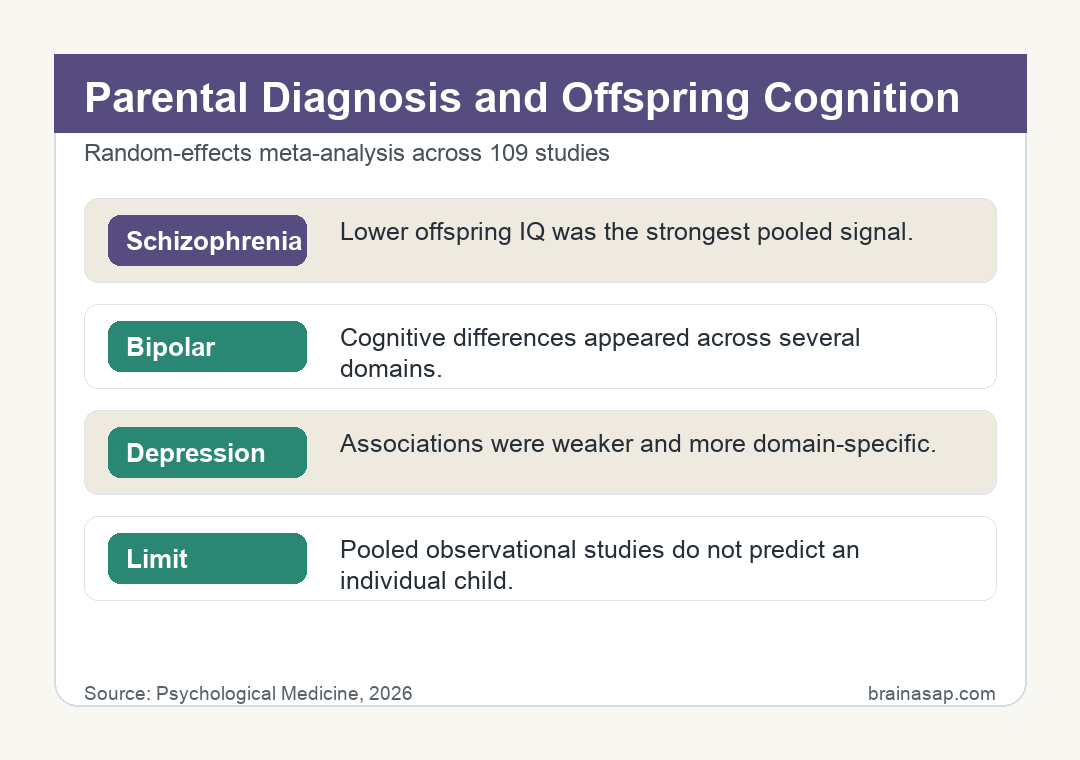
Parental schizophrenia showed the strongest pattern. In the abstracted pooled results, offspring of parents with schizophrenia had lower general cognition, language, and IQ scores than comparison offspring.
The IQ estimate was SMD -0.53 , with a 95% confidence interval from -0.72 to -0.34. Language showed a similar direction, with an SMD of -0.70.
General cognition was also lower, though the exact estimate varied by domain and study set. Those are not diagnostic statements about individual children.
They are group-level averages across studies.
Many offspring of parents with schizophrenia will perform in the typical range, and many cognitive outcomes are shaped by schooling, family support, sleep, stress, poverty, healthcare access, and early intervention.
The schizophrenia findings are still clinically relevant because the affected domains include skills used in school and daily functioning. Language, IQ, and general cognition can influence reading, problem solving, classroom support needs, and later academic performance.
The review also found signs of publication bias or small-study effects in the schizophrenia literature. That means the exact pooled size should be interpreted carefully, even though the overall direction of lower cognitive performance was consistent across several domains.
Parental Bipolar Disorder Was Also Linked to Lower Cognitive Scores
Parental bipolar disorder was associated with lower cognitive performance across multiple domains. The pooled estimate for general cognition was SMD -0.45, with a 95% confidence interval from -0.79 to -0.12.
Specific domains also showed lower scores. Memory had an estimate around -0.40, executive function around -0.34, IQ around -0.32, and language around -0.18.
Those values suggest a broad pattern rather than a single isolated cognitive domain.
The review does not show whether these differences are driven mainly by inherited liability, prenatal exposures, early-life stress, medication context, parenting disruption during mood episodes, socioeconomic factors, or combinations of those mechanisms. The pooled data show association, not one clean causal pathway.
That distinction is central to prevention.
The diagnosis may identify a family context with greater cognitive-development risk, but it does not identify the exact mechanism for a given child.
Support has to be based on observed developmental and educational needs.
For bipolar disorder, the spread across domains is important. A small difference in one test could be a measurement artifact, but lower estimates across memory, executive function, IQ, and language point to a broader developmental pattern that deserves follow-up.
- Schizophrenia estimate: Larger pooled differences appeared in IQ, language, and general cognition.
- Bipolar estimate: Lower scores appeared across several domains, not just one test.
- Depression estimate: Associations were weaker and more domain-specific.
Parental Major Depressive Disorder Showed Weaker Cognitive Associations
Parental major depressive disorder had smaller pooled associations than schizophrenia or bipolar disorder. The review reported statistically significant links with executive function, general cognition, and language development, but the pattern was weaker overall.
“Severe mental illness” can sound like one exposure. It is not.
Schizophrenia, bipolar disorder, and major depressive disorder differ in genetics, course, symptoms, medication patterns, hospitalization risk, and family stress profile.
Major depression can also vary widely in severity and timing. A brief treated episode, chronic recurrent depression, depression during pregnancy, and depression with major socioeconomic stress may not carry the same developmental context for a child.
The findings support a diagnosis-specific approach. A child with a parent who has recurrent depression may need a different risk assessment than a child with a parent who has schizophrenia and repeated psychosis-related hospitalizations.
Cognitive support should match the family’s actual needs rather than the label alone.
Cognitive Screening Claims Are Limited by Heterogeneous Study Designs
The study is large, but the included literature is mixed. Some studies were cohort designs, others were cross-sectional, and the age of offspring varied.
Cognitive tests also differed by domain, country, age group, and study design.
The main limits are straightforward:
- Heterogeneity: Different studies measured cognition with different tools and at different ages.
- Residual confounding: Genetic, prenatal, social, and family-environment factors are hard to separate fully.
- Publication bias: The schizophrenia literature showed signs of small-study effects or publication bias.
- Group averages: The pooled estimates do not predict an individual child’s cognitive outcome.
The fairest interpretation is that offspring of parents with severe mental illness are a group with greater cognitive-difficulty risk, not a predetermined group. That supports early developmental monitoring, school support when needed, and family-centered care that treats cognition as one part of child well-being.
The review also points toward a practical research need: more longitudinal studies that follow children over time, separate maternal and paternal diagnoses, and account for social conditions that can either compound or reduce risk.
That kind of work would help separate inherited vulnerability from modifiable context. It would also clarify when cognitive differences first appear and whether early support changes school and developmental outcomes.
Citation: DOI: 10.1017/S0033291726103985. Adane et al. Cognitive performance in offspring of parents with severe mental illness: a meta-analysis. Psychological Medicine. 2026;56:e115.
Study Design: Systematic review and random-effects meta-analysis of studies comparing cognitive and academic performance in offspring of parents with severe mental illness versus controls.
Sample Size: 109 studies with 1,586,339 participants.
Key Statistic: Parental schizophrenia was associated with lower offspring IQ, with SMD -0.53 and 95% CI -0.72 to -0.34.
Caveat: The pooled estimates combine heterogeneous observational studies and describe group-level associations, not a deterministic cognitive outcome for any individual child.