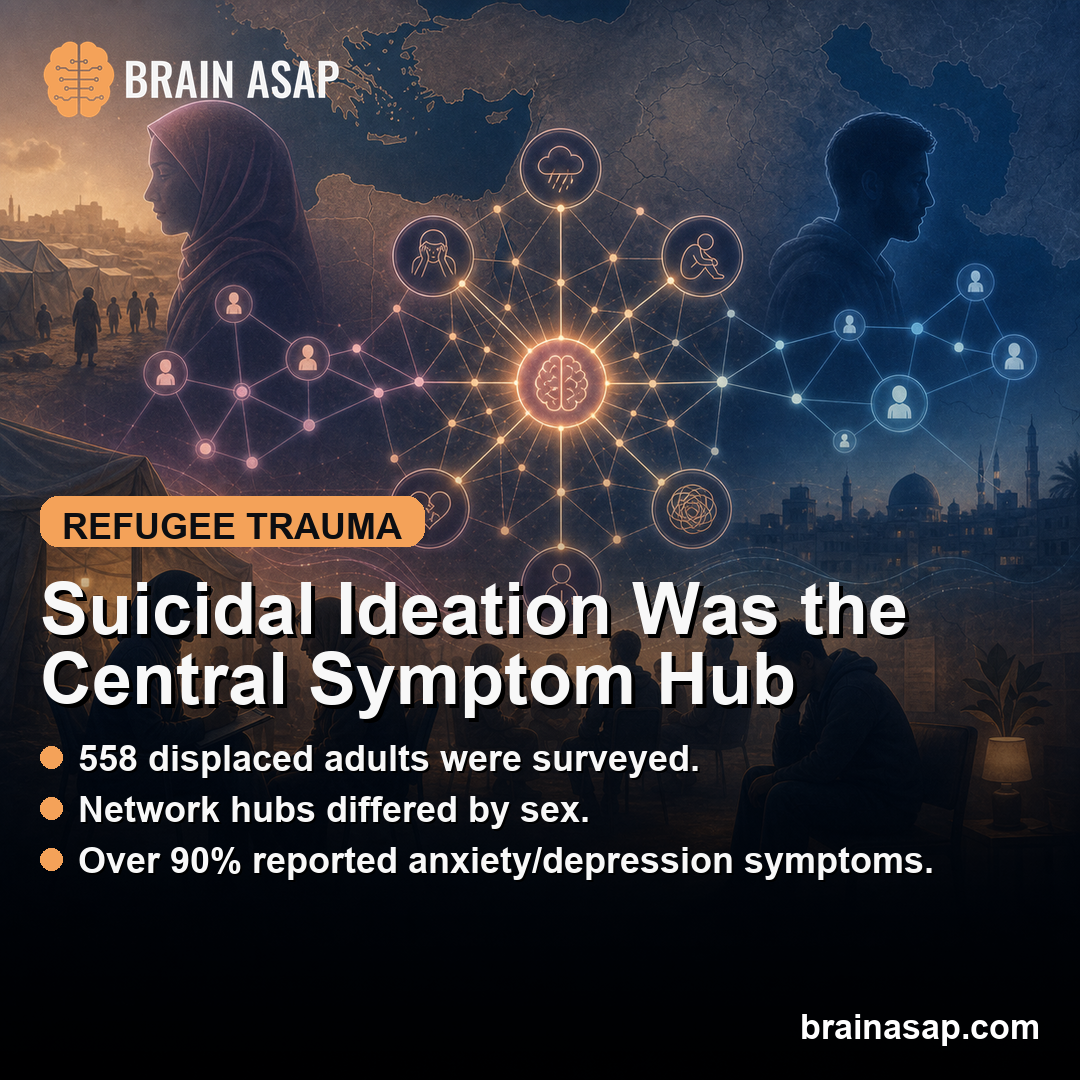
TL;DR: A 2026 cross-sectional study in Psychiatry Research surveyed 558 Palestinian refugees displaced to Egypt after the 2023 Gaza war and used Bayesian network analysis to map their psychological symptoms; suicidal ideation emerged as the central hub for both men and women, with secondary core symptoms differing by gender (loss of energy in men, psychomotor agitation/retardation in women) and 90% of refugees reporting multiple anxiety and depression symptoms.
Key Findings
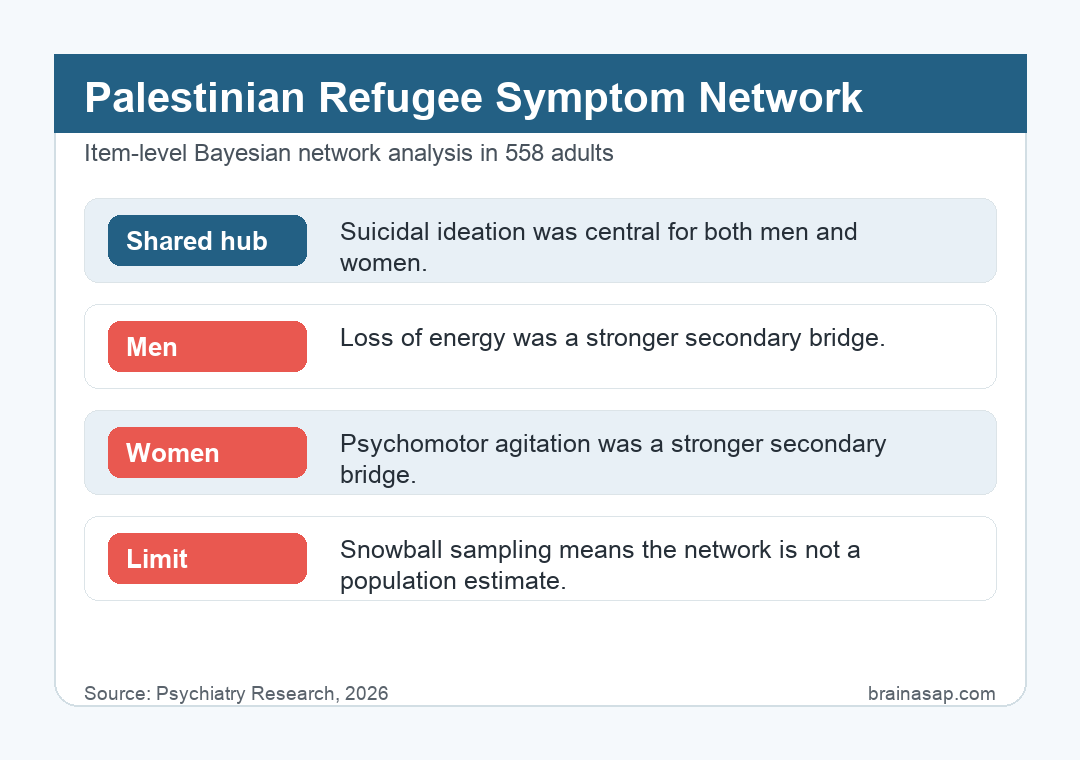
- Suicidal ideation was the central network hub for both sexes: In separate Bayesian networks built for men and women, thoughts of self-harm were the symptom most densely connected to other anxiety, depression, and trauma items — the symptom whose treatment would most likely reduce the rest.
- Over 90% reported multiple anxiety and depression symptoms: More than 9 in 10 surveyed refugees endorsed multiple symptoms across the anxiety and depression scales, and well over half showed signs of severe trauma response.
- Refugee network included 558 adults: Recruited via snowball sampling through Palestinian university students who had themselves been recently displaced; data collected through both online forms and in-person surveys.
- Secondary core symptoms differed by gender: For men, severe loss of energy — possibly a behavioral-shutdown response — was a secondary hub linked to appetite changes. For women, psychomotor agitation or retardation (slowed or restless movement) was the secondary hub.
- Strongest anxiety-depression bridge differed by gender: In men, fear of future threats bridged into depressed mood. In women, inability to relax bridged into anhedonia — the loss of pleasure.
Source: Psychiatry Research (2026) | Fadl et al.
Refugees displaced by armed conflict carry one of the highest psychiatric burdens in global mental health, and resources to treat them in host countries are typically inadequate.
Traditional psychiatric models treat anxiety, depression, and PTSD as distinct underlying diseases, each producing a fixed symptom checklist.
This study used a different framework — network theory — to map which individual symptoms drove the rest, with the practical aim of identifying the highest-leverage targets for limited clinical resources.
Why Network Theory Instead of Traditional Diagnostic Models
The Fadl team built their analysis around a network framework that treats mental health conditions as dynamic webs of interacting symptoms rather than as fixed clinical categories.
The reasoning:
- Symptoms interact: Sleep loss can drive fatigue, which can drive depressed mood, which can drive sleep loss. The categorical-diagnosis model misses these dynamics.
- Central symptoms have outsized leverage: Some symptoms are densely connected to many others. Treating those central symptoms could collapse a wider portion of the psychological network.
- Treatment under resource scarcity: In conflict-affected populations with limited clinical capacity, identifying the highest-leverage symptom is a practical question with direct consequences for which patients get treated and how.
The team built separate networks for men and women, on the prior literature showing that biology, social roles, and trauma exposure produce sex-specific psychiatric responses.
558 Adult Palestinian Refugees Surveyed Across Egypt
The study population was Palestinian adults displaced to Egypt after the outbreak of the 2023 war in Gaza.
The recruitment and measurement design:
- Sample: 558 Palestinian refugees aged 18 and older.
- Recruitment: Snowball sampling through Palestinian university students themselves recently displaced to Egypt; their familiarity with the population helped reach respondents who would otherwise be missed by formal public-health surveys.
- Survey delivery: Both secure online forms and in-person interviews.
- Measures: Standardized questionnaires for anxiety, depression, and post-traumatic stress disorder symptom severity.
The combination of cultural-insider data collection and standardized symptom scales is the methodological move that lets the analysis reach a population usually invisible to mental-health epidemiology.
The Symptom Burden Was Severe Across the Board:
Before any network mapping, the raw prevalence figures already make the population’s mental-health load clear:
- Over 90%: Reported multiple symptoms of anxiety and depression.
- Well over 50%: Showed signs of severe trauma responses.
- Suicidal ideation: Common enough across both sexes to emerge as the central network hub when symptoms were mapped.
The burden is consistent with prior literature on conflict-displaced populations, but the within-population mapping is what gives the work its actionable contribution.
Suicidal Ideation Emerged as the Central Hub for Both Sexes
The Bayesian graphical model treats each symptom as a node and computes the strength of direct relationships between pairs of nodes while controlling for the influence of every other symptom.
In both the men’s and women’s networks, suicidal ideation came out as the most densely connected symptom — the gravity well into which many other symptoms pulled.
The clinical implication is direct: a screening or treatment program in resource-limited settings should prioritize detecting and addressing suicidal ideation as the highest-leverage intervention point.
The authors attribute the centrality of this symptom to a combination of poor financial status, inadequate social support, and the general distress of forced migration.
Secondary Hubs Differed Sharply Between Men and Women
Beyond the shared suicidal-ideation hub, the male and female networks diverged in their secondary structure.
For men: For women:
- Secondary core symptom: Psychomotor agitation or retardation — the clinical term for either unusually slow or unusually restless physical movement.
- Linked feature: Inability to regulate both emotion and physical behavior.
- Authors’ framing: A pattern of distress in which emotional dysregulation translates into somatic-motor consequences.
The divergence has direct treatment implications. A program calibrated to identify only one of these secondary hubs would miss the other half of the affected population.
Anxiety-Depression Bridges Were Also Sex-Specific:
The networks also identified the strongest “bridge symptoms” — items most strongly linking the anxiety subnetwork to the depression subnetwork.
Men: Women:
- Bridge: Inability to relax ↔ total loss of pleasure (anhedonia).
- Pattern: Sustained physical and mental tension drained the capacity to experience positive emotion.
- Within-anxiety coupling: Women also showed tight coupling between general tension and being easily annoyed, which the authors describe as emotional hyperreactivity.
For trauma symptoms specifically, men’s intrusive thoughts paired with hypervigilance (constant physical readiness to detect threat), while women’s intrusive thoughts paired with environmental reminders of the conflict — suggesting external cues more frequently triggered involuntary traumatic memories in women than in men in this sample.
Single-Snapshot Design, Self-Report, and Snowball Sampling Limit Causal Reading
- Single-snapshot design: The networks reveal mathematical associations but cannot show that one symptom causes another over time. Longitudinal data is needed to test whether treating the central hubs actually collapses the rest of the network.
- Self-reported symptoms, not clinical diagnoses: Severity scores came from standardized questionnaires rather than structured psychiatric interviews. That introduces measurement error.
- Snowball sampling cannot be randomized: The chaotic conditions of forced displacement make true random sampling impossible. The sample is the population that recruitment networks could reach, not necessarily the full refugee population.
- Pre-existing conditions not screened out: Some respondents may have had mental-health conditions before displacement. The data cannot separate displacement-driven distress from baseline psychiatric load.
- No data on displacement timeline or medical history: Time since displacement, medical history, and exposure variation are unmeasured factors that could shape the network structure.
Suicidal-Ideation Screening Should Be the Resource-Limited Entry Point for Refugee Care
Practical implications follow from the network-leverage framing:
- Suicidal-ideation screening should be the entry point: Any program operating under resource scarcity should treat detection of suicidal ideation as the first priority, given its central position in the symptom network for both sexes.
- Sex-specific secondary screening matters: Loss of energy in men and psychomotor agitation in women should each be added as a second-tier indicator, since they carry different leverage in their respective networks.
- Anxiety-depression bridges suggest different intervention angles: For men, programs targeting fear of future threats and sustained worry may have outsized benefit. For women, interventions reducing tension and supporting the capacity for pleasure may carry more leverage.
- Trauma-cue management differs by sex: Programs reducing environmental triggers may benefit women more directly; programs reducing chronic hypervigilance may benefit men more directly.
- Network-centrality logic generalizes beyond this population: The actionable claim — that mapping symptom centrality identifies the highest-leverage treatment targets — can be applied to other resource-limited mental-health settings.
Citation: DOI: 10.1016/j.psychres.2026.117210. Fadl N et al. Anxiety, depression, and post-traumatic stress disorder among Palestinian refugees in Egypt: Gender-stratified item-level Bayesian network analysis. Psychiatry Research. 2026.
Study Design: Cross-sectional study using gender-stratified item-level Bayesian network analysis to map anxiety, depression, and PTSD symptom networks.
Sample Size: 558 adult Palestinian refugees displaced to Egypt after the 2023 Gaza war; recruited via snowball sampling through Palestinian university students themselves recently displaced.
Key Statistic: Suicidal ideation was the central network hub for both men and women. Over 90% reported multiple anxiety and depression symptoms; over 50% met criteria for severe trauma response. Secondary hubs differed by sex (loss of energy in men; psychomotor agitation in women); anxiety-depression bridges differed by sex (fear-of-future-threats ↔ depressed mood in men; inability-to-relax ↔ anhedonia in women).
Caveat: Cross-sectional design cannot establish symptom-to-symptom causality; self-reported questionnaires rather than structured psychiatric interviews; snowball sampling rather than randomized recruitment; pre-existing conditions and displacement-timeline data not available.