TL;DR: A 2026 preprint in medRxiv used 18F-DOPA positron emission tomography (PET) to estimate dopamine synthesis and storage, and found that caudate dopamine synthesis decreased as schizophrenia patients moved from active psychosis into early psychotic remission.
Key Findings
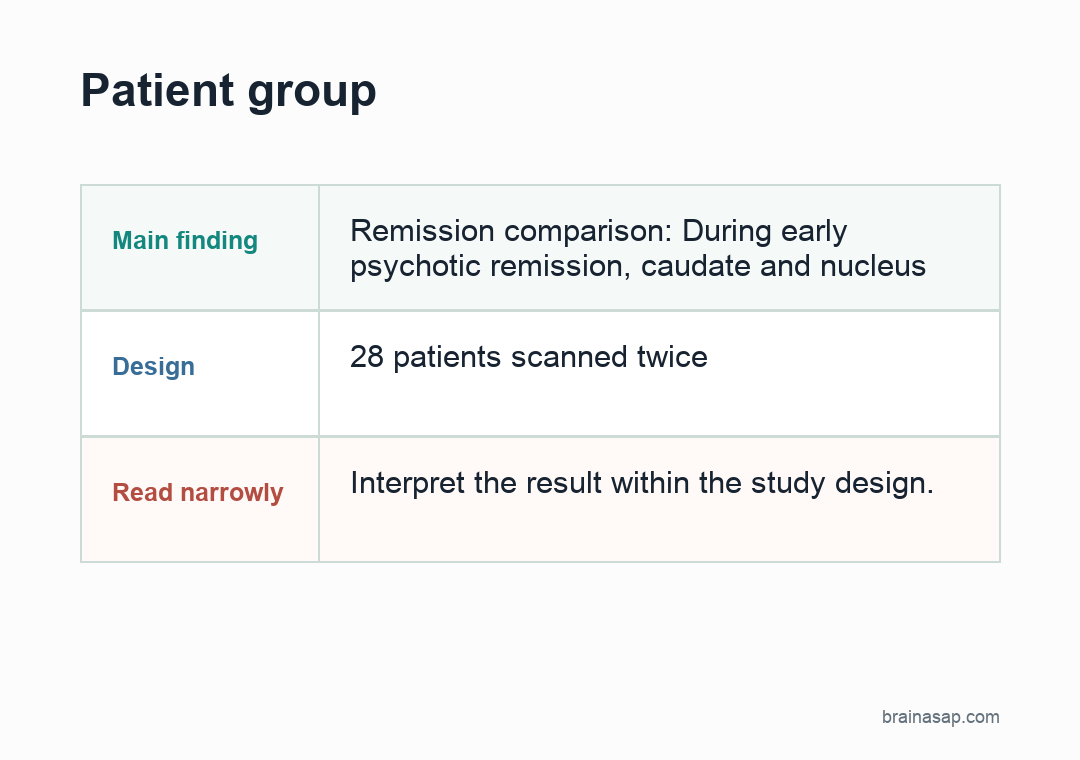
- Patient group: Researchers scanned 28 schizophrenia patients twice and compared them with 21 healthy controls scanned over a similar interval.
- Main measure: 18F-DOPA PET estimated dopamine synthesis and storage (DSS) in the nucleus accumbens, caudate, and putamen.
- Caudate result: Caudate DSS decreased from psychosis to remission in patients, while healthy controls did not show the same change.
- Remission comparison: During early psychotic remission, caudate and nucleus accumbens DSS were lower in patients than in controls.
- Relapse finding: In an exploratory follow-up, 32% of reached patients relapsed, and later relapsers had higher caudate DSS during the earlier psychotic scan.
Source: Schulz et al. reported this as a medRxiv preprint, so the result should be treated as preliminary until peer review.
Schizophrenia often moves through periods of active psychosis and remission. The clinical symptoms are visible, but the underlying dopamine biology is harder to track because most studies measure patients at only one point in time.
This study focused on dopamine synthesis and storage (DSS), a PET-based estimate of how much dopamine-making capacity is present in striatal brain regions. Researchers used 18F-DOPA PET, a positron emission tomography method that tracks uptake of a dopamine precursor.
28 Schizophrenia Patients Were Scanned During Psychosis and Remission
The design was longitudinal. Researchers scanned 28 patients with schizophrenia during an acute psychotic episode, then scanned them again after early psychotic remission.
A comparison group of 21 healthy controls was scanned twice across a comparable time interval.
Psychosis at the first scan required at least moderate symptoms on Positive and Negative Syndrome Scale items for delusions, hallucinations, or suspiciousness. Remission required those same symptom items to remain mild or lower for at least 6 weeks.
The PET analysis focused on 3 striatal subregions:
- Caudate: a striatal region heavily connected with associative and cognitive control circuits.
- Nucleus accumbens: a reward-related striatal region often discussed in motivation and salience processing.
- Putamen: a striatal region more closely tied to motor and sensorimotor circuits.
The regional split is important because dopamine findings in schizophrenia are not uniform across the striatum. A whole-striatum average can hide whether the change is strongest in associative, reward, or motor-linked regions.
Caudate Dopamine Synthesis Decreased After Psychotic Remission
The main statistical result was a group x session interaction in the caudate and nucleus accumbens. In plain terms, patients changed differently over time than healthy controls did.
Post hoc testing showed a significant decrease in caudate DSS from psychosis to remission in patients. The nucleus accumbens showed a similar direction, but the within-patient change did not reach the same threshold.
The strongest scan-level findings were:
- Nucleus accumbens interaction: F(1,40) = 4.4, P = 0.041.
- Caudate interaction: F(1,40) = 4.8, P = 0.034.
- Caudate longitudinal decrease: t = 1.8, P = 0.043 in patients from psychosis to remission.
- Putamen: no comparable group-by-session effect was detected.
During remission, patients also had lower caudate and nucleus accumbens DSS than controls. The remission comparison was significant in the nucleus accumbens (t = 2.4, P = 0.01) and caudate (t = 2.1, P = 0.02).
A direct interpretation is that dopamine capacity did not simply stay high in schizophrenia. In this sample, striatal dopamine capacity looked dynamic: higher during psychosis for some patients, then lower during early remission in specific striatal regions.
Relapse Follow-Up Pointed Back to Caudate Dopamine During Psychosis
Researchers also asked whether the earlier dopamine scan related to relapse after remission. Of 22 reached patients with longitudinal data, 32% had a psychotic relapse within 12 months.
The relapse analysis was exploratory and small, but it was clinically relevant because the pattern appeared before remission was established. Patients who later relapsed had higher caudate DSS during psychosis than patients who did not relapse (F(1,19) = 4.4, P = 0.049).
The same pattern did not appear everywhere:
- Caudate during remission: no significant difference between later relapsers and non-relapsers.
- Nucleus accumbens during psychosis: no significant relapse-group difference.
- Nucleus accumbens during remission: no significant relapse-group difference.
The relapse finding is a candidate marker, not a clinical prediction tool. Dopamine dynamics during an acute episode may carry information, but the sample was too small to support individual risk decisions.
The Result Fits a State-Dependent Dopamine Model
Schizophrenia dopamine research often emphasizes elevated striatal dopamine synthesis during psychosis. This study adds a more state-dependent reading: dopamine synthesis may fall after symptoms remit, especially in caudate-linked circuits.
Researchers also checked whether medication changes explained the result. Average chlorpromazine-equivalent antipsychotic dose and antipsychotic plasma levels did not significantly change across scans, which makes a simple dose-change explanation less likely.
Important boundaries remain:
- Preprint status: the study has not yet passed peer review.
- Sample size: 28 patients is useful for a PET study but still small for relapse prediction.
- Treatment context: patients were receiving antipsychotic medication, so the scans do not isolate untreated dopamine biology.
- Clinical use: 18F-DOPA PET is a research tool here, not a routine remission or relapse test.
The strongest supported claim is narrower and still useful: in this longitudinal PET sample, caudate dopamine synthesis decreased as patients moved from active psychosis to early psychotic remission, and higher caudate dopamine synthesis during psychosis was linked with later relapse in an exploratory follow-up.
Citation: DOI: 10.64898/2026.04.20.26351256. Schulz et al. Striatal dopamine synthesis in schizophrenia decreases from psychosis to psychotic remission. medRxiv. 2026.
Study Design: Longitudinal 18F-DOPA PET preprint with schizophrenia patients scanned during psychosis and early remission, plus healthy controls scanned twice.
Sample Size: 28 schizophrenia patients and 21 healthy controls; relapse follow-up reached 22 patients.
Key Statistic: Caudate group-by-session interaction F(1,40) = 4.8, P = 0.034; later relapse occurred in 32% of reached patients.
Caveat: This was a small preprint PET study, and the relapse analysis was exploratory rather than a validated clinical prediction model.