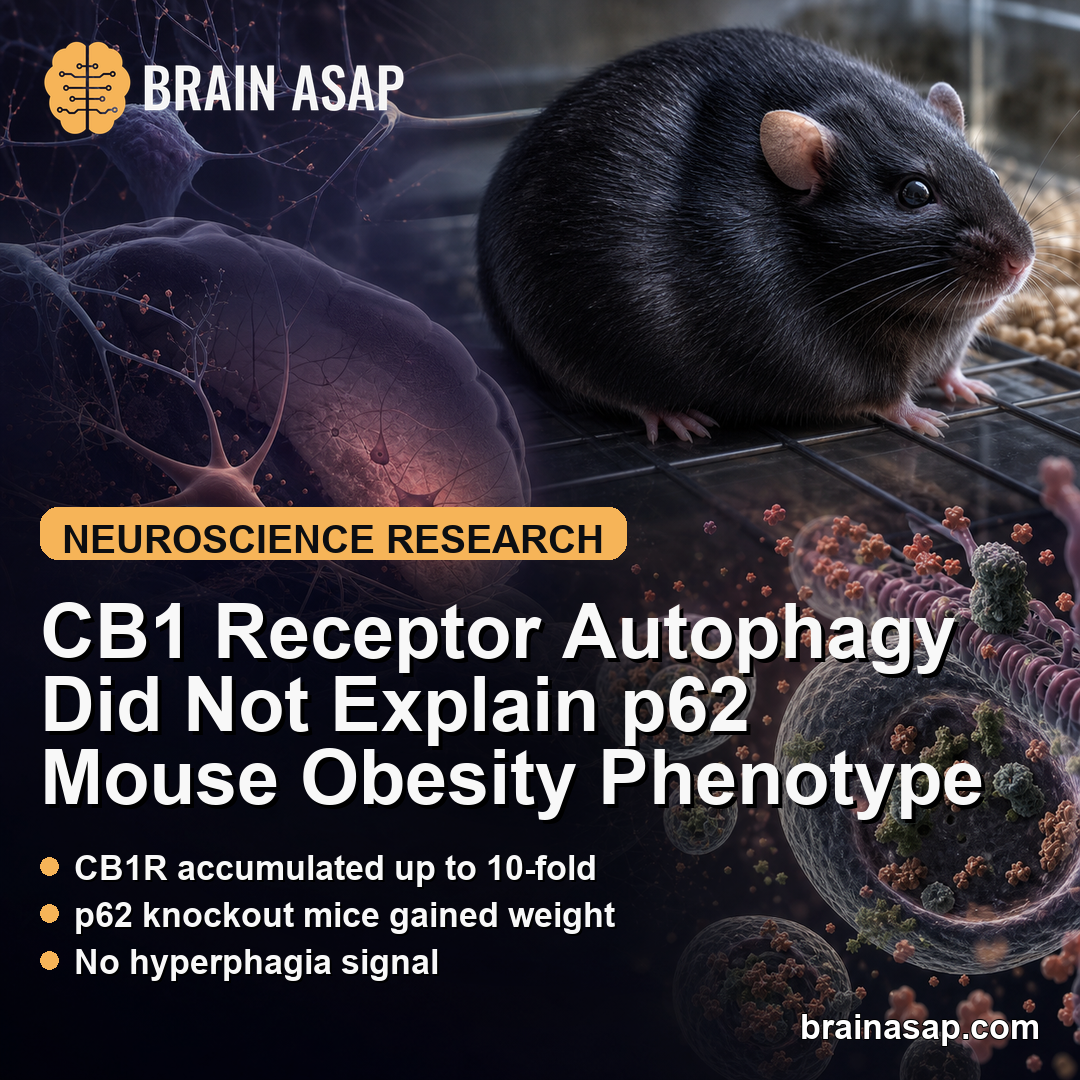
TL;DR: A 2026 study in Biochemistry and Biophysics Reports found that cannabinoid receptor 1 (CB1R) undergoes autophagy-linked degradation in mouse cortical neurons, but p62 deficiency did not make CB1R the main driver of obesity and low activity in p62 knockout mice.
Key Findings
- CB1R accumulated up to 10-fold: Blocking autophagic flux with Bafilomycin A1 in wild-type cortical neurons caused substantial CB1R buildup.
- p62 knockout mice gained weight: Male p62 KO mice showed late-onset obesity, with body weight rising more than 6 g above wild-type littermates by 21 weeks.
- No hyperphagia signal: During obesity onset, p62 KO mice ate about the same daily amount as wild-type mice, arguing against overeating as the primary cause.
- Activity dropped before obesity: Voluntary locomotion was reduced by about 15 weeks, several weeks before significant weight gain began.
- CB1R was not the main explanation: CB1R abundance was not significantly altered in whole brain or hypothalamus, and CB1R antagonism did not reveal a direct receptor-dependent mechanism.
Source: Biochemistry and Biophysics Reports (2026) | Keller et al.
CB1R Links Cannabinoid Signaling to Appetite, Activity, and Neurons
Cannabinoid receptor 1 (CB1R) is a brain-enriched receptor that responds to endocannabinoids, the body’s own cannabinoid-like signaling molecules. It is especially relevant to appetite, energy balance, movement, reward, and synaptic transmission.
The study focused on whether CB1R turnover is controlled by autophagy, the cell’s recycling pathway for degrading damaged or unnecessary material. The other central protein was p62, also called sequestosome 1, an autophagy adaptor that helps move tagged cargo toward degradation.
The brain-metabolism link is direct because CB1R activation can increase feeding and reduce locomotor activity. p62 knockout mice also develop obesity, insulin resistance, and abnormal energy balance with age.
The researchers tested whether those two stories connect. If p62 normally helps degrade CB1R, losing p62 might increase CB1R signaling and explain obesity or hypoactivity in the knockout mice.
- Cell test: whether CB1R builds up when autophagy is blocked in neurons.
- Mouse tissue test: whether p62 knockout mice show altered brain CB1R abundance or signaling.
- Behavior test: whether CB1R explains late-onset obesity, reduced locomotion, or altered fasting-refeeding behavior.
Bafilomycin A1 Caused CB1R Buildup in Cortical Neurons
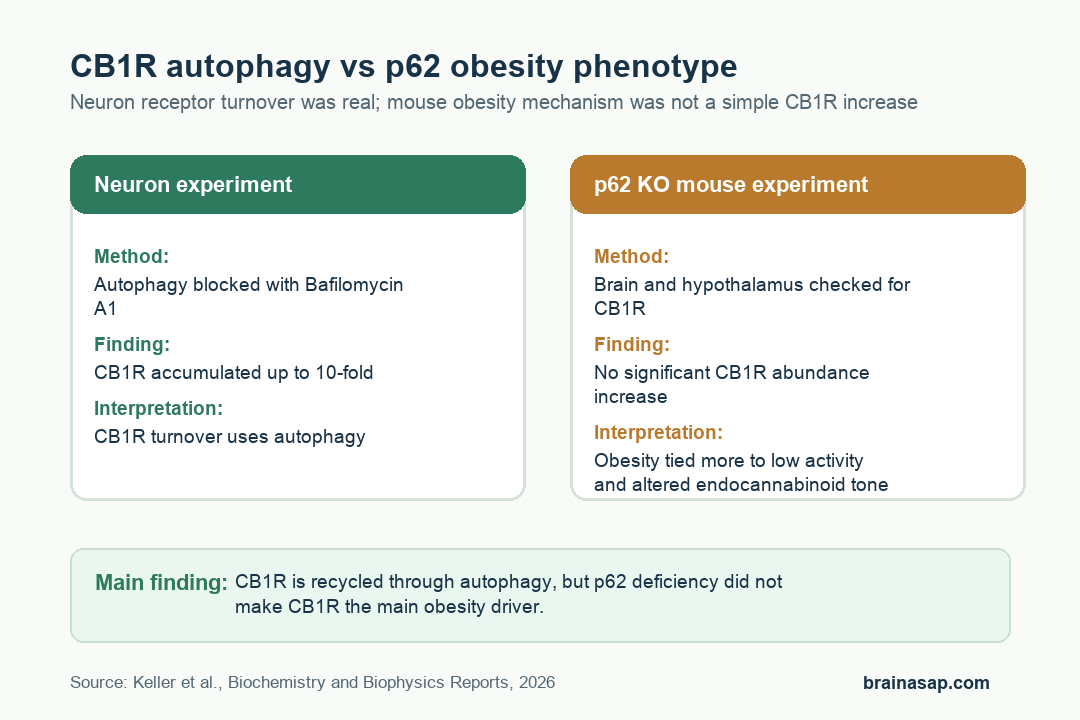
In primary mouse cortical neurons, the team blocked autophagic flux with Bafilomycin A1, a drug that interferes with autophagosome-lysosome fusion. CB1R protein levels rose substantially, reaching up to a 10-fold increase.
That result supports the first major conclusion: neuronal CB1R is an autophagy substrate. In other words, autophagy contributes to the normal turnover of this receptor in neurons.
Researchers also tested the CB1R agonist HU-210 and the CB1R antagonist SR141716A, also known as rimonabant. HU-210 partially reduced the Bafilomycin-induced CB1R accumulation, suggesting receptor activation can influence trafficking or degradation fate.
SR141716A did not clearly block the buildup. The study interpreted CB1R turnover as a complex process involving autophagy, internalization, receptor desensitization, and possibly other degradation routes.
- Autophagy block: Bafilomycin A1 increased CB1R and LC3-II/LC3-I ratio, consistent with blocked autophagic flux.
- Agonist effect: HU-210 reduced some CB1R accumulation under autophagy-blocked conditions.
- p62 uncertainty: these neuron experiments showed autophagy involvement, but did not prove that p62 itself was required for CB1R degradation.
p62 Knockout Mice Became Obese Without Eating More
The in vivo results did not support a simple CB1R-overexpression explanation. Male p62 knockout mice had similar body weight to wild-type mice at 12 weeks, but then gained more weight as they aged.
By 21 weeks, p62 knockout mice weighed about 32.9 g, compared with 28.3 g in wild-type controls. The difference grew to more than 6 g between knockout and wild-type animals.
Daily food intake increased with age in both groups, but p62 knockout mice showed no clear hyperphagia during obesity onset. Both genotypes consumed about 3.2 g per day across the testing period.
At 5 months, adipose tissue was increased in p62 knockout mice. Liver weight showed a trend, but body fat increased without a matching overeating pattern.
- Weight timing: p62 KO mice separated from controls after early adulthood.
- Food intake: daily intake was comparable during the obesity-onset window.
- Energy balance clue: reduced expenditure or activity became a stronger candidate than excess intake.
Reduced Locomotion Appeared Before Major Weight Gain
Home-cage activity gave the strongest behavioral clue. Voluntary locomotion was reduced in male p62 knockout mice by about 15 weeks, roughly 3 weeks before significant weight gain became clear.
The activity difference was most visible during the dark phase, when mice are usually most active. That timing supports reduced locomotion as an early part of the phenotype rather than only a consequence of severe obesity.
In 1-year-old male mice, the phenotype was stronger. p62 knockout mice weighed 18 g more than wild-type littermates, but food intake was only modestly higher and not statistically significant.
Activity during the active phase was much lower: p62 knockout mice averaged 1.7 minutes per hour of activity, compared with about 3.6 minutes per hour in wild-type mice.
The study also found elevated hypothalamic 2-arachidonoylglycerol (2-AG), an endocannabinoid that activates CB1R, in 7-month-old male p62 knockout mice. That raised the possibility of altered central endocannabinoid tone without higher receptor abundance.
CB1R Abundance Did Not Explain the p62 Phenotype
Western blot analyses found comparable CB1R levels in whole-brain lysates from p62 knockout and wild-type mice. Hypothalamic CB1R was slightly lower in male knockout mice, but the difference did not reach statistical significance.
Downstream signaling was mixed. Hypothalamic ERK1/2 phosphorylation, a signaling readout downstream of CB1R and other pathways, was modestly lower in p62 knockout mice. But total CB1R abundance was not elevated.
Fasting-refeeding tests added another layer. Adult and aged female p62 knockout mice ate less after an 18-hour fast than wild-type mice, while juvenile knockout mice did not show the same reduced feeding response.
SR141716A still reduced food intake in p62 knockout mice, meaning CB1R blockade remained effective. Hypothalamic CB1R, ERK1/2 activation, and AMPK activation after fasting were not significantly different between genotypes in that experiment.
- Receptor level: CB1R protein abundance did not increase enough to explain obesity.
- Ligand level: hypothalamic 2-AG was elevated, suggesting altered endocannabinoid tone.
- Behavioral level: hypoactivity and age-dependent fasting-response changes were stronger phenotype markers.
The careful interpretation is that CB1R is processed through autophagy in neurons, but p62 deficiency does not make CB1R the primary cause of the knockout mouse obesity phenotype under these conditions.
Citation: DOI: 10.1016/j.bbrep.2026.102571. Keller et al. Exploring cannabinoid receptor CB1 autophagy and the obesity phenotype of p62-deficient mice. Biochemistry and Biophysics Reports. 2026;46:102571.
Study Design: Mouse neuron, p62 knockout mouse, western blot, endocannabinoid, locomotion, and fasting-refeeding experiment series.
Sample/Model: Primary mouse cortical neurons plus p62 knockout and wild-type mouse cohorts across juvenile, adult, and aged groups.
Key Statistic: Bafilomycin A1 increased neuronal CB1R up to 10-fold, while p62 knockout mice showed obesity without matching hyperphagia and no significant CB1R abundance increase in brain or hypothalamus.
Caveat: Animal and cell study; it does not establish a human obesity mechanism or a clinical CB1R treatment strategy.