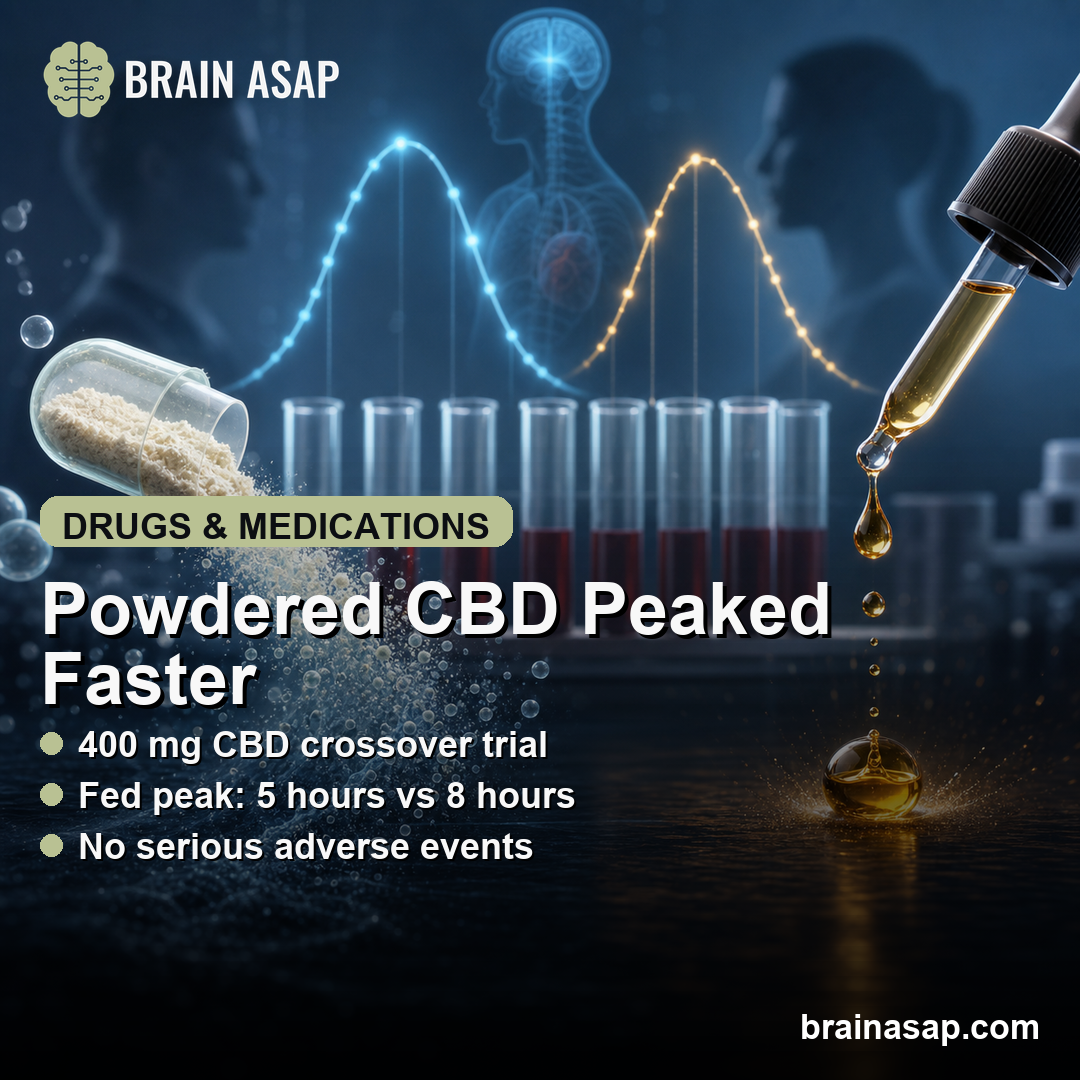
TL;DR: A 2026 Phase I study in CNS Drugs found that a 400 mg powdered cannabidiol (CBD) formulation reached peak blood levels faster than oil-based Epidyolex, especially after a high-fat meal, while both products were generally well tolerated in healthy adults.
Key Findings
- Four-way crossover trial: Researchers gave 32 healthy adults single 400 mg doses of powdered CBD and oil-based Epidyolex under both fed and fasted conditions.
- Faster CBD absorption: Median time to peak CBD concentration was 3.0 hours vs 3.5 hours when fasted and 5.0 hours vs 8.0 hours when fed.
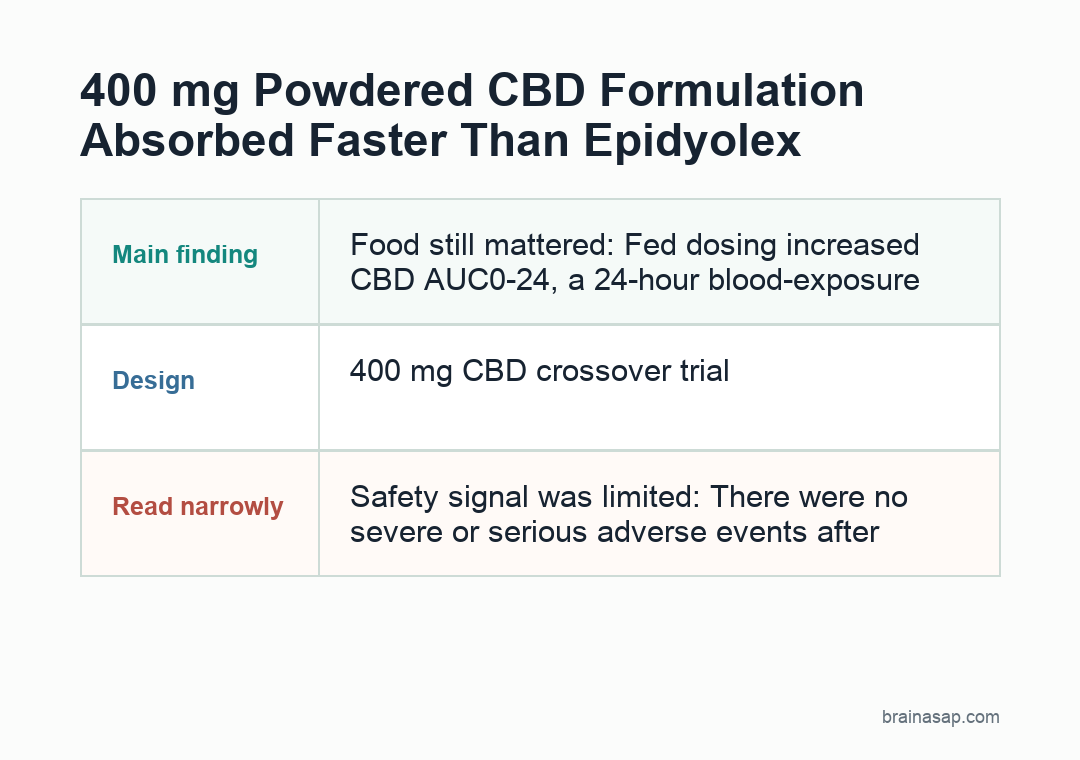
- Food still mattered: Fed dosing increased CBD AUC0-24, a 24-hour blood-exposure measure, by about 3.0-fold for the powder and 3.5-fold for Epidyolex.
- Metabolites differed while fasted: The powder produced higher fasted exposure to 7-OH-CBD and 7-COOH-CBD, the main measured CBD metabolites.
- Safety signal was limited: There were no severe or serious adverse events after single-dose testing, but the trial was small and used healthy participants.
Bendik et al. compared an encapsulated powdered CBD emulsion called CBtru with the approved oil-based CBD solution Epidyolex in a randomized Phase I pharmacokinetic trial.
A 400 mg CBD Dose Was Tested Four Ways
Cannabidiol (CBD) is difficult to deliver by mouth because it dissolves poorly in water and is heavily processed by the liver after absorption.
Epidyolex uses an oil-based vehicle to help with that problem, but oral CBD exposure can still vary widely from person to person and can change substantially with food.
Researchers tested whether a powdered emulsion formulation could make CBD absorption more predictable. The test product, CBtru, was delivered as six capsules.
The reference product, Epidyolex, was delivered as 4 mL of oral solution. Each dose provided 400 mg of CBD.
The trial used a randomized, open-label, four-period crossover design, meaning each participant could act as their own comparison across the product and food conditions. The four dosing conditions were:
- CBtru fasted: Powdered CBD after an overnight fast.
- Epidyolex fasted: Oil-based CBD after an overnight fast.
- CBtru fed: Powdered CBD after a high-fat, high-calorie breakfast.
- Epidyolex fed: Oil-based CBD after the same type of breakfast.
Blood samples were collected before dosing and repeatedly through 24 hours. Researchers measured CBD itself and two metabolites: 7-OH-CBD, an active metabolite, and 7-COOH-CBD, the major circulating carboxy metabolite.
The Powdered CBD Formulation Reached Peak Levels Earlier
The clearest product difference was timing. When participants were fasted, median CBD tmax, the time to peak blood concentration, was 3.0 hours for CBtru and 3.5 hours for Epidyolex.
Under fed conditions, the difference was larger: 5.0 hours for CBtru and 8.0 hours for Epidyolex.
The total amount of CBD in blood over 24 hours, measured as AUC0-24, was not statistically different between products under either condition. In fasted dosing, CBtru’s CBD AUC0-24 was numerically 115.3% of Epidyolex, but the comparison did not reach statistical significance.
In fed dosing, the CBD AUC0-24 ratio was essentially identical at 99.3%.
Peak CBD concentration also trended higher for the powder. Fasted CBtru had a geometric mean Cmax of 154.8 ng/mL, compared with 115.0 ng/mL for fasted Epidyolex.
Fed CBtru had a geometric mean Cmax of 323.9 ng/mL, compared with 255.5 ng/mL for fed Epidyolex. These peak-concentration differences did not meet the study’s statistical threshold.
The powder did not clearly deliver more parent CBD overall, but it reached peak CBD levels sooner and tended to show less variability in peak concentrations.
Food Increased CBD Exposure for Both Products
The meal effect was substantial. Compared with fasted dosing, fed dosing increased CBD AUC0-24 by 301.4% for CBtru and 350.1% for Epidyolex. CBD peak concentration also rose with food: 209.2% for CBtru and 224.8% for Epidyolex.
This result fits the broader CBD pharmacology problem. CBD is lipophilic, so a high-fat meal can improve solubilization and transport through the gut.
The study used a standardized 800-1000 kcal breakfast with about half the calories from fat, which is the kind of meal intended to stress-test food effects in pharmacokinetic studies.
The food result matters because product comparisons can look different depending on dosing instructions. Under fed conditions, overall CBD and metabolite exposure looked broadly comparable between products, even though CBtru reached peak concentrations sooner.
- Parent CBD exposure: Fed dosing increased systemic CBD exposure for both formulations.
- Absorption timing: CBtru still peaked earlier than Epidyolex after the high-fat meal.
- Metabolite pattern: Food changed metabolite exposure differently across the measured compounds.
Fasted Metabolite Exposure Was Higher With the Powder
Under fasted conditions, the powdered formulation produced larger differences in CBD metabolites than in parent CBD. Compared with Epidyolex, CBtru had 149.2% of the 7-OH-CBD AUC0-24 and 184.5% of the 7-OH-CBD Cmax.
Both comparisons were statistically significant.
The 7-COOH-CBD differences were also significant. Fasted CBtru produced 158.4% of the 7-COOH-CBD AUC0-24 and 168.9% of the 7-COOH-CBD Cmax compared with fasted Epidyolex.
The researchers also summed exposure measures into active drug exposure and total drug exposure. In fasted dosing, CBtru produced 127.1% of active drug exposure, defined as CBD plus 7-OH-CBD, and 154.5% of total drug exposure, defined as CBD plus both measured metabolites.
These metabolite findings are important but should not be overread. The trial did not test seizure control, anxiety, pain, sleep, or any other clinical endpoint.
It showed how blood levels changed after a single dose in healthy adults.
Adverse Events Were Mostly Mild in This Small Trial
Safety results were reassuring for single-dose exposure. Across all treatment periods, 14 of 32 participants reported 32 treatment-emergent adverse events. No severe adverse events, serious adverse events, deaths, or adverse-event-related withdrawals were reported.
The most common adverse events were ordinary tolerability complaints rather than organ-safety signals:
- Headache: Reported by 6 participants.
- Loose stool: Reported by 3 participants.
- Nausea: Reported by 3 participants.
- Drowsiness: One moderate event occurred after fed CBtru dosing and resolved within 2 hours.
No consistent liver-enzyme, ECG, vital-sign, or physical-exam safety signal emerged. The early safety profile supports continued formulation testing, but the limits are narrow.
A single-dose Phase I study cannot show long-term safety, dose accumulation, or clinical benefit in patients who use CBD repeatedly.
The Main Limitation Is Clinical Translation
The strongest conclusion is pharmacokinetic: powdered CBD reached peak levels faster and showed some more consistent exposure measures than oil-based Epidyolex. The study does not prove that the powder works better for epilepsy, pain, anxiety, or neuropsychiatric symptoms.
Several design limits keep the clinical claim bounded:
- Healthy adults: The sample did not include patients using CBD for a neurological or psychiatric condition.
- Single dose: Researchers did not test repeated dosing, steady-state levels, or accumulation.
- Short sampling window: Blood collection ended at 24 hours, which limited terminal-phase estimates for some analytes.
- Sponsor involvement: The study was funded by dsm-firmenich, which developed CBtru, and several study authors were company employees.
The specific takeaway is that formulation and food state can strongly change measured CBD exposure. The powder formulation may make absorption faster and somewhat more predictable, but patient-level benefit still requires trials in the conditions where CBD is meant to be used.
Citation: DOI: 10.1007/s40263-026-01280-1. Bendik et al. Comparative Pharmacokinetics and Safety of Cannabidiol in a Powder Formulation, CBtru, vs an Oil-Based Formulation, Epidyolex, Under Fasted and Fed Conditions in Healthy Participants: A Randomized Open-Label Cross-Over Phase I Study. CNS Drugs. 2026;40:709-723.
Study Design: Single-center, randomized, open-label, four-period crossover Phase I pharmacokinetic trial.
Sample Size: 32 healthy adults randomized; 30 completed all trial periods per protocol.
Key Statistic: Median CBD tmax was 5.0 hours for fed CBtru versus 8.0 hours for fed Epidyolex; fed dosing increased CBD AUC0-24 by about 3.0-fold to 3.5-fold.
Caveat: Single-dose healthy-volunteer data do not establish clinical benefit, long-term safety, or dosing performance in patients.