TL;DR: A 2026 European Journal of Pediatrics study found that children with phenylketonuria, or PKU, had higher depression scores and lower quality of life than controls, with the worse pattern in children diagnosed later.
Key Findings
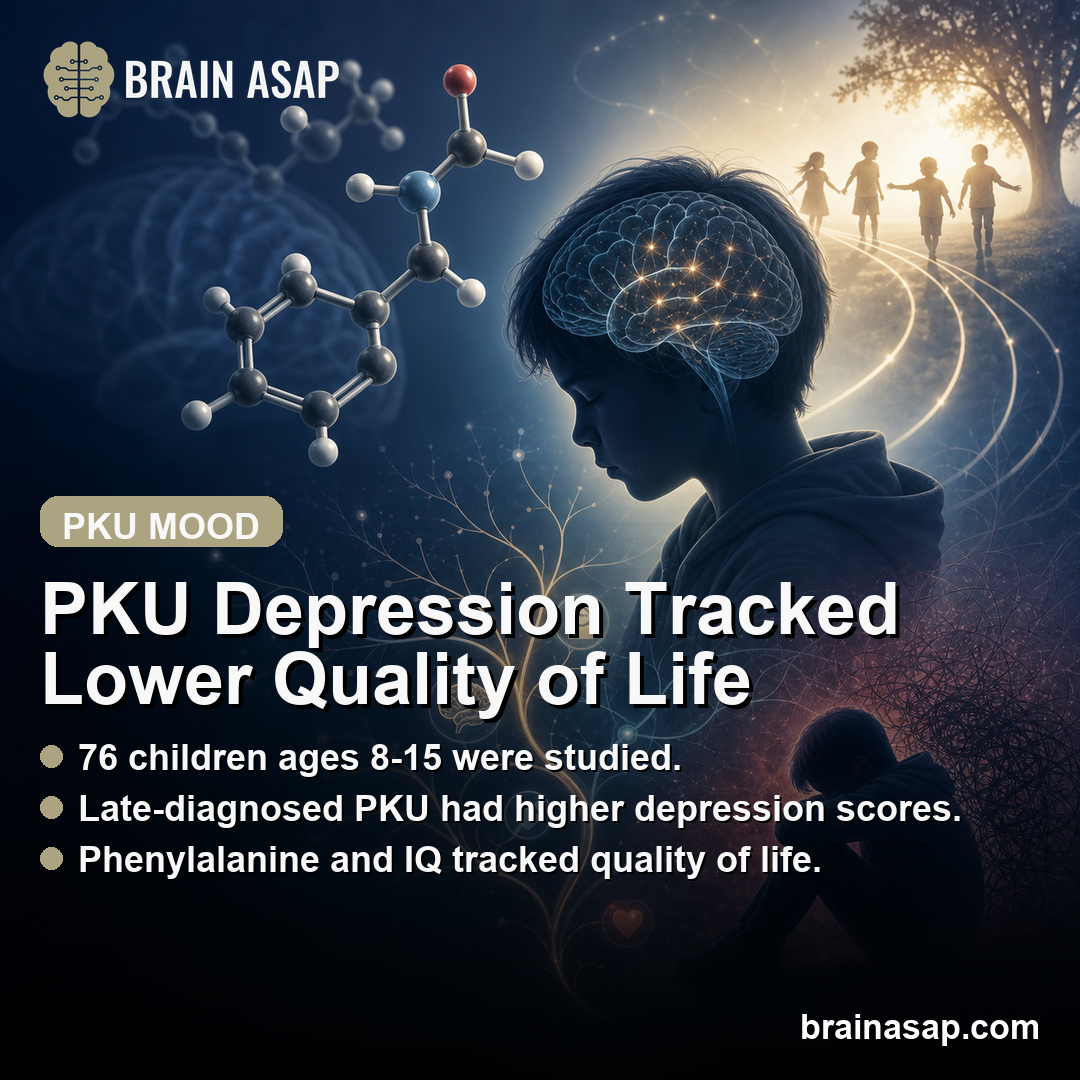
- Children studied: The study included 76 children ages 8-15, split into early-diagnosed PKU, late-diagnosed PKU, and healthy control groups.
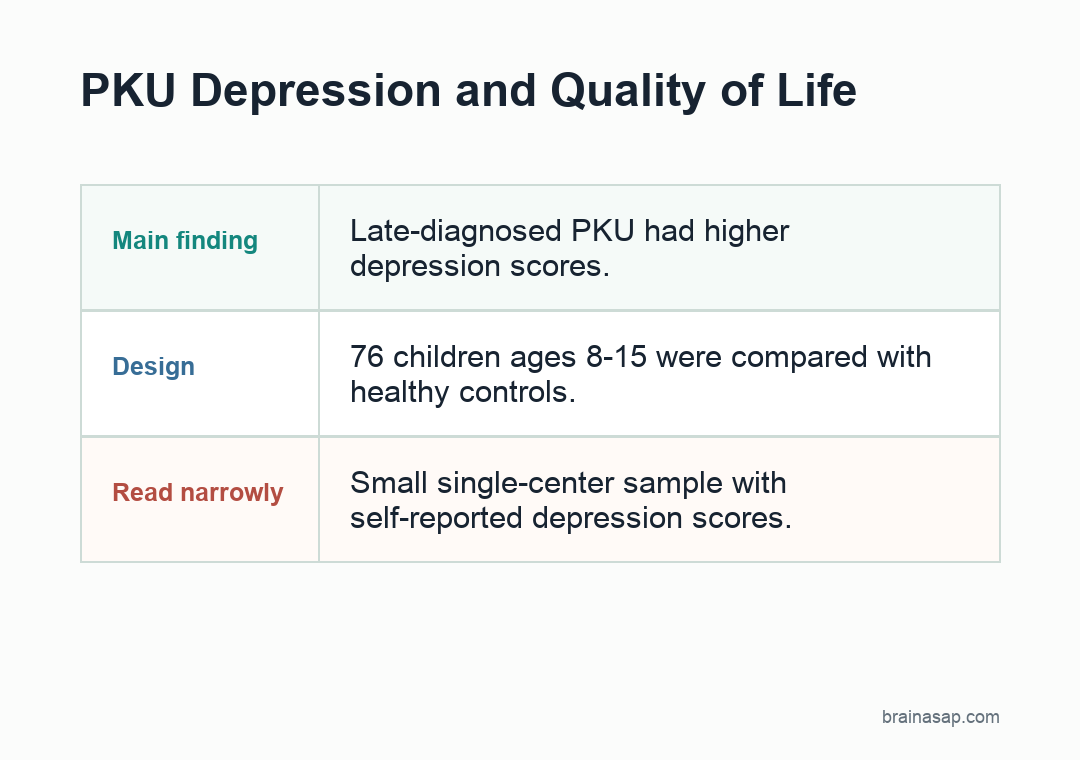
- Depression scores: Median Birleson depression scores were 7 in late-diagnosed PKU, 3 in early-diagnosed PKU, and 2 in controls.
- Quality of life: PKU children had lower PedsQL quality-of-life scores than controls across total and domain scores.
- Correlations: Quality of life was negatively correlated with phenylalanine level and depression score, and positively correlated with IQ.
- Caution: This was a small, single-center study using a self-reported depression scale.
Source: European Journal of Pediatrics (2026) | Abuelela et al.
Phenylketonuria, usually shortened to PKU, is an inherited metabolic disorder in which phenylalanine can build up when treatment is delayed or metabolic control is poor. Phenylalanine is an amino acid, but in PKU high levels can affect the brain.
Early newborn screening and a phenylalanine-restricted diet can prevent the most severe neurological outcomes. Even so, children and adults with PKU can still face cognitive, emotional, dietary, and social burdens that are easy to undercount if care focuses only on blood phenylalanine levels.
That is the reason quality of life belongs in this conversation. A child may have a treatment plan, clinic follow-up, and lab monitoring, while still dealing with school strain, diet restrictions, family stress, or mood symptoms that change daily functioning.
Researchers studied depression and health-related quality of life in children with PKU.
The clearest pattern was that late-diagnosed children had higher depressive symptoms, lower quality-of-life scores, and lower IQ than early-diagnosed children and healthy controls.
PKU Children Were Compared by Diagnosis Timing
The study included 76 children ages 8-15. The PKU group included early-diagnosed and late-diagnosed children, while the control group included healthy children.
Participants completed the Birleson Depression Self-Rating Scale for Children and the PedsQL 4.0 quality-of-life measure. Researchers also measured phenylalanine at testing and calculated average levels from the previous year.
The comparison by diagnosis timing is important. PKU is treatable, but high phenylalanine exposure can affect brain development.
A child diagnosed through newborn screening is not in the same clinical situation as a child diagnosed late after symptoms or developmental problems have already emerged.
The analysis also kept the outcomes practical.
It asked whether children reported more depressive symptoms, whether parents and children described lower daily functioning, and whether those reports lined up with metabolic and cognitive measures.
The main groups are worth keeping separate:
- Early-diagnosed PKU children: Earlier access to diagnosis and treatment.
- Late-diagnosed PKU children: Likely more untreated phenylalanine exposure.
- Healthy controls: The non-PKU comparison group.
Late-Diagnosed PKU Children Had Higher Depression Scores
Median depression scores differed across groups. Late-diagnosed PKU children had a median score of 7, compared with 3 in early-diagnosed PKU children and 2 in controls.
The late-diagnosed group also showed more concerning individual symptoms. The abstract reported loss of energy in 85.7%, irritability in 78.6%, and suicidal thoughts in 21.4% of late-diagnosed children.
This was not the same as diagnosing major depressive disorder in every affected child. The scale measured depressive symptoms, and researchers used it as a screening-style measure rather than a full psychiatric interview.
Still, the symptom pattern is clinically notable rather than a small statistical wrinkle. Low energy, irritability, and suicidal thoughts are exactly the kinds of concerns that can change a child’s school life, treatment adherence, family relationships, and willingness to keep up with a restrictive diet.
The late-diagnosed group also had lower IQ scores than early-diagnosed children and controls. Interpretation is complicated because mood symptoms, cognitive functioning, and quality of life can reinforce one another instead of moving independently.
Quality of Life Was Lower Across PKU Groups
Quality-of-life scores were lower in children with PKU than in controls, including total score and domain scores. Late-diagnosed children had the lowest quality of life, especially in school and psychosocial domains.
PedsQL is designed to capture everyday functioning rather than one narrow symptom. In this context, lower scores can reflect problems with physical activity, emotional well-being, social relationships, and school performance.
The paper reported several linked factors:
- Phenylalanine: Higher median phenylalanine was associated with lower total quality of life.
- Depression: Higher depression scores were associated with lower total quality of life.
- IQ: Higher IQ was associated with better quality-of-life scores.
The correlations were clinically readable. Total quality of life was negatively correlated with phenylalanine level at r = -0.32 and depression score at r = -0.51. It was positively correlated with IQ at r = 0.74.
Higher phenylalanine and higher depressive symptoms pointed toward worse reported functioning, while higher IQ pointed toward better functioning.
The IQ relationship was especially strong, which is consistent with the idea that neurocognitive burden can shape school, independence, and daily coping.
Correlations cannot prove which factor caused which outcome.
They do show why a narrow metabolic-only read would miss part of the picture: a child with PKU can need diet optimization, cognitive support, and mood screening at the same time.
Phenylalanine, Depression, and IQ Together Explained More QoL Variance
The regression analysis tested how much different factors explained quality of life in the PKU cases. Diagnosis timing and phenylalanine level explained 35% of quality-of-life variance in the first model.
Adding depression score increased explained variance to 44%. Adding IQ increased it further to 61%. That means depression and cognitive functioning added information beyond diagnosis timing and phenylalanine level alone.
The interpretation should still stay cautious. Phenylalanine, IQ, diagnosis timing, and mood are not separate compartments.
Elevated phenylalanine can affect cognition and contribute to psychiatric symptoms, while lower quality of life can also worsen mood.
The informative part of the regression is the layering. Diagnosis timing and phenylalanine mattered first. Depression symptoms then added more explanatory power.
IQ added still more, which suggests that cognitive development was not a side detail in the quality-of-life picture.
A practical reading from that sequence: a PKU clinic may miss important risk if it stops after reviewing diet history and blood values. Mental health symptoms and cognitive functioning can help identify which children are struggling most in daily life.
The study cannot tell clinicians which intervention would improve quality of life the most. It does point to a broader assessment model, where metabolic control, school functioning, emotional symptoms, and cognitive development are reviewed together instead of being treated as separate appointments.
PKU Care Should Include Mental Health Screening
The study supports a practical care point: pediatric PKU follow-up should include more than metabolic numbers. Mood symptoms, school functioning, family support, and quality of life belong in the same conversation as diet and phenylalanine control.
That does not require turning every metabolic visit into a full psychiatric evaluation. It can start with short screening tools, clear referral pathways, and direct questions about energy, irritability, school avoidance, sleep, social withdrawal, and suicidal thoughts.
For late-diagnosed children, the threshold for support should probably be lower. The study suggests this subgroup carried the heaviest combined burden: higher phenylalanine exposure, lower IQ, higher depressive symptoms, and lower quality-of-life scores.
The limits are straightforward:
- Small sample: Only 76 children were included.
- Single center: Findings may not generalize to every PKU clinic or health system.
- Self-report: Depression symptoms were screened with a questionnaire, not a full diagnostic interview.
- PKU-specific burden: The quality-of-life tool was general, not PKU-specific.
The responsible conclusion: children with PKU, especially those diagnosed late, may need routine depression screening and quality-of-life monitoring. Newborn screening and metabolic treatment remain central, but brain and mental health outcomes deserve direct follow-up too.
For families, a mood symptom is not evidence that treatment has failed.
PKU care can be medically successful and still need more attention to the child’s lived experience. When researchers connect phenylalanine, depression, IQ, and quality of life, the humane response is to ask about all four.
Citation: DOI: 10.1007/s00431-026-06933-3. Abuelela et al. Impact of depression on quality of life in PKU children. European Journal of Pediatrics. 2026;185:293.
Study Design: Pediatric observational study comparing early-diagnosed PKU, late-diagnosed PKU, and healthy control children.
Sample Size: 76 children ages 8-15.
Key Statistic: Median depression score was 7 in late-diagnosed PKU, 3 in early-diagnosed PKU, and 2 in controls.
Caveat: Small single-center observational study using a depression symptom scale rather than a full psychiatric interview.