TL;DR: A 2026 study in Glia used human single-nucleus RNA sequencing datasets and mouse validation to identify a shared neurodegeneration-linked microglial transcription program, highlighting SPP1 as a disease-associated microglia marker.
Key Findings
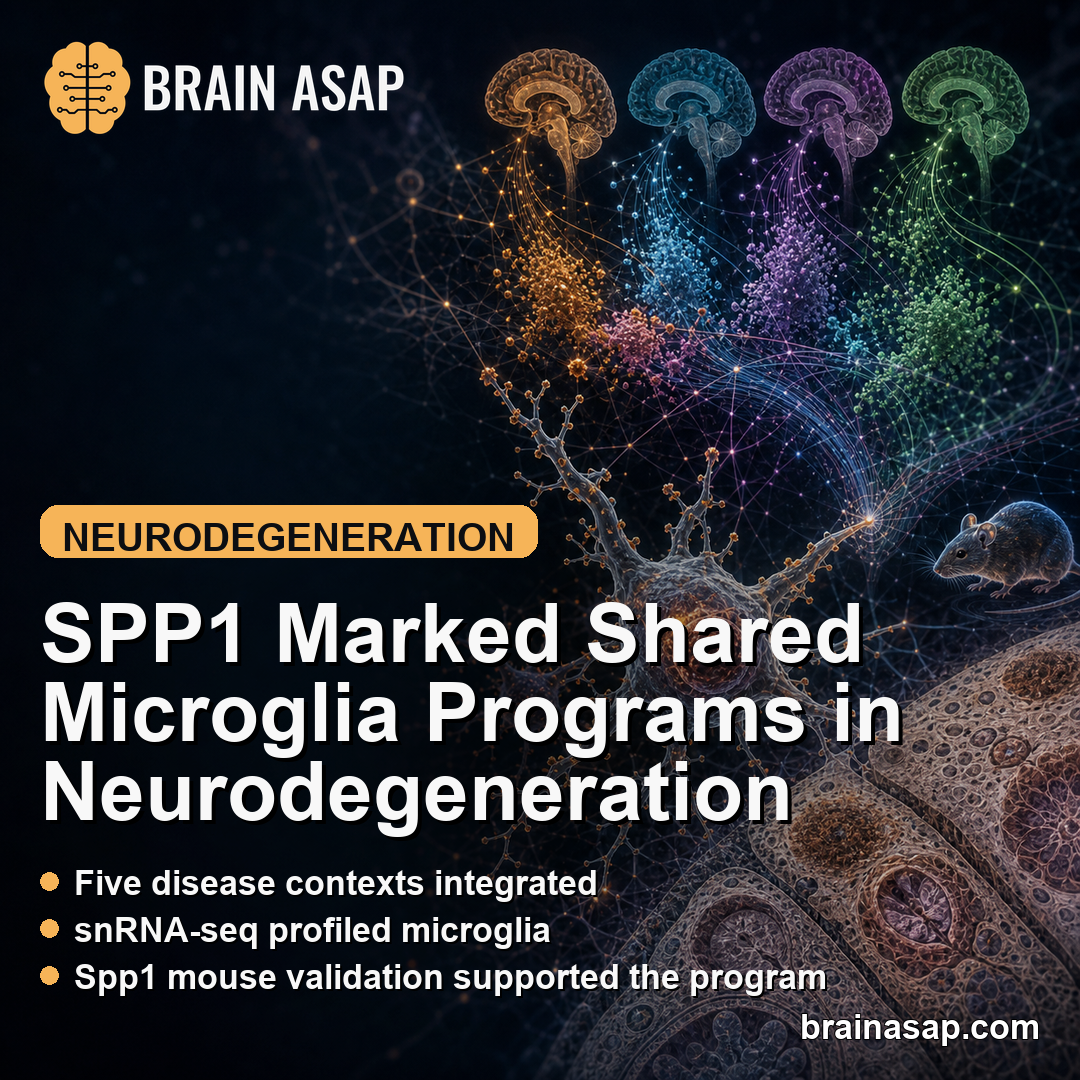
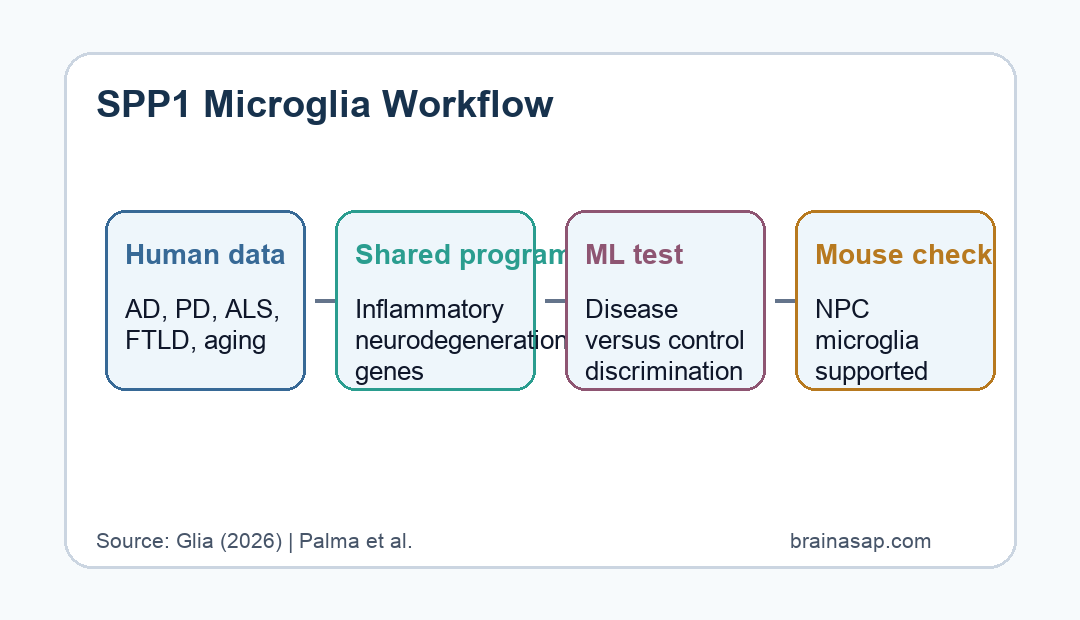
- Five disease contexts: The analysis integrated human microglia datasets from Alzheimer’s disease, Parkinson’s disease, amyotrophic lateral sclerosis, frontotemporal dementia, and aging.
- Single-nucleus RNA-seq: Researchers used single-nucleus RNA sequencing (snRNA-seq), a method that profiles gene expression from individual cell nuclei.
- Shared microglial program: A cross-disease transcriptional program was linked with inflammatory and neurodegenerative processes.
- Machine learning discrimination: The transcriptional program separated neurodegenerative and control samples in the study’s analysis.
- Spp1 mouse validation: Primary microglia from a Niemann-Pick type C mouse model supported conservation of key program components and highlighted Spp1.
Source: Glia (2026) | Palma et al.
SPP1 is the gene for osteopontin, a protein often discussed in immune activation and disease-associated microglial states. The study asks whether different neurodegenerative diseases share a microglial gene-expression pattern rather than each disease having a completely separate microglial signature.
Across datasets, researchers found a conserved program that separated neurodegenerative samples from controls and appeared again in an experimental mouse model.
Single-Nucleus RNA Sequencing Mapped Microglia Across Neurodegeneration
The analysis used human single-nucleus RNA sequencing datasets. That method profiles RNA from individual nuclei, allowing researchers to compare cell states within complex brain tissue.
The disease set covered Alzheimer’s disease, Parkinson’s disease, amyotrophic lateral sclerosis, frontotemporal dementia, and aging-related samples analyzed alongside matched control material.
- AD: Alzheimer’s disease was included as an amyloid- and tau-linked dementia context.
- PD: Parkinson’s disease contributed a synuclein-linked neurodegenerative context.
- ALS and FTLD: Motor neuron and frontotemporal degeneration datasets widened the comparison beyond classic dementia.
Researchers integrated the datasets and focused on microglial/myeloid clusters. They also excluded an ependymal-marker cluster before downstream analysis so the results would better represent bona fide microglia.
A Shared Microglial Program Separated Disease From Controls
The main result was a cross-disease microglial transcriptional program associated with inflammatory and neurodegenerative processes. In plain terms, microglia from different disorders shared part of a disease-state gene pattern.
The study also used machine learning to test whether that program could distinguish neurodegenerative samples from controls. The abstract describes robust discrimination, supporting the idea that the program captured disease-relevant information.
- Homeostatic markers: The analysis considered genes such as P2RY12, TMEM119, CX3CR1, and SALL1 as homeostatic microglial markers.
- Reactive markers: The disease-associated set included APOE, SPP1, CST7, LPL, CD9, ITGAX, CHI3L1, AIF1, GPNMB, and TREM2.
- State transition: TREM2 appeared in both lists because its expression can depend on microglial state and inflammatory environment.
This helps neurodegeneration research because microglia can be protective, harmful, or both depending on timing and state. A shared program may identify which parts of microglial response are common across diseases.
The study also avoids reducing microglia to an older activated-versus-resting split. By scoring homeostatic and reactive marker sets, it treats microglia as cells that move through several states, some of which may overlap across diseases even when the primary pathology differs.
That interpretation fits current neurodegeneration research. Alzheimer’s disease, Parkinson’s disease, ALS, and frontotemporal dementia have different initiating proteins and affected circuits, but injured tissue can still recruit similar immune and cleanup programs.
Spp1 Was Supported in a Niemann-Pick Type C Mouse Model
The validation step used primary microglia from a mouse model of Niemann-Pick disease type C (NPC), a lysosomal storage disease with neuroinflammation and neurodegenerative features.
That model supported conservation of key components of the human disease-associated program. The authors highlighted Spp1 as a marker of disease-associated microglia states.
- Mouse validation: Primary microglia were used rather than relying only on reanalysis of human datasets.
- NPC context: The model has lipid-storage pathology plus neuroinflammatory and neurodegenerative features.
- Spp1 signal: Spp1 emerged as a candidate marker connecting reactive microglia across disease contexts.
Mouse validation does not prove that SPP1 drives human neurodegeneration. It does strengthen the case that this gene belongs to a conserved microglial disease-state pattern.
NPC was a relevant validation context because it combines lysosomal dysfunction, lipid handling, neuroinflammation, and neurodegenerative features. The model is not identical to Alzheimer’s or Parkinson’s disease, but it lets researchers test whether parts of the human microglial program appear in an experimental system.
SPP1 Is a Biomarker Candidate, Not a Treatment Target Yet
The study is strongest as a map of conserved microglial states. It does not show that blocking or boosting SPP1 would slow Alzheimer’s disease, Parkinson’s disease, ALS, or frontotemporal dementia.
That distinction is important because disease-associated microglia can have mixed roles. Some reactive programs may help clear debris or contain injury, while other aspects may amplify inflammation and neuronal damage.
SPP1 also should not be interpreted in isolation. The marker sits inside a broader reactive gene set that included APOE, CST7, LPL, CD9, ITGAX, CHI3L1, AIF1, GPNMB, and TREM2, so the finding is a coordinated cell-state pattern rather than one single-gene switch.
- Strength: The study integrated multiple human neurodegenerative datasets and added experimental validation.
- Limit: Transcriptomic signatures show cell-state associations, not direct causation.
- Next step: Functional experiments need to test whether SPP1-positive microglia protect neurons, harm neurons, or mark a broader response.
The practical takeaway is that microglia may share a disease-state transcription pattern across several neurodegenerative disorders. SPP1 is one of the clearer markers in that shared program, but its therapeutic meaning still needs functional testing.
Citation: DOI: 10.1002/glia.70163. Palma et al. A Cross-Disease Microglial Transcriptional Program Characterizes Neurodegeneration and Highlights SPP1 as a Biomarker. Glia. 2026;74:e70163.
Study Design: Integrative single-nucleus RNA sequencing analysis with machine learning and mouse-model validation.
Sample/Model: Human microglia datasets from AD, PD, ALS, FTLD, aging, and controls, plus primary microglia from an NPC mouse model.
Key Statistic: A shared transcriptional program discriminated neurodegenerative from control samples and highlighted SPP1/Spp1 as a disease-associated marker.
Caveat: Gene-expression programs identify disease-associated cell states but do not prove that SPP1 causes or treats neurodegeneration.