TL;DR: A 2026 qualitative study in BMC Psychology reported that the For Baby’s Sake whole-family domestic violence and abuse programme was linked to parents’ perceived changes in abuse recognition, emotion regulation, and parenting behavior across pregnancy-to-two-year interviews.
Key Findings
- 83 interviews: Researchers analyzed 83 interviews from 39 parents enrolled in the For Baby’s Sake programme.
- 26 mothers and 13 fathers: The sample included 26 mothers and 13 fathers, with interviews planned during pregnancy, at 1 year, and at 2 years.
- Two linked targets: The programme addressed domestic violence and abuse (DVA) and parenting together instead of treating them as separate family problems.
- Six subthemes: Results were organized around violence and parenting, with separate mother and father subthemes across the three time points.
- Attrition mattered: Only 18 participants took part in the 2-year interview, so the clearest evidence is perceived change among families who stayed engaged.
Source: BMC Psychology (2026) | Taccini et al.
For Baby’s Sake is a trauma-informed programme for families experiencing domestic violence and abuse during the transition to parenthood. The study did not test a medication, device, or one-session class; it examined how parents described change while receiving support from pregnancy through the child’s early years.
The main point is practical. When violence, trauma history, and parenting are handled together, some parents described a clearer ability to name abuse, understand its effects on children, and practice safer parent-child interactions.
For Baby’s Sake Combined DVA Support With Parenting Work
The intervention was designed for families where the mother had experienced domestic violence and abuse from the father of the baby. Both parents had to be at least 17 years old and intending to co-parent, even if they were no longer a couple.
Researchers described the programme as a whole-family approach. Mothers and fathers received separate work, but the shared clinical target was family safety, trauma recovery, and the child’s developmental environment.
- DVA recognition: Mothers described psychoeducation and safety planning as helping them understand coercive or violent behavior more clearly.
- Father behavior change: Some fathers described acknowledging violent behavior, working on adverse childhood experiences, and learning anger-management skills.
- Parenting skills: Parents reported learning about child development and receiving feedback from video-recorded parent-child interactions.
The service-design issue is that parenting and partner violence are often addressed in separate systems. For families preparing for a baby, that split can miss how adult trauma and child safety develop in the same household.
Longitudinal Interviews Followed 39 Parents Across Three Time Points
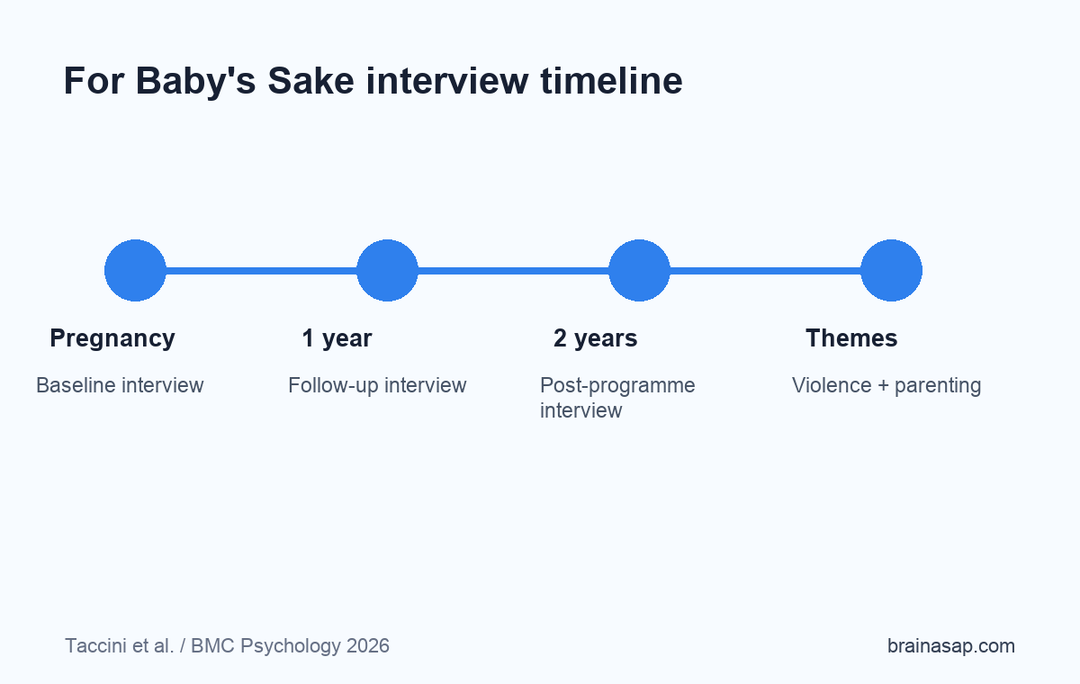
The evidence came from reflexive thematic analysis, a qualitative method that looks for patterns in interview data. Researchers conducted baseline interviews during pregnancy, a 1-year follow-up, and a 2-year post-programme interview.
The full dataset included 83 interviews. At baseline, 38 participants were interviewed; at the 1-year follow-up, 27 participated; and at 2 years, 18 participants took part.
- Baseline: Interviews captured how parents understood violence, safety, and parenting before much programme exposure.
- One year: Follow-up interviews looked for changes in recognition, emotional control, and parent-child interaction.
- 2 years: Later interviews asked whether reported changes persisted near programme completion.
This design cannot prove that the programme caused every change parents described. It can show whether participants’ own language shifted over time in ways consistent with the programme’s goals.
Mothers Described Abuse Recognition and Safety Planning
At baseline, many mothers did not initially describe their experiences as DVA. Some wanted the relationship to improve and did not frame the father’s behavior as abuse.
Over time, mothers described programme elements that helped them make sense of current and past experiences. The strongest recurring ingredients were psychoeducation, a nonjudgmental therapeutic relationship, and explicit safety planning.
- Abuse education: Mothers reported that naming abusive patterns helped them see coercive or violent behavior more clearly.
- Intergenerational insight: Some mothers connected their own childhood experiences with what they had come to accept in adult relationships.
- Safety planning: The programme gave practical space to discuss risks without reducing the intervention to a single instruction to leave.
The mental-health relevance is direct. DVA is associated with depression, anxiety, substance use, and suicide attempts, and pregnancy can be a period when abuse begins or escalates.
Fathers Reported Emotion Regulation and Parenting Motivation
Some fathers acknowledged violent behavior and described working on adverse childhood experiences (ACEs), anger, and emotional regulation. The programme therefore included behavior-change work with fathers, not only support for mothers.
Parenting motivation appeared to be a route into behavior change. Fathers and mothers both described wanting better relationships with their children as a reason to stay engaged.
- Anger management: Fathers described learning skills for managing anger and emotional escalation.
- Parent-child feedback: Video feedback gave parents concrete examples of attuned or less attuned interaction.
- Nonjudgmental setting: Parents repeatedly described trust and lack of judgment as making difficult admissions more possible.
The caveat is that self-reported change is not the same as independently verified safety. A programme can create insight and still require careful risk assessment, safeguarding, and long-term follow-up.
For Baby’s Sake Shows Promise, Not Proof of DVA Reduction
The study gives qualitative support for whole-family DVA and parenting interventions, especially during the perinatal period. It does not establish that For Baby’s Sake reduces violence rates in a controlled comparison.
Attrition also matters. Participants who remained through the 2-year interview may have been more engaged, safer to contact, or more likely to report useful change than families who dropped out.
- Strength: Repeated interviews captured change processes rather than a single snapshot.
- Limit: The study relied on parent reports and qualitative interpretation, not a randomized outcome design.
- Clinical use: The findings support integrating DVA work, trauma-informed care, and parenting support when services are designed for high-risk families.
For mental-health and child-development services, the useful message is structural. Families affected by DVA may need interventions that address adult safety and child caregiving in the same coordinated plan.
Citation: DOI: 10.1186/s40359-026-03979-8. Taccini et al. Can whole-family interventions target violence and parenting in families experiencing domestic violence and abuse? A longitudinal study of the For Baby’s Sake programme. BMC Psychology. 2026.
Study Design: Longitudinal qualitative interview study using reflexive thematic analysis.
Sample Size: 39 parents, including 26 mothers and 13 fathers, across 83 interviews.
Key Statistic: 2-year interviews included 18 participants after 38 baseline and 27 1-year participants.
Caveat: The study reports perceived change from interviews and cannot prove intervention-caused reductions in violence.