TL;DR: A 2026 study in The British Journal of Psychiatry found that psychiatrists described parental profession as shaping psychiatry career choice mainly through role modeling, family values, autonomy, guidance, and lived experience with mental health.
Key Findings
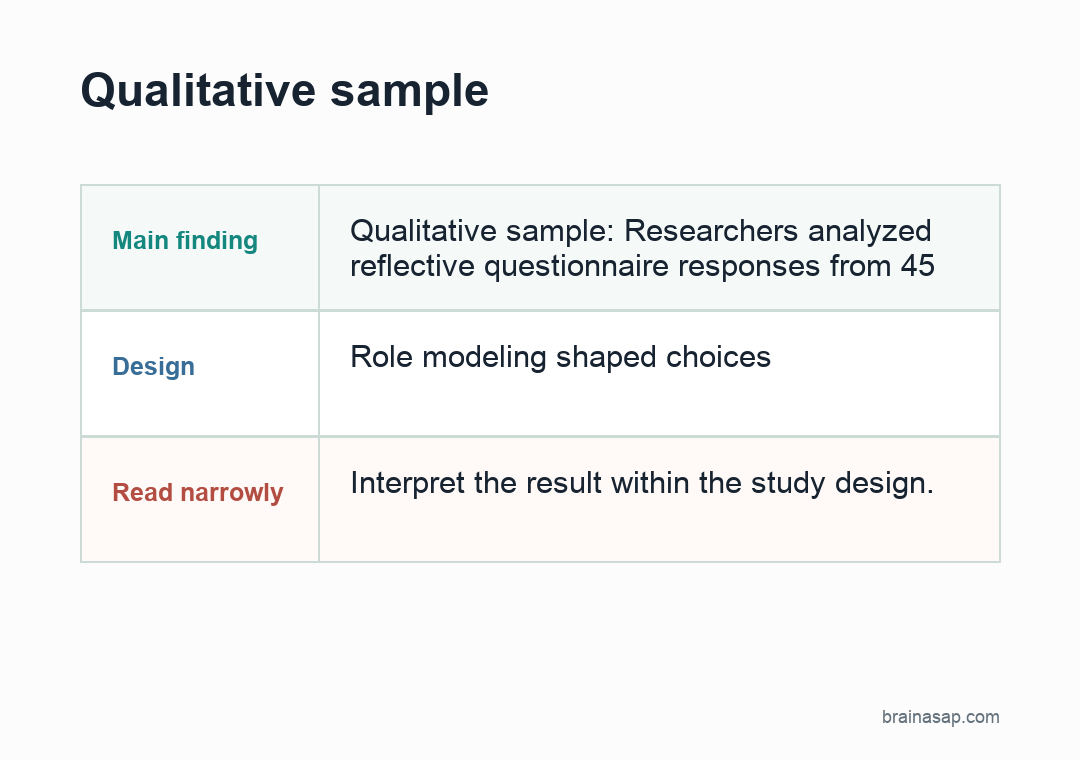
- Qualitative sample: Researchers analyzed reflective questionnaire responses from 45 doctors working in child and adolescent psychiatry and 24 family members.
- Parental medicine: Among practicing doctors, 22% had at least one parent who was a medical doctor, including 3 with a psychiatrist parent.
- Main themes: Career influence clustered around autonomy and guidance, family sociocultural background, and lived experience with mental health.
- Transmission pattern: The themes emphasized professional culture and personal identity more than technical qualification requirements.
- Teaching implication: The researchers framed family narratives and role modeling as useful material for psychiatry career reflection and professional identity formation.
Source: The British Journal of Psychiatry (2026) | Deschamps et al.
Career choice in psychiatry is usually discussed as a medical-school or residency decision. Researchers in this study looked earlier, at the family environment that can make psychiatry familiar, meaningful, attractive, or difficult.
The central question was not whether psychiatrists simply copy their parents’ jobs. It was how parents’ work, values, and mental-health experiences entered the background of career choice.
Researchers recruited an international convenience sample of doctors working in child and adolescent psychiatry, then invited family members to add their own perspectives. The final analysis included written reflections from 45 doctors and 24 relatives, including parents and children older than 16.
Psychiatry Career Choice Was Studied Through Family Narratives
The study used qualitative thematic analysis, which means the researchers coded written responses for recurring patterns rather than testing one numerical exposure against one outcome.
Two open-ended questions drove the analysis:
- Past influence: How participants thought their parents’ professional occupations shaped their own career choice and professional involvement.
- Current influence: How doctors working in psychiatry thought their own profession would influence their children’s future career choices.
Participants came from nine countries: Belgium, Cyprus, Denmark, Germany, Greece, the Netherlands, Slovenia, Switzerland, and the UK. The practicing-doctor group included 16 resident-trainees and 29 registered specialists.
Parental medicine was present but not dominant. In the doctor group, 10 of 45 participants had at least one parent who was a medical doctor, and 3 had a parent who was a psychiatrist.
Other parental occupations included administration, education, social or healthcare-related work, engineering, management, agriculture, defense, and home work.
Autonomy and Guidance Were the First Career-Influence Theme
The first theme was the balance between letting a child choose freely and offering guidance. Participants described several forms of influence that were not always direct advice.
- Explicit advice: Some parents stated clear views about university, medicine, family life, or career stability.
- Implicit expectations: Some participants perceived a quieter mandate to fulfill family ambitions or make parents proud.
- Role modeling: Seeing a parent work with people, science, illness, or service steered some children toward medicine or away from it.
The distinction separates supportive guidance from simple occupational inheritance. Several participants described parents who shaped interests without pushing a specific career.
The same issue appeared when psychiatrists reflected on their own children. Many wanted to support freedom of choice, but they also recognized that a parent is never fully neutral.
The profession comes home through schedules, work accounts, stress, values, and visible commitment.
Family Values Made Psychiatry Familiar or Unappealing
The second theme was the broader sociocultural background of the family. Researchers found that psychiatry career choice was often connected to shared values, daily conversation, and the way work entered home life.
Some participants linked their later specialty choice to family exposure to education, social work, healthcare, children, communication, or helping professions. The parent did not need to be a psychiatrist for psychiatry-relevant values to become familiar.
Work narratives were especially important. When parents brought professional accounts home, children could hear how adults made sense of responsibility, suffering, problem-solving, and care.
The influence went in either direction:
- Positive route: Family narratives presented human behavior, care work, and mental health as meaningful.
- Negative route: Complaints about medical systems, work pressure, or professional devaluation discouraged children from medicine.
- Indirect route: A child rejected the exact parental profession while still absorbing interests in biology, people, or social development.
For doctors thinking about their own children, the same family-values pathway was visible. Many believed their work reduced stigma by making mental illness and psychiatric care ordinary topics inside family life.
Lived Mental-Health Experience Also Shaped Career Meaning
The third theme was lived experience with mental health. Several participants described a close relative’s mental suffering as part of their early understanding of empathy, distress, and the need for care.
That experience was not always simple or positive. Some participants described a psychiatrist parent’s work as contributing to home stress because of workload, emotional pressure, or the strain of clinical responsibility.
Others described family mental-health experience as an early form of empathy training. The researchers did not claim that personal or family distress causes psychiatry career choice.
The narrower finding was that lived experience gave psychiatry emotional and moral meaning for some participants.
When the doctors considered their own influence on their children, they often talked about mental well-being rather than career recruitment. They hoped their work would help children talk openly about emotions, mental illness, stigma, and care.
The Study Emphasized Identity More Than Qualification
The researchers interpreted the themes through three education domains: qualification, socialisation, and subjectification.
Qualification refers to the competencies needed to enter and perform a profession. That domain appeared only indirectly, through interests in behavior, psychology, medicine, or child development.
Socialisation and subjectification were more central:
- Socialisation: Children encounter the culture of a profession through stories, routines, values, and family expectations.
- Subjectification: Children develop a sense of the person they will become, not only the job they will hold.
- Professional identity: Psychiatry becomes meaningful when family narratives connect care, mental health, responsibility, and autonomy.
That distinction is useful for psychiatry recruitment. A specialty can be technically available to medical students but still appear alien, stigmatized, low-status, or emotionally unsafe.
Family narratives help explain why some doctors arrive with an early sense that psychiatry is a serious, human, and intellectually demanding field.
Psychiatry Training Can Make Family Influence Explicit
Psychiatrists should not steer their children into psychiatry. The study argues for reflective awareness: doctors, teachers, and trainees can examine how family narratives and professional role models shape career identity.
For psychiatry educators, that may mean asking students about the experiences that made mental health care attractive, uncomfortable, familiar, or stigmatized. Those conversations can surface assumptions that influence specialty choice long before formal recruitment events.
For doctors already working in psychiatry, the findings also point inward. How clinicians talk about their work at home, in teaching, and around students affects whether psychiatry is seen as a depleted profession or as a demanding field with real human value.
The caveats are important. This was a small qualitative study, based on a convenience sample of people already working in child and adolescent psychiatry.
Participants with strong views about parental influence had a clear reason to respond, and the questionnaire format limited live follow-up.
The result should therefore be read as a framework, not a prevalence estimate. It identifies recurring pathways by which parental profession and family experience can shape psychiatry career meaning: guidance, values, work narratives, stigma, and mental-health experience.
Citation: DOI: 10.1192/bjp.2026.10603. Deschamps et al. The influence of parental profession on offspring career choice among psychiatrists. The British Journal of Psychiatry. 2026.
Study Design: Qualitative thematic analysis of written reflective questionnaire responses.
Sample Size: 45 doctors working in child and adolescent psychiatry and 24 family members from nine countries.
Key Statistic: 22% of participating doctors had at least one parent who was a medical doctor; three had a psychiatrist parent.
Caveat: The convenience sample and written questionnaire format limit generalizability and did not test how common these influence pathways are across all psychiatry trainees.