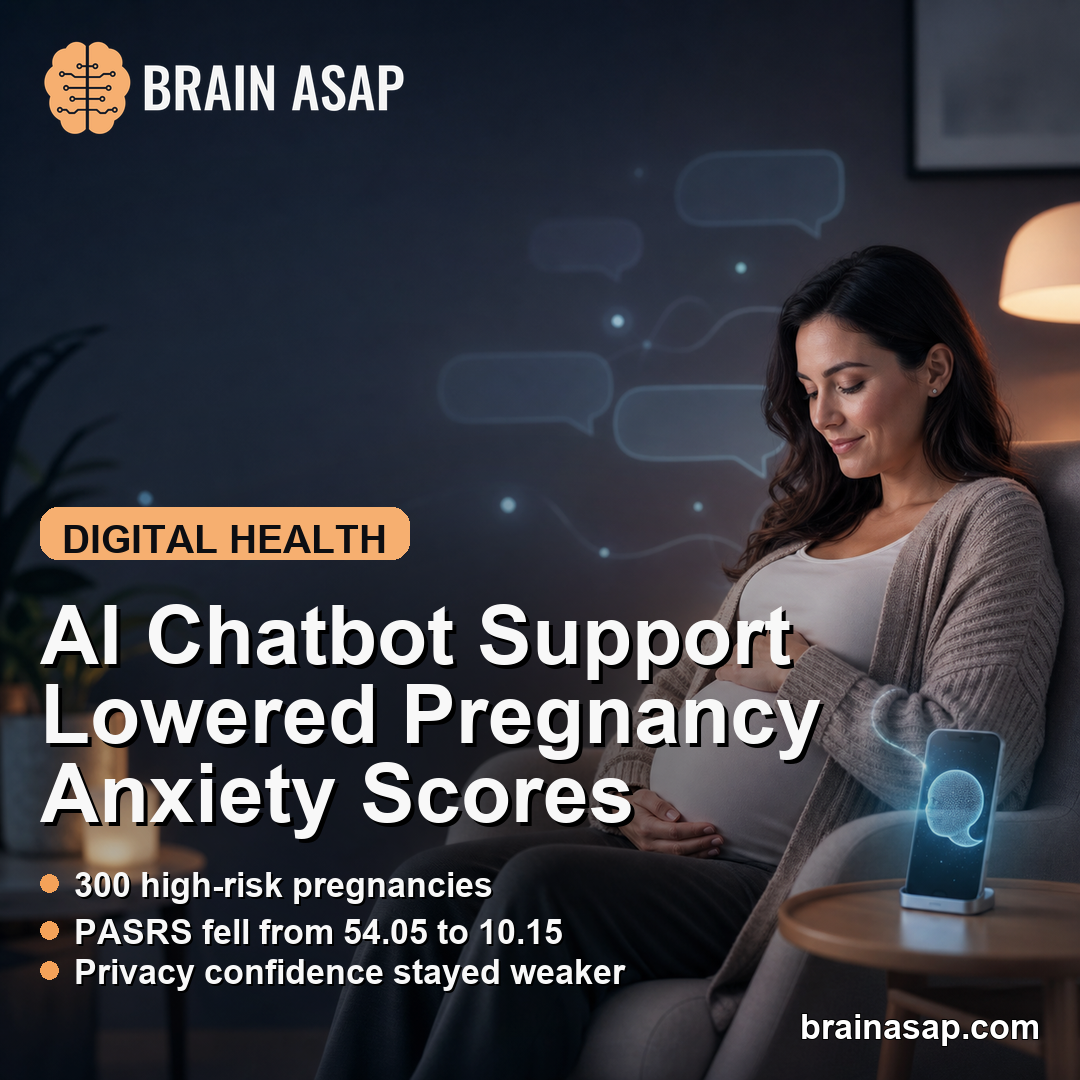
TL;DR: A 2026 study in Scientific Reports found that 300 high-risk pregnant women in Egypt reported much lower pregnancy anxiety and stress scores after 4 weeks of daily AI chatbot emotional support, although the pre-post design cannot prove the chatbot caused the full change.
Key Findings
- 300 high-risk pregnancies: Researchers recruited women aged 18-45 from obstetrics and gynecology services in New Damietta, Egypt.
- Four-week chatbot use: Participants were trained to use Replika, an AI chatbot, and were instructed to engage with it daily for emotional support.
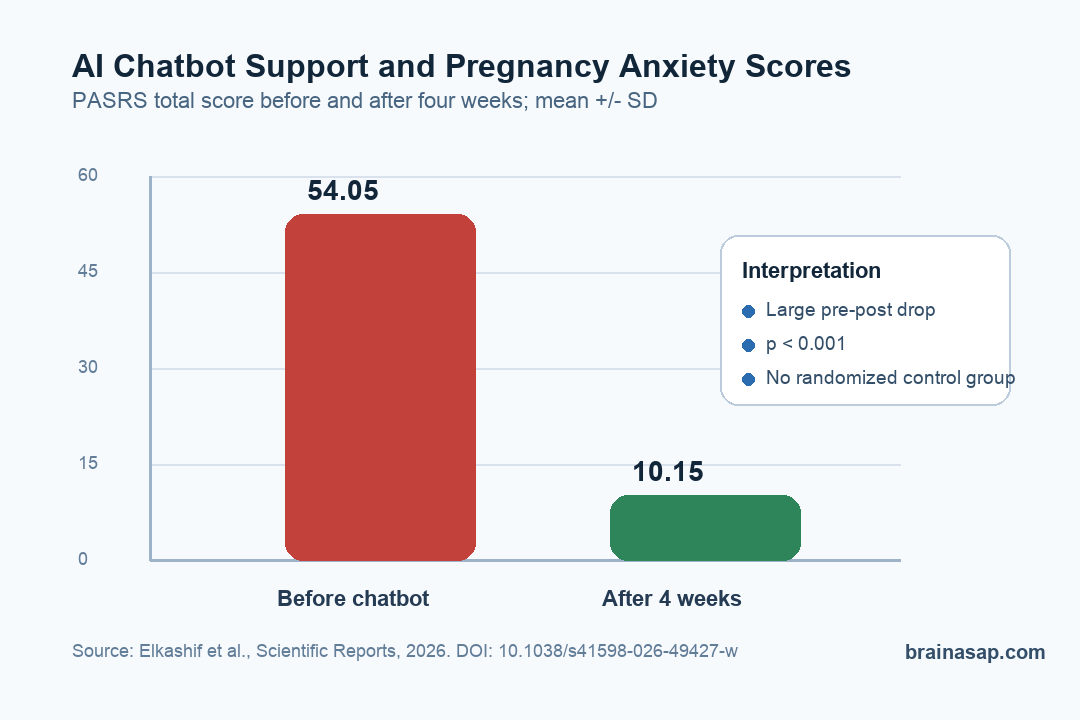
- Pregnancy anxiety and stress fell: Mean PASRS score dropped from 54.05 +/- 5.99 before the intervention to 10.15 +/- 3.82 afterward.
- User experience was mostly strong: Overall chatbot usability averaged 46.93 out of 55, with high ratings for conversation quality and responsiveness.
- Privacy was the weaker domain: Privacy confidence averaged 3.87 out of 5, lower than accessibility, functionality, conversation, and responsiveness.
Source: Scientific Reports (2026) | Elkashif et al.
High-risk pregnancy can turn ordinary prenatal uncertainty into a daily source of stress. Concerns about fetal health, hypertensive disorders, gestational diabetes, placenta problems, preterm labor risk, and prior losses can all push anxiety higher during a period when many health systems offer limited mental-health support.
Researchers tested a simple digital support idea: give women with high-risk pregnancies access to an AI emotional support chatbot for 4 weeks, then compare anxiety and stress scores before and after use.
300 Women Used a Chatbot During High-Risk Pregnancy
The study used a quasi-experimental pre-post design, meaning every participant was measured before and after the intervention but there was no randomized control group. That design can show a large change over time, but it cannot separate the chatbot from time, clinical reassurance, repeated contact, or expectancy effects.
Researchers recruited 300 women at Al-Azhar University Hospital in New Damietta, Egypt. Eligible participants were 18-45 years old, had a confirmed high-risk pregnancy, had smartphone and internet access, and were willing to use the chatbot.
The high-risk conditions included:
- Hypertensive disorders: preeclampsia or eclampsia, reported in 31.0% of the cohort.
- Gestational diabetes: reported in 27.0% of participants.
- Placenta complications: placenta previa or placental abruption, reported in 24.0%.
- Preterm labor risk: reported in 11.7%.
- Hyperemesis gravidarum: reported in 6.3%.
Most participants were in the second or third trimester, and none reported prior use of an AI-based tool for emotional or mental support. The usability results are especially relevant because this was not a cohort already selected for digital-mental-health familiarity.
Pregnancy Anxiety Scores Dropped After 4 Weeks
The main outcome was the Pregnancy Anxiety and Stress Rating Scale (PASRS), a self-report measure where higher scores indicate more anxiety and stress. Participants completed the scale before chatbot use and again after 4 weeks.
The score change was large. The mean PASRS total fell from 54.05 +/- 5.99 before the intervention to 10.15 +/- 3.82 afterward. The paired comparison was statistically significant, with p < 0.001.
Several item-level responses moved in the same direction. Before the intervention, many women endorsed frequent worry about their child’s health, their own health, childbirth, appointments, body changes, support, loneliness, and information overload.
After the intervention, responses shifted mostly toward “not at all” or “rarely”. The clearest example was worry about the child’s health.
Before chatbot use, 96.7% of women reported this worry often or always. Afterward, the study reported 0% in those two highest-frequency categories for that item, with most women moving to lower-frequency responses.
Women Rated Conversation and Responsiveness Highly
The second question was whether women would actually find the chatbot usable. Researchers used an AI Usability and Perceived Emotional Support Scale covering accessibility, functionality, conversation quality, privacy, and responsiveness.
The overall usability score averaged 46.93 out of 55. Conversation quality was the strongest domain, with a mean of 17.57 out of 20. Responsiveness also rated highly, with a mean of 4.41 out of 5.
Post-intervention item responses showed why the total score was high:
- Access: 88.6% agreed or strongly agreed that they could easily access the chatbot when needed.
- Technical availability: 85.0% agreed or strongly agreed that it was available without technical difficulty.
- Clear communication: 89.3% agreed or strongly agreed that chatbot communication was clear and understandable.
- Fast replies: 97.0% agreed or strongly agreed that the chatbot responded quickly.
Those numbers matter because digital mental-health tools often fail on engagement rather than theory. A support system that is technically impressive but frustrating to use is unlikely to help people during a stressful pregnancy.
Privacy Concerns Keep the Result From Being Simple
The weaker domain was privacy confidence. Participants rated privacy at 3.87 out of 5, below conversation, responsiveness, accessibility, and functionality.
Only 60.6% agreed or strongly agreed that they were confident their information was kept private and secure. That is not a minor detail for maternal mental health.
A pregnant patient may disclose fears about miscarriage, birth complications, family support, partner reactions, finances, loneliness, or medical trauma. If the tool provides emotional support but data handling remains unclear, trust can become the limiting factor.
The study’s practical message is therefore two-sided. AI support may be scalable and available between appointments, especially in settings where mental-health access is thin.
At the same time, prenatal use needs stronger guardrails around privacy, transparency, clinical escalation, and how chatbot advice is separated from medical decision-making.
The Best Reading Is Promising, Not Definitive
The main limitation is the lack of a control group. Without randomization or usual-care comparison, the study cannot prove that the chatbot caused the entire anxiety-score reduction.
Women may also improve because they had repeated study contact, more attention to their emotional state, clinical follow-up, or natural symptom fluctuation.
Self-report is another boundary. PASRS scores are useful, but they do not show whether obstetric outcomes changed, whether benefits lasted after the 4-week period, or whether women with severe psychiatric symptoms would respond similarly.
The study excluded participants with diagnosed severe psychiatric disorders and those requiring immediate intensive care.
The safest conclusion is still meaningful: in this Egyptian high-risk pregnancy cohort, daily chatbot support was feasible, well-liked, and followed by a large drop in self-reported pregnancy anxiety and stress.
The next step is a randomized trial that tests the chatbot against usual care or another active digital support condition, with privacy protections and clinical escalation rules built in from the start.
Citation: DOI: 10.1038/s41598-026-49427-w. Elkashif et al. The impact of artificial intelligence-based emotional support tools on anxiety and stress levels in high-risk pregnant women. Scientific Reports. 2026.
Study Design: Quasi-experimental pre-post study of 4 weeks of daily AI chatbot emotional support.
Sample Size: 300 high-risk pregnant women recruited from obstetrics and gynecology services in New Damietta, Egypt.
Key Statistic: Mean PASRS score fell from 54.05 +/- 5.99 before chatbot use to 10.15 +/- 3.82 after 4 weeks, p < 0.001.
Caveat: The study had no randomized control group, so the pre-post change should not be treated as definitive causal evidence.