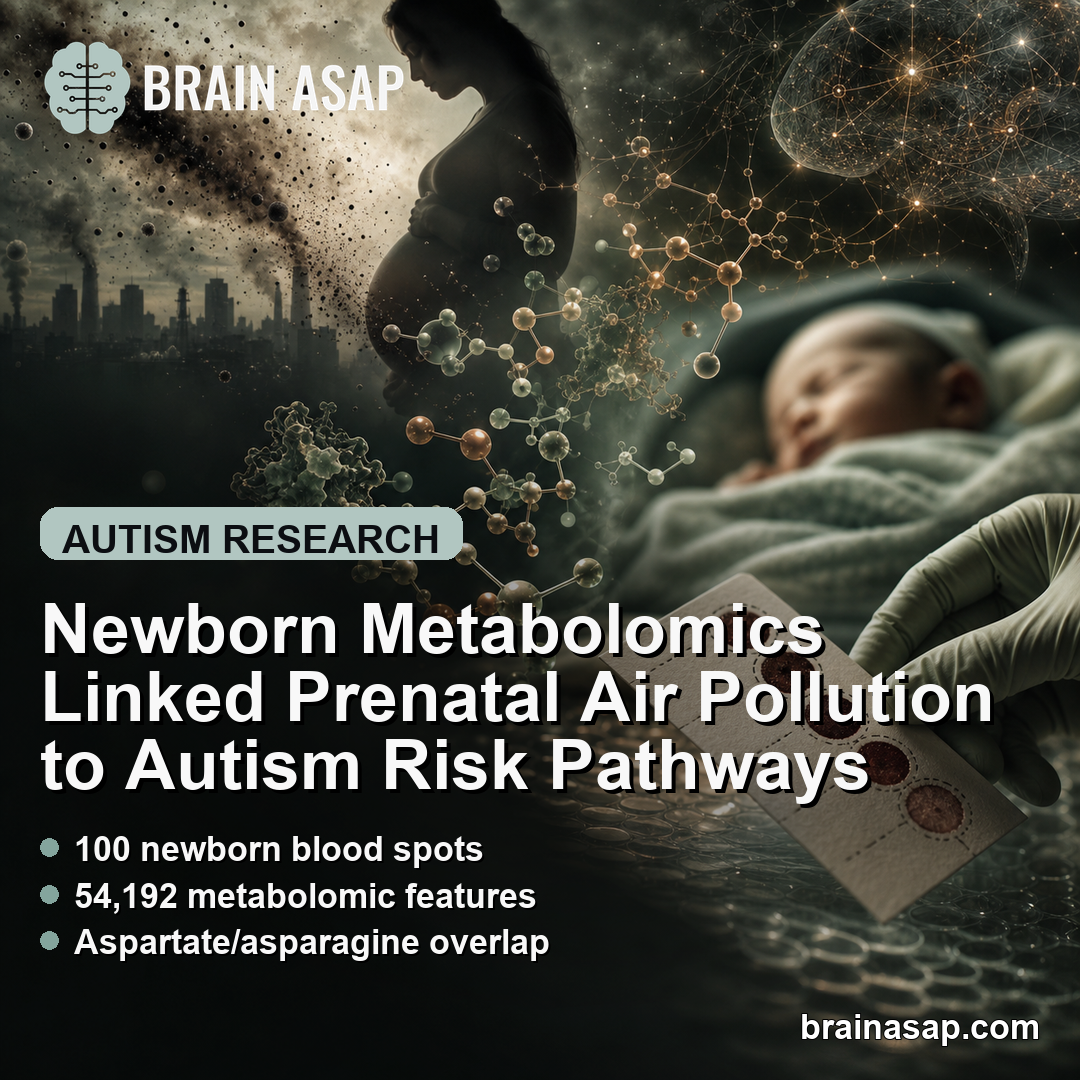
TL;DR: A 2026 study in Journal of Exposure Science & Environmental Epidemiology linked prenatal PM2.5 and non-freeway NOx exposure with newborn amino-acid metabolism pathways that also tracked autism spectrum disorder (ASD) diagnosis before age 5.
Key Findings
- 100 newborn blood spots: Researchers analyzed 50 children later diagnosed with ASD and 50 matched controls from Kaiser Permanente Southern California births in 2007-2009.
- 54,192 metabolomic features: After filtering, the untargeted LC-MS workflow kept 26,578 HILIC and 27,614 C18 features for pathway analysis.
- Aspartate/asparagine overlap: This pathway was associated with ASD (p = 0.01), pregnancy PM2.5 (p < 0.001), first-trimester PM2.5 (p < 0.001), and non-freeway NOx (p = 0.003).
- Air pollution levels: Mean pregnancy PM2.5 was 14.03 ug/m3, first-trimester PM2.5 was 14.51 ug/m3, and non-freeway NOx was 2.07 ppb.
- Pilot-study caveat: No individual metabolomic feature survived false-discovery-rate correction, so the strongest result is a pathway-level hypothesis for larger cohorts.
Source: Journal of Exposure Science & Environmental Epidemiology (2026) | Kang et al.
Newborn Dried Blood Spots Were Used to Study ASD Pathways
Autism spectrum disorder (ASD) is usually diagnosed years after birth, long after the first biological changes may have occurred. Stored newborn screening cards let researchers study that early window instead of relying only on later behavioral records.
Researchers used stored dried blood spots, the small newborn blood samples collected shortly after birth for routine screening. That gave the analysis a child-specific biological readout instead of relying only on maternal blood or later childhood samples.
The design was a matched case-control study. The ASD group included 50 children diagnosed before age 5, and the comparison group included 50 children matched on birth year, sex, race/ethnicity, and medical center.
Matching helped reduce some obvious confounding, but this was still a small observational pilot. The clinical meaning comes from the overlap between pathways, not from a diagnostic test that can classify individual newborns.
- Population: Singleton births from Kaiser Permanente Southern California between 2007 and 2009.
- Exposure estimates: Residential histories were linked to high-resolution models of PM2.5 and traffic-related NOx.
- Biology measured: Untargeted liquid chromatography-mass spectrometry looked for metabolic features in newborn blood spots.
PM2.5 and Non-Freeway NOx Were Modeled During Pregnancy
The environmental exposures were fine particulate matter (PM2.5) and non-freeway nitrogen oxides (NOx), a traffic-related pollution marker. Both have been studied in prior autism epidemiology, but the biological link remains uncertain.
Average exposure in this cohort was not extreme by modern pollution-study standards. Mean PM2.5 across pregnancy was 14.03 ug/m3, while first-trimester PM2.5 averaged 14.51 ug/m3.
Non-freeway NOx averaged 2.07 ppb. The researchers focused on non-freeway NOx because earlier work in this cohort found that this source pattern, rather than freeway NOx, was linked with ASD risk.
The study then compared three exposure windows against metabolomic pathways:
- Whole-pregnancy PM2.5: the average fine-particle exposure across gestation.
- First-trimester PM2.5: an early developmental window often treated as sensitive in neurodevelopmental research.
- Non-freeway NOx: a local traffic-related exposure estimate tied to residential history.
Aspartate and Asparagine Metabolism Was the Main Overlap
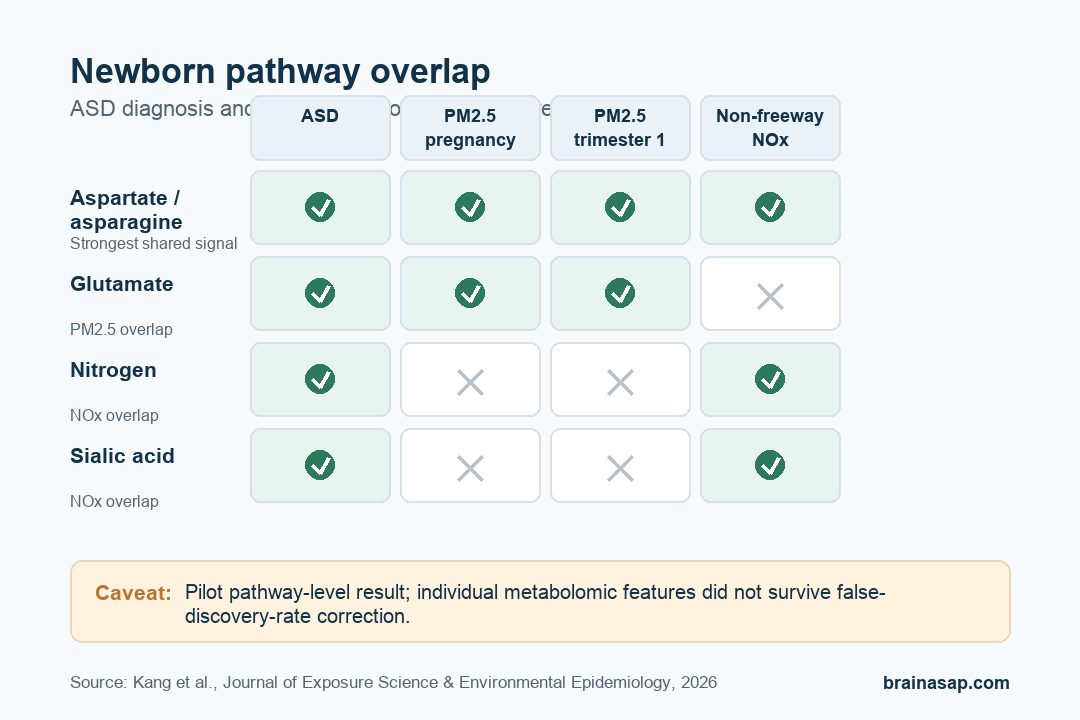
The clearest shared result was aspartate and asparagine metabolism. It was associated with ASD at the pathway level and also with whole-pregnancy PM2.5, first-trimester PM2.5, and non-freeway NOx.
This pathway included metabolites such as L-asparagine, succinate semialdehyde, and 4-aminobutanoate (GABA). GABA is the brain’s main inhibitory neurotransmitter, so it is a biologically plausible bridge between metabolism and neurodevelopment.
Other shared pathways were narrower. Glutamate metabolism overlapped with ASD and PM2.5 exposure, while nitrogen metabolism and sialic acid metabolism overlapped with ASD and non-freeway NOx.
Glutamate and GABA balance is central to neurodevelopment, which makes the pathway list biologically plausible. A newborn pattern in those pathways does not prove causation, but it gives future studies a more specific place to look.
- ASD plus PM2.5: aspartate/asparagine metabolism and glutamate metabolism appeared in the shared pathway results.
- ASD plus non-freeway NOx: aspartate/asparagine, nitrogen, and sialic acid metabolism overlapped.
- Named metabolites: L-asparagine, GABA, succinate semialdehyde, and L-glutamine were highlighted as pathway members.
Oxidative Stress and Inflammation Are Plausible Mechanisms
The researchers interpreted the shared amino-acid pathways through oxidative stress and inflammation. Those mechanisms are common in air-pollution biology and have also been discussed in autism neurodevelopment research.
During pregnancy, pollution-related inflammation could affect the maternal-fetal environment. One proposed route is greater inflammatory signaling and blood-brain-barrier vulnerability during sensitive developmental periods.
The newborn metabolomics data do not show that PM2.5 or NOx directly caused autism. They show that pathways related to amino-acid metabolism were statistically connected to both exposure estimates and later ASD case status in a small sample.
That distinction keeps the finding useful. A specific pathway pattern can guide larger studies, especially if future cohorts can measure the same metabolites, test targeted concentrations, and connect them with neurodevelopmental outcomes.
Small Sample Size Keeps the ASD Result Hypothesis-Generating
The main limitation is statistical power. The sample had 100 children total, and no individual metabolomic feature met a false-discovery-rate threshold after correction for multiple comparisons.
Because of that, the study reported nominal pathway-level results. Pathway enrichment can reduce some noise by asking whether related metabolites cluster together, but it cannot remove the need for replication.
Several practical limits should shape how readers interpret the finding:
- Untargeted metabolomics: the analysis identified relative features and pathway patterns, not absolute clinical concentrations.
- Annotation uncertainty: some metabolite assignments can be wrong or incomplete in high-resolution screening data.
- Observational design: residential exposure models and later ASD diagnosis can support associations, not causal proof.
Still, the study is useful because newborn dried blood spots are already collected at scale. If larger cohorts confirm these pathway links, archived newborn samples could help researchers study how prenatal environmental exposures shape early neurodevelopmental biology.
Citation: DOI: 10.1038/s41370-026-00897-0. Kang et al. Newborn metabolomics linking prenatal air pollution exposure and autism spectrum disorder risk in children. Journal of Exposure Science & Environmental Epidemiology. 2026.
Study Design: Matched case-control metabolomics study using newborn dried blood spots and modeled prenatal air pollution exposure.
Sample Size: 100 mother-child pairs: 50 children diagnosed with ASD before age 5 and 50 matched controls.
Key Statistic: Aspartate/asparagine metabolism overlapped with ASD (p = 0.01), pregnancy PM2.5 (p < 0.001), first-trimester PM2.5 (p < 0.001), and non-freeway NOx (p = 0.003).
Caveat: Small pilot sample with no individual metabolomic feature surviving false-discovery-rate correction.