TL;DR: A 2026 medRxiv preprint applied ChatGPT-4o-assisted Bayesian-frequentist hybrid inference to Alzheimer’s single-nucleus RNA-seq data and identified gamma-secretase and HP1 transcription pathways that a no-evidence frequentist setting did not recover.
Key Findings
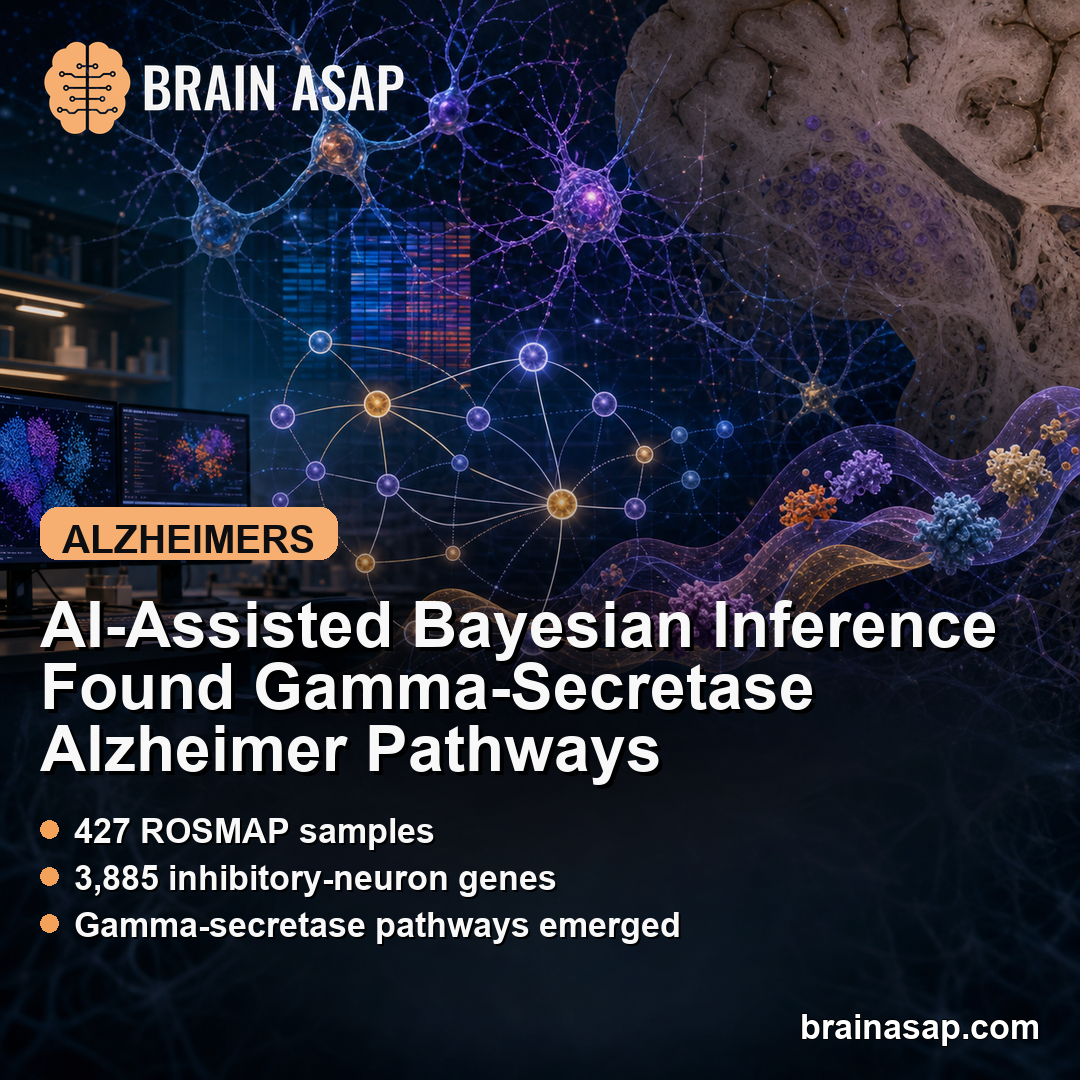
- 427 ROSMAP samples: The application used postmortem prefrontal cortex single-nucleus RNA-seq data from 427 Religious Orders Study and Memory and Aging Project samples.
- 3,885 genes screened: Inhibitory-neuron genes were filtered to 3,885 genes for AI-assisted prior generation.
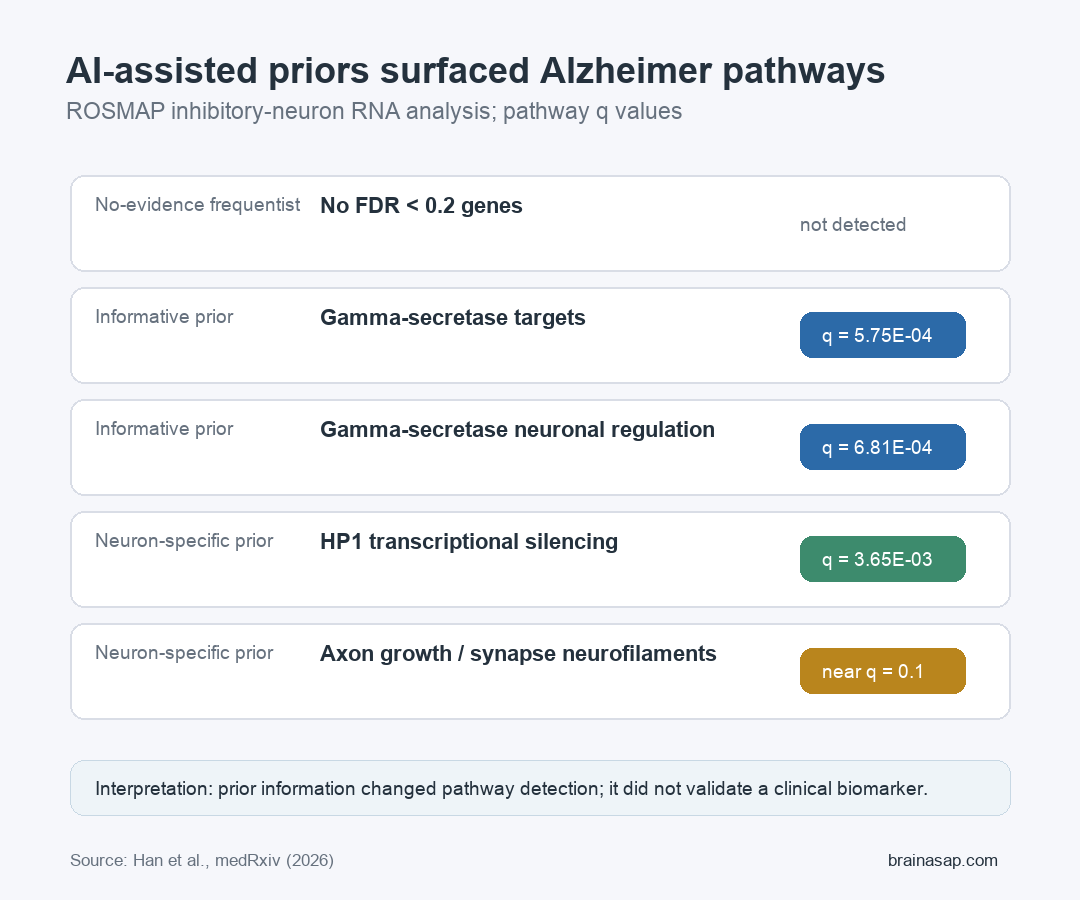
- No frequentist hits: In the no-evidence/frequentist setting, no genes met FDR < 0.2 in the reported application.
- Gamma-secretase pathways emerged: Informative priors identified gamma-secretase proteolytic targets at q = 5.75E-04 and gamma-secretase neuronal regulation at q = 6.81E-04.
- Neuron-specific priors added HP1: The HP1 transcriptional-silencing pathway reached q = 3.65E-03 with neuron-specific informative priors.
Source: medRxiv (2026) | Han et al.
Alzheimer’s single-nucleus RNA sequencing can measure gene expression in specific brain-cell populations, but thousands of genes create a statistical power problem. A conventional model may miss pathways when sample size, technical variation, and multiple-testing correction all work against detection.
This preprint tested whether a structured AI-assisted prior could help. ChatGPT-4o was used to rate existing evidence linking each gene to Alzheimer’s disease, then those ratings were converted into prior distributions for a hybrid Bayesian model.
ChatGPT-4o Ratings Became Alzheimer’s Gene Priors
The method separated the Alzheimer’s case-control parameter from other covariates. The Alzheimer’s parameter received an informative prior, while age, sex, APOE status, intercept, and residual variance were handled as frequentist parameters.
The AI step used a standardized prompt rather than open-ended interpretation. Each gene was rated on an evidence scale, then mapped to a Cohen’s d effect-size prior.
- Level 1: No evidence, mapped to Cohen’s d = 0.
- Level 2: Weak evidence, mapped to Cohen’s d = 0.2.
- Level 3: Moderate evidence, mapped to Cohen’s d = 0.5.
- Level 4: Moderate-to-strong evidence, mapped to Cohen’s d = 0.9.
- Level 5: Strong evidence, mapped to Cohen’s d = 1.5.
That mapping is the core editorial point. The language model did not diagnose Alzheimer’s disease or inspect brain tissue; it converted literature context into a structured statistical input.
ROSMAP Inhibitory Neurons Provided the Alzheimer’s Test Case
The application used public single-nucleus RNA-seq data from 427 postmortem prefrontal cortex samples in ROSMAP. Researchers dichotomized Alzheimer’s pathology by Braak stage, comparing mild/none pathology with severe pathology.
A second prefrontal cortex dataset from Lau et al. supplied variability estimates for the prior construction. The final application focused on inhibitory neurons, a cell type relevant to brain-circuit regulation.
- ROSMAP analysis set: 203 severe Alzheimer’s samples and 113 mild/none samples in inhibitory neurons.
- Prior-variance source: 12 severe and 9 mild/none samples from the Lau dataset.
- Gene filtering: 13,649 inhibitory-neuron genes were narrowed to 3,885 genes for prior generation.
The model adjusted for baseline age, sex, and APOE E4 carrier status. Alzheimer’s gene-expression analysis needs those covariates because age and APOE can strongly shape disease-associated transcription patterns.
No-Evidence Frequentist Analysis Found No FDR-Significant Genes
The comparison across prior settings gives the preprint its practical result. In the no-evidence/frequentist setting, no genes had FDR less than 0.2.
The non-informative prior setting also did not identify significant pathways. The pathway signal appeared only when the analysis used informative AI-assisted priors based on Alzheimer’s evidence.
- No evidence setting: No genes passed the reported FDR threshold.
- Non-informative prior: No significant pathways were identified.
- Informative prior: Alzheimer’s-relevant pathways appeared in the pathway analysis.
This is a sensitivity result, not proof that every AI-assisted gene prior was biologically correct. It shows how prior information can change what becomes detectable in a high-dimensional RNA analysis.
Gamma-Secretase Pathways Emerged With Informative Priors
With the informative prior, two gamma-secretase pathways were highly ranked. Gamma-secretase proteolytic targets had q = 5.75E-04, and gamma-secretase regulation of neuronal cell development and function had q = 6.81E-04.
That is biologically plausible because gamma-secretase cleaves amyloid precursor protein, helping generate amyloid-beta peptides. Amyloid-beta plaques are a core Alzheimer’s pathology, although this RNA analysis does not measure plaque burden directly.
A third pathway, ACM1/ACM3/ACM5 signaling in the brain, reached q = 0.04 with the informative prior and q = 0.07 with the neuron-specific informative prior. Those values put the pathway inside or near the preprint’s pathway significance range.
- Gamma-secretase target pathway: q = 5.75E-04 with the informative prior.
- Gamma-secretase neuronal pathway: q = 6.81E-04 with the informative prior.
- Brain cholinergic signaling pathway: q = 0.04 with the informative prior.
The important boundary is that pathway enrichment is downstream of the model. It can organize gene-level results into biological themes, but it does not prove a pathway is driving disease progression.
Neuron-Specific Priors Highlighted HP1 Transcriptional Silencing
The neuron-specific informative prior changed the pathway ranking. The HP1 family transcriptional-silencing pathway reached q = 3.65E-03, while it was not below 0.1 in the informative-prior column.
HP1 is tied to heterochromatin, a compact DNA-protein state involved in gene regulation. Alzheimer’s research has connected chromatin remodeling and tau-related pathology, so the HP1 result fits a plausible disease-biology context.
- Cell-type context: Neuron-specific priors were intended to make the literature input more relevant to inhibitory neurons.
- HP1 pathway: The q value improved to 3.65E-03 under the neuron-specific informative prior.
- Axon/synapse signal: Neurofilaments in axon growth and synapses moved close to significance at q = 0.1.
The analysis therefore produced two related messages: known Alzheimer’s biology became detectable, and neuron-specific priors shifted attention toward cell-type-relevant regulatory pathways.
AI-Assisted Priors Need Transparent Validation Before Biology Claims
The caution is straightforward. A language model can summarize literature associations, but it can also inherit uneven literature coverage, database bias, and prompt sensitivity.
The preprint partly handles that risk by using a standardized prompt and a defined mapping from evidence levels to priors. Still, any claimed pathway needs independent replication, preferably with preregistered prior rules and external datasets.
- Best use: Hypothesis generation for high-dimensional omics analyses where power is limited.
- Main risk: Overconfident priors can pull estimates toward literature expectations.
- Next test: Repeating the pipeline across additional Alzheimer’s cell types, cohorts, and prompt-locked prior files.
For Alzheimer’s research, the study does not show ChatGPT-4o discovering a new disease mechanism by itself. The stronger claim is narrower: AI-structured priors helped a hybrid statistical model recover plausible Alzheimer’s pathways from inhibitory-neuron RNA data.
Citation: DOI: 10.64898/2026.04.17.26351142. Han et al. Generative AI-assisted Bayesian-frequentist Hybrid Inference in Single-cell RNA Sequencing Analysis for Genes Associated with Alzheimer’s Disease. medRxiv. 2026.
Study Design: Statistical-methods preprint with simulations and an Alzheimer’s single-nucleus RNA-seq application.
Sample Size: ROSMAP application used 427 postmortem prefrontal cortex samples, with 203 severe and 113 mild/none Alzheimer’s pathology samples in the inhibitory-neuron analysis.
Key Statistic: The no-evidence setting found no genes at FDR < 0.2, while informative AI-assisted priors identified gamma-secretase pathways with q values of 5.75E-04 and 6.81E-04.
Caveat: The findings are from a preprint method demonstration and need external replication before being treated as Alzheimer’s biomarker evidence.